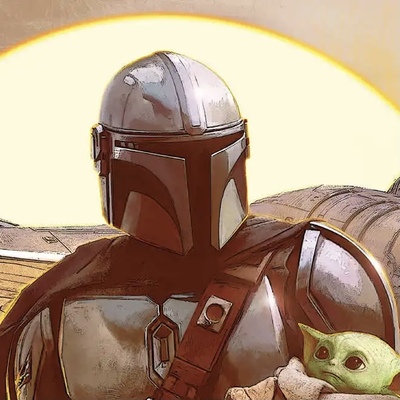
"Earth has blue skies too, you know?"

"Yeah? Jus'magine that!" He scratched the white stubble on his chin thoughtfully.

"You've really never left Saturn, huh?"

"Been workin' cloud mines m'whole life. Someone's gotta get all that helium-3 for you kids. 'Sides," he laughed, "pretty sure most other planets'd look too small to me!"

Together, they gazed out over endless swirling yellow clouds under a deep blue sky.

"Yeah," she nodded. "They really would."
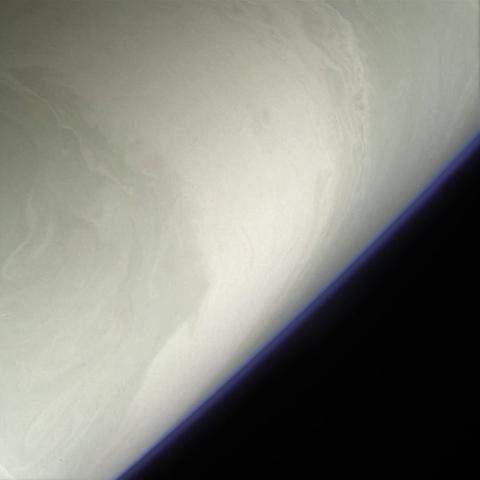
🪐
#MicroFiction #TootFic #SmallStories

The distance to the horizon on any planet is actually pretty simple. All you need is the planet's radius and your height above the surface. Saturn doesn't really have a surface, but this uses the cloud tops instead.

On Earth, at sea level and assuming a flat surface, the horizon is 4-5 km away (depending how tall you are and how high your eyes are above the ground. 50m above the tops of Saturn's clouds, the horizon would be about 76 km away!

If you're reading this and you want to play with numbers, the equation is:

√(2Rh+h²)

where R is the planet's radius and h is your height off the surface. Both must have the same units (metres, inches, cubits, or whatever).

As an example, Earth's radius is 6,378,000 metres.

So an average 1.7m tall human at sea level would see the horizon at 4.7 km away. To a 1m tall child, the horizon would be only 3.6 km away.

From the top floor of the Burj Khalifa, the horizon would be 86 km away.

From the summit of Everest, the horizon would be 336 km away.

From the window of a passenger aeroplane, the horizon would be 384 km away.

This long nerdy ramble is basically to say that yes, larger planets do actually look larger if you're standing on them. Smaller ones look smaller too, which is one reason why those Apollo images from the Moon feel like they "don't look right".