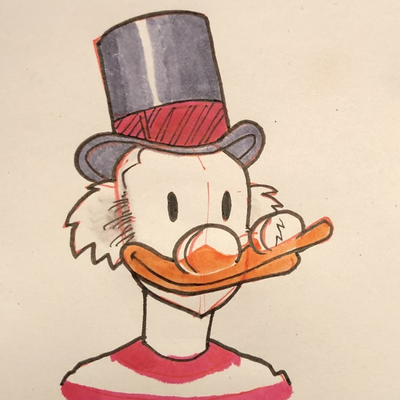
To A Louse starts with Burns spotting a louse on a ladies bonnet, unnoticed by her.

Ha! whaur ye gaun, ye crowlin ferlie?
Your impudence protects you sairly;
I canna say but ye strunt rarely,
Owre gauze and lace;
Tho, faith! I fear ye dine but sparely
On sic a place.

He goes on to admonish the louse for not realising the importance of the person its sitting on.

#robertburns #toalouse
He finishes the poem with a reflection that in the louse's eyes, everyone is equal prey, and our pretensions would drop if we could see through each other's eyes.

O wad some Power the giftie gie us
To see oursels as ithers see us!
It wad frae mony a blunder free us,
An foolish notion:
What airs in dress and gait wad lea'e us,
An ev'n devotion!

#robertburns #toalouse
It's a particularly good one because it starts with one view and ends with another.

His other very very famous ones, such as To a Mouse and To a Haggis, start with one viewpoint (poor mouse, or haggis is delicious) and end with the same one.
To a Mouse being famous worldwide largely through the book Of Mice and Men, which comes from the poem's penultimate verse:

But, Mousie, thou art no thy lane,
In proving foresight may be vain;
The best-laid schemes o mice an men
Gang aft agley,
An lea'e us nought but grief an pain,
For promis'd joy!

#robertburns #toamouse
To a Mouse is a fun one especially due to it switching back and forth between Scots and English every verse.

#toamouse
Here's the first two verses:

Wee, sleekit, cow'rin, tim'rous beastie,
O, what a panic's in thy breastie!
Thou need na start awa sae hasty,
Wi' bickering brattle!
I wad be laith to rin an' chase thee,
Wi' murd'ring pattle!

I'm truly sorry man's dominion,
Has broken nature's social union,
An' justifies that ill opinion,
Which makes thee startle
At me, thy poor, earth-born companion,
An' fellow-mortal!

#robertburns #toamouse