
[no comment, for purposes of minimal labouring/#data gifting]
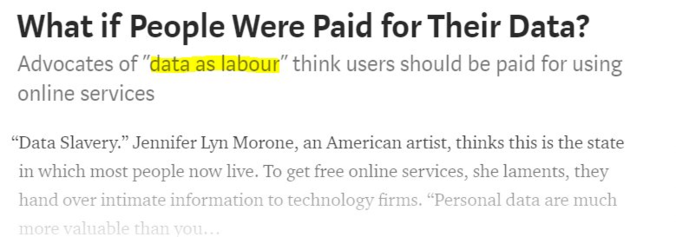
#dataaslabour

okay okay, maybe i need to say a bit more about this. basically - surveillance capitalism is bad, and the platform economy that is increasingly dominant is bad new. BUT i don't think data is labour. maybe I'm wrong though?!?

#dataaslabour

undoubtedly, companies and even states can exert control through their access to and even ownership of our data, but are we 'enslaved' by this? i think it certainly can become dangerous + limiting, but not sure the rhetoric of slavery is right, and 'labour' certainly feels wrong

#dataaslabour

@eevb The rhetoric of slavery, on the other hand, is spot on because what we are talking about is loss of personhood. We’re talking about the violation of the encapsulation of the self. So slavery not due to forced labour but due to ownership of the person and the person becoming property yet again.

In case you haven’t seen them, a few posts I wrote on the subject:

https://2018.ar.al/notes/the-nature-of-the-self-in-the-digital-age/

https://2018.ar.al/notes/encouraging-individual-sovereignty-and-a-healthy-commons/

https://2018.ar.al/notes/we-didnt-lose-control-it-was-stolen/

Aral Balkan — The nature of the self in the digital age

@aral right - so I felt that slavery made more sense, but felt unsure about how one could be anti the labour rhetoric but pro the slavery one? surely slavery is enforced and unpaid labour? but as i say in original thread - this is something i'm well aware i don't know lots about.
@eevb It’s more about what’s at stake: if you own a person, everything else comes along for free. That’s what we must protect: personhood. If we can do that (via extending our understanding of the self to include the technologies by which we extend our selves, and thereby having our entire persons protected by human rights law in the digital/networked age) then we can start to build a sustainable society and a healthy commons made up of the interconnections between individually-sovereign people.
@aral That makes sense... only reservation about that vocab though is the history of the terminology, particularly in terms of race? Is it okay for us to refer to our data being owned and used without our consent for the profit of others (bad) using the same word that referred to mass physical (and sexual) violent abuse and exploitation of people?
@aral
We can, at the moment, get on with our lives relatively painfree whilst our data is being used... of course, things could massively change, and I am particularly concerned about eg incarceration and restriction of rights based on identity, views, etc which could be done through data access and ownership... but this is still different from the nature of the horrors of slavery eg in 19th C Americas