$2 WeAct Display FS adds a 0.96-inch USB information display to your computer

WeAct Display FS is an inexpensive 0.96-inch USB display dongle designed to add an information display or a tiny secondary display to your computer or SBC. We've seen this type of information display with products such as the Turing Smart Screen, a larger 3.5-inch color display, or small OLEDs integrated into cases such as the Pironman 5 Max to disable text. The WeAct Display FS V1 may be tiny, but it's also a full-color 160x80 resolution display that can be customized with software provided by WeAct. WeAct Display FS V1 specifications: Display - 0.96-inch RGB565 display with 160x80 resolution Host interface - "Reversible" USB 2.0 Type-A Full Speed (FS) port showing as a CDC device Dimensions - 43 x 14.5 mm Since you wouldn't want to get a display only for it to face the wrong direction, for instance, the desk or the wall, the company made the USB-A port

CNX Software - Embedded Systems News

A Mini USB Display For Your PC Desktop

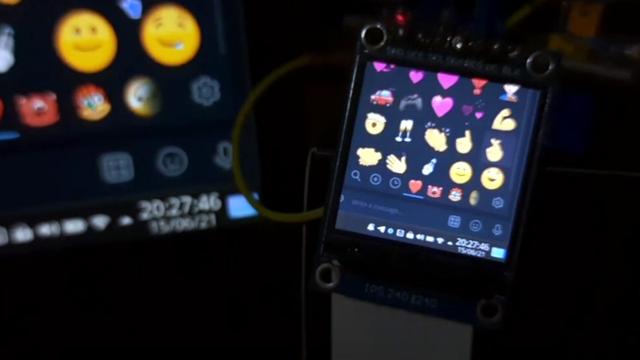
By now it's likely that most Hackaday readers will be used to USB display adapters, in their most common form channeling DisplayPort over the ubiquitous serial interface. Connecting to projectors and other screens with a laptop becomes a breeze, and gone are the days of "Will my laptop work in the venue" stress for people delivering presentations. [Avra Mitra]'s STM32 tiny monitor may not ascend to these giddy heights, but it does at least live up to the promise of reproducing a desktop onto a small colour LCD hooked up through a USB port.

Not through any DisplayPort wizardry though, instead it relies on a Python script that takes successive screen grabs and streams them through USB to the microcontroller, which in tun puts them on the display. It's claimed to achieve 6 to 7 frames per second as you can see in the video below, with an admission that there remains a huge scope for improvement.

Notwithstanding its limited utility at the moment, we can see that maybe this idea could have its uses in a very basic display after a few improvements. Meanwhile, more conventional monitors take the established route of pairing a dedicated controller board with an LCD panel.

Thanks [Pyrofer] for the tip.

#computerhacks #microcontrollers #display #lcd #usbdisplay

A Mini USB Display For Your PC Desktop

By now it’s likely that most Hackaday readers will be used to USB display adapters, in their most common form channeling DisplayPort over the ubiquitous serial interface. Connecting to projec…

Hackaday