#CMSpaper: Measurement of the t-channel single top quark cross section in proton-proton collisions at √s = 5.02 TeV (arXiv:2603.13592) https://arxiv.org/abs/2603.13592 #TopQuark
Measurement of the $t$-channel single top quark cross section in proton-proton collisions at $\sqrt{s}$ = 5.02 TeV

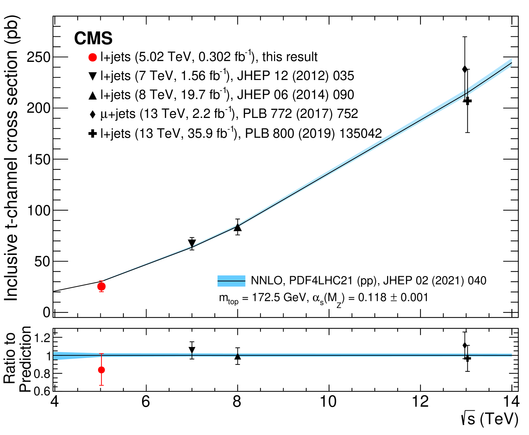
The single top quark $t$-channel production cross section is measured in proton-proton collisions at the CERN LHC at $\sqrt{s}$ = 5.02 TeV, using data recorded with the CMS detector in 2017, corresponding to an integrated luminosity of 302 pb$^{-1}$, and resulting in the first CMS measurement of the process at that energy. Events with one electron or muon and two or more jets, among which at least one is identified as originating from a b quark fragmentation, are analyzed. The combined cross section of single top quark (tq) and single top antiquark ($\mathrm{\bar{t}q}$) production is $σ_{\mathrm{tq+\bar{t}q}}$ = 25.4$^{+3.6}_{-3.5}$ (stat) $^{+4.2}_{-3.9}$ (syst) $\pm$ 0.5 (lumi) pb. The individual cross sections are measured to be $σ_{\mathrm{tq}}$ = 17.6$^{+2.8}_{-2.7}$ (stat) $^{+2.6}_{-2.4}$ (syst) $\pm$ 0.3 (lumi) pb and $σ_{\mathrm{\bar{t}q}}$ = 6.6$^{+2.4}_{-1.6}$ (stat) $^{+2.1}_{-2.5}$ (syst) $\pm$ 0.1 (lumi) pb. Their ratio is measured to be $\mathcal{R}_{\mathrm{t-ch}}$ = 2.7$^{+1.5}_{-0.8}$ (stat) $^{+1.3}_{-0.3}$(syst). The absolute value of the Cabibbo$-$Kobayashi$-$Maskawa matrix element is found to be $\lvert f_{\mathrm{LV}}V_\mathrm{tb}\rvert$ = 0.92 $\pm$ 0.09 (exp) $\pm$ 0.01 (thy). The measurements are in good agreement with the standard model predictions at next-to-next-to-leading order accuracy in quantum chromodynamics.

arXiv.org
#CMSpaper: Jet peak shapes based on two-particle angular correlations in lead-lead collisions at √(s_NN) = 5.02 TeV (arXiv:2603.14385) https://arxiv.org/abs/2603.14385 #HeavyIons
Jet peak shapes based on two-particle angular correlations in lead-lead collisions at $\sqrt{s_{\mathrm{NN}}}$ = 5.02 TeV

The longitudinal invariance of jet-induced peaks in two-particle correlation functions from relativistic lead-lead collisions is experimentally explored. The data were collected at a center-of-mass energy per nucleon pair of 5.02 TeV in 2018 using the CMS detector. The dataset corresponds to an integrated luminosity of 0.607 nb$^{-1}$. Long- and short-range correlations are studied through two-dimensional distributions of the separations in pseudorapidity and azimuth between particles in an event. Jets manifest as a well-defined peak at small angular separations, and the shape of this peak provides insight into jet medium interactions. This Letter examines the evolution of the jet peak shape, focusing on the dependence of its width and longitudinal asymmetry on the transverse momentum, collision centrality, and pseudorapidity of the associated charged particles. The jet-peak distributions of lower transverse momentum particles broaden in both pseudorapidity and azimuth with increasing collision overlap, with the broadening in pseudorapidity being more pronounced. The longitudinal asymmetry of the peaks is also found to increase as the average pseudorapidity increases. These results are compared to proton-proton collision data that were obtained at the same nucleon-nucleon collision center-of-mass energy with an integrated luminosity of 252 nb$^{-1}$.

arXiv.org
#CMSpaper soon on arXiv: Jet peak shapes based on two-particle angular correlations in lead-lead collisions at √(s_NN) = 5.02 TeV (CERN-EP-2025-112) https://cds.cern.ch/record/2957508 #HeavyIons
Jet peak shapes based on two-particle angular correlations in lead-lead collisions at $ \sqrt{{s_{_{\mathrm{NN}}}}} = $ 5.02 TeV

The longitudinal invariance of jet-induced peaks in two-particle correlation functions from relativistic lead-lead collisions is experimentally explored. The data were collected at a center-of-mass energy per nucleon pair of 5.02 TeV in 2018 using the CMS detector. The dataset corresponds to an integrated luminosity of 0.607$ \text{nb}^{-1}$. Long- and short-range correlations are studied through two-dimensional distributions of the separations in pseudorapidity and azimuth between particles in an event. Jets manifest as a well-defined peak at small angular separations, and the shape of this peak provides insight into jet medium interactions. This Letter examines the evolution of the jet peak shape, focusing on the dependence of its width and longitudinal asymmetry on the transverse momentum, collision centrality, and pseudorapidity of the associated charged particles. The jet-peak distributions of lower transverse momentum particles broaden in both pseudorapidity and azimuth with increasing collision overlap, with the broadening in pseudorapidity being more pronounced. The longitudinal asymmetry of the peaks is also found to increase as the average pseudorapidity increases. These results are compared to proton-proton collision data that were obtained at the same nucleon-nucleon collision center-of-mass energy with an integrated luminosity of 252$ \text{nb}^{-1}$.

CERN Document Server
#CMSpaper soon on arXiv: Measurement of the t-channel single top quark cross section in proton-proton collisions at √s = 5.02 TeV (CERN-EP-2025-289) https://cds.cern.ch/record/2957466 #TopQuark
Measurement of the $t$-channel single top quark cross section in proton-proton collisions at $\sqrt{s}$ = 5.02 TeV

The single top quark $t$-channel production cross section is measured in proton-proton collisions at the CERN LHC at $\sqrt{s}$ = 5.02 TeV, using data recorded with the CMS detector in 2017, corresponding to an integrated luminosity of 302 pb$^{-1}$, and resulting in the first CMS measurement of the process at that energy. Events with one electron or muon and two or more jets, among which at least one is identified as originating from a b quark fragmentation, are analyzed. The combined cross section of single top quark (tq) and single top antiquark ($\mathrm{\bar{t}q}$) production is $\sigma_{\mathrm{tq+\bar{t}q}}$ = 25.4$^{+3.6}_{-3.5}$ (stat) $^{+4.2}_{-3.9}$ (syst) $\pm$ 0.5 (lumi) pb. The individual cross sections are measured to be $\sigma_{\mathrm{tq}}$ = 17.6$^{+2.8}_{-2.7}$ (stat) $^{+2.6}_{-2.4}$ (syst) $\pm$ 0.3 (lumi) pb and $\sigma_{\mathrm{\bar{t}q}}$ = 6.6$^{+2.4}_{-1.6}$ (stat) $^{+2.1}_{-2.5}$ (syst) $\pm$ 0.1 (lumi) pb. Their ratio is measured to be $\mathcal{R}_{\mathrm{t-ch}}$ = 2.7$^{+1.5}_{-0.8}$ (stat) $^{+1.3}_{-0.3}$(syst). The absolute value of the Cabibbo$-$Kobayashi$-$Maskawa matrix element is found to be $\lvert f_{\mathrm{LV}}V_\mathrm{tb}\rvert$ = 0.92 $\pm$ 0.09 (exp) $\pm$ 0.01 (thy). The measurements are in good agreement with the standard model predictions at next-to-next-to-leading order accuracy in quantum chromodynamics.

CERN Document Server
The Higgs boson can decay to many different particles from the standard model. But... is the Higgs boson also decaying to undiscovered particles? This #CMSPaper looks for extra (light) bosons that would create the Higgs boson to four electron signature arxiv.org/abs/2511.19563
This #CMSPaper looks for production of photons in these boson collisions, meaning the LHC is a W boson collider, which is the first time this has ever been seen! It measures properties of the photons produced and compares them to the standard model predictions arxiv.org/abs/2512.00502
This #CMSPaper measures the simultaneous production of Z bosons and photons. That way their interactions can be measured and can be compared to predictions by the standard model arxiv.org/abs/2512.08582
One of the classical ways to look for undiscovered particles at the LHC is to look for unexpected resonances in the jets coming from quarks and gluons. This #CMSPaper compares the cutting edge of #machinelearnining #ai methods to see how well they do for top quark resonances arxiv.org/abs/2512.20395
This #CMSPaper searches for a heavy particle decaying into pairs of undiscovered light bosons, which in turn decay into photons that can partially overlap. This is technically a difficult signature because overlapping photons are not easy to disentangle arxiv.org/abs/2601.00183
Are there undiscovered charged heavy Higgs bosons? If they are heavier than the top quark, they would decay into a top quark + b quark signature. This #CMSPaper looks for these, and also compares them in dedicated theory frameworks that include neutral heavy Higgs bosons arxiv.org/abs/2512.24471