Decided to remove date-fns from #teamstatus, because their ESM approach is a mess and Intl.DateTimeFormat exists and is good: https://developer.mozilla.org/en-US/docs/Web/JavaScript/Reference/Global_Objects/Intl/DateTimeFormat

There is also Intl.RelativeTimeFormat (https://developer.mozilla.org/en-US/docs/Web/JavaScript/Reference/Global_Objects/Intl/RelativeTimeFormat) for formatting relative dates.

It's nice that we have nice tools for dealing with dates now.

Intl.DateTimeFormat - JavaScript | MDN

The Intl.DateTimeFormat object enables language-sensitive date and time formatting.

MDN Web Docs
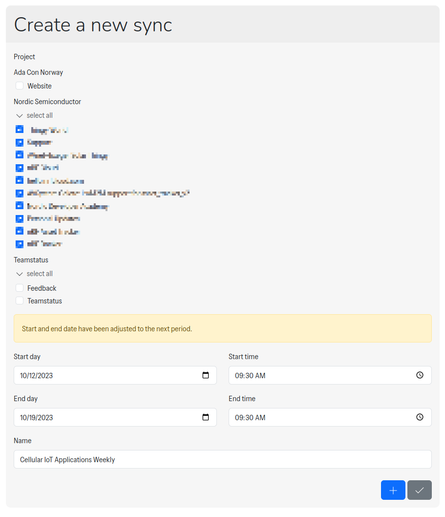
After #adaCon2023 I have a bit time again to work on my other side project, and added some convenience features to #teamstatus that will allow cloning of syncs, and the new sync draft will have the sync period moved automatically forward to the next period.
Just discovered Atlassian Atlas, and it's more or less what I am trying to build with #teamstatus:
https://youtu.be/dYTpwQZWNtw
An introduction to Atlas | Atlassian

YouTube
I ran the first sync meeting with #teamstatus and it's turns out to be really useful to keep track of what's happening in a week. I still have to implement storing and sharing of the syncs, but the mechanics are promising.
I also have the challenge to be able to present updates in multiple syncs with different stakeholders, and syncs have a preparation time where they are in a draft stage.
Started a new side project (#teamstatus), something that I wished I had in at least three companies I worked in, and it never materialized. And it's fun!
It's a tool that will make meetings more efficient, allow peers to celebrate wins, provide feedback on progress, and track your achievements.
It's made for distributed teams, that sync regularly, but not daily.
It's just a small tool, but I'm looking forward to getting my team to use it when I'm back from vacation. Will share more soon.