
LED Filaments Make a Retro Clock Without Any Retro Parts

We love clock projects here at Hackaday, and we've seen many beautiful designs based on a wide variety of display technologies. There are various types of glass tubes like Nixies, Numitrons and classic VFD displays, all of which have that warm "retro" glow to them. Then there's LEDs, which are useful for making cool pixel-based timepieces and easy to drive with low-voltage electronics. So how about combining the best of both worlds, by using LEDs to make a Numitron-like display? That's exactly what [Jay Hamlin] did when he built a digital clock based on LED filaments.

The heart of the project consists of orange LED filaments similar to the ones used in vintage-style LED light bulbs. [Jay] bought a bunch of them online and tried various ways of combining them into seven-segment displays, eventually settling on a small PCB with a black finish to give good contrast between the LEDs and the background. To make the displays look like they're encased in glass, [Jay] bought a set of plastic test tubes and cut them to size.

The base of the clock is formed by a slick black PCB that holds an ESP32. The segments are driven through a set of 74LV595 shift registers to keep the required number of GPIOs to a minimum. There are no buttons: thanks to a WiFi connection and the Network Time Protocol the ESP32 automatically keeps the correct time.

The end result looks remarkably like a Numitron display at first glance, and remains a beautifully-made clock even if you notice that there's no glass to be found. If you're into LED filament clocks (and who isn't?), check out this analog wall clock, or this spiderweb-like digital clock.

#clockhacks #ledfilament #numitronclock #sevensegmentled

LED Filaments Make A Retro Clock Without Any Retro Parts

We love clock projects here at Hackaday, and we’ve seen many beautiful designs based on a wide variety of display technologies. There are various types of glass tubes like Nixies, Numitrons a…

Hackaday

Simple Arduino Build Lets You Keep An Eye On Pi

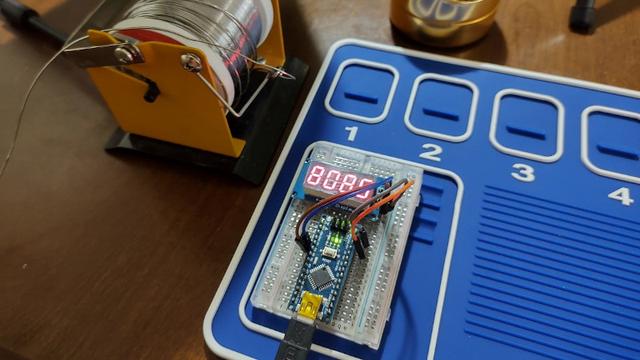
Are you a math aficionado in need of a new desk toy? Then do we have the project for you. With nothing more than an Arduino and a seven-segment LED module, [Cristiano Monteiro] has put together a little gadget that will slowly work its way through the digits of Pi forever…or until you get bored of looking at it and decide to use the parts for something else.

On the hardware side, we really can't overstate how simple this project is. A common four-digit LED display is connected up to an Arduino Nano, which is then plugged into the computer for power. [Cristiano] is using a breadboard here, but you could just as easily use four female-to-female jumpers to connect the two devices together. We suppose this would be a pretty good project for anyone who's looking to get some practical experience with PCB design as well.

The real magic is in the software, which [Cristiano] has been kind enough to release under the MIT license. Calculating Pi on such a resource-constrained chip as the ATmega328P is far from ideal, but by porting over a C++ algorithm developed by [Xavier Gourdon] and [Pascal Sebah] for their paper Computation of the n-th Decimal Digit of π with Low Memory he was able to pull it off, albeit slowly.

Now if you've got slightly better hardware, say a pair of Xeon processors and 96 GB of RAM, you could calculate Pi out to a few trillion digits for fun, but it wouldn't look as cool as this little guy blinking away.

#arduinohacks #classichacks #mathematics #pi #sevensegmentled

Simple Arduino Build Lets You Keep An Eye On Pi

Are you a math aficionado in need of a new desk toy? Then do we have the project for you. With nothing more than an Arduino and a seven-segment LED module, [Cristiano Monteiro] has put together a l…

Hackaday