Is the grass *always* greener on the other side?
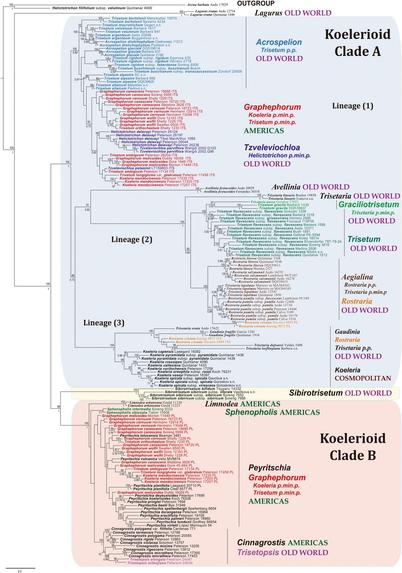
Maybe Barberá et al. know! They certainly know a lot about #phylogenetics and #reticulation among koelerioid clades. Don't miss this fascinating #OpenAccess study published in #JSE!
https://doi.org/10.1111/jse.13133
@WileyEcolEvol
#PlantSci #evolution #botany
Peterson et al. investigate the #phylogeny, #biogeography, #reticulation, and #classification of Agrostis in their latest study published in #JSE!
Explore their #phylogeny right here!👇
https://doi.org/10.1111/jse.13175
@WileyEcolEvol
#PlantSci #systematics #evolution #ecology #grasses #botany

(7/7) And the winner was Crossroad.

To explain the genetic puzzle in the Philippines, we concluded that two of the genus' major lineages, one Pacific, one African-Asian populated the Philippines when they came in reach and found enough place (niches) to radiate there. In course of this (early) contact, inter-lineage mixing occured (#CoralOfLife #reticulation) leading to the modern-day genetic mosaic.

#OpenAccess
http://dx.doi.org/10.1186/s12862-017-0974-3

Ixora (Rubiaceae) on the Philippines - crossroad or cradle? - BMC Ecology and Evolution

Background The Philippine archipelago is globally one of the most important model island systems for studying evolutionary processes. However, most plant species on this archipelago have not yet been studied in sufficient detail. The main aim of this study is to unravel the evolutionary history and biogeographic relationships of the Philippine members of the pantropical genus Ixora. Results The complex plastid and nuclear divergence patterns in Philippine Ixora, documented using tree and network approaches, reveal a highly dynamic evolution in Ixora, involving several phases of radiation and recolonization. Philippine Ixora comprises at least five lineages, of which one is most closely related to species from Wallacea, and the remaining four to species from Asia. Conclusions Our study highlights the importance of Philippine species for understanding phytogeographic patterns in the Indomalayan-Australasian eco-region. The overall genetic differentiation, as well as the incongruence between genealogies based on the biparentally inherited nucleome and the maternally inherited plastome in Ixora, reflect the complex tectonic history of the Philippine archipelago. The Ixora lineage related to Wallacean species supports the delimitation of different ecozones along Huxley’s line, because it is absent from Palawan. The remaining four lineages are all allied with Asian taxa, reflecting several waves of colonization. Close relationships between some widespread Philippine species and locally adapted narrow endemics suggest that the widespread, genetically diverse species act as pools for the formation of new species in a process of ongoing speciation. Our results suggest that the species concepts of some of the more widespread taxa need to be revised.

BioMed Central

@AnnBot

Towards that end, it may be worthwhile to explore the incongruent signals (see gCF results): what are the alternatives?

Between-gene incongruence and phylogenomic branch supports < 100 may relate to lack of discriminative signal (fast ancient radiations) and ILS. Or evidences evolutionary #reticulation

A dichotomous tree may simply be not comprehensive enough, for any group of plants #CoralOfLife

@chasewnelson

PS If you like to go down the rabbit hole of #reticulation, check out the (now dormant)
Genealogical World of Phylogenetic Networks
https://phylonetworks.blogspot.com/

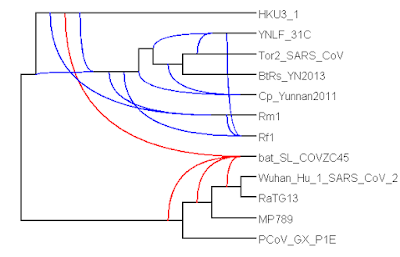
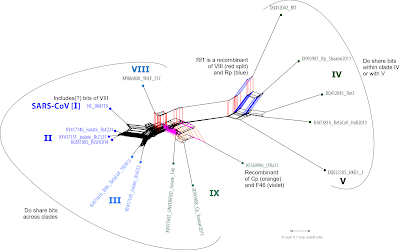
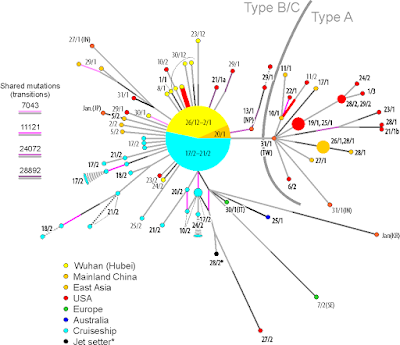
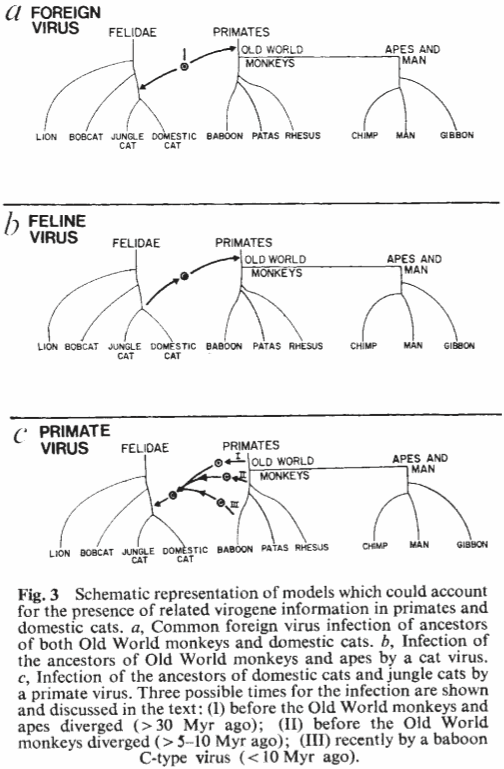
Includes a few posts on viruses, too, especially towards the end. Teaser attached.

The Genealogical World of Phylogenetic Networks

Biology, anthropology, computational science, and networks in phylogenetic analysis

Are #grasses your thing?
How about #phylogenetics and #reticulation among koelerioid clades?
If you answered🤩to any of these, then today is your lucky day! Read part 1 of a new study from Barberá et al. in #JSE!
https://doi.org/10.1111/jse.13133
@WileyEcolEvol
#PlantSci #evolution #botany #OpenAccess