A thought about the #RepublicOfLetters, which I still intend to revive – send mail to [email protected], and it will be accepted but ignored:

Maybe a useful pattern back then was A sending to B, asking “can you make this more palatable to C? [with a cover letter? or a a summary that prompts/facilitates a new kind of A-C interaction?]

Because, in my life, I would have benefited enormously by a B intermediary between me and C.

Anyway, just received 2 books on the culture of the RoL.

For more information on Ekeziel Spanheim see:

Sven Externbrink, Diplomatie und République des Lettres. Ezechiel Spanheim (1629–1710). In: Francia. Forschungen zur Westeuropäischen Geschichte. 34/2, 2007, S. 25–59. (7/7)

#emdiplomacy #RepublicOfLetters #NewDiplomaticHistory #earlymodern #history #histodons #adventCalendar2024 #AdventCalendar

@histodons @historikerinnen @earlymodern

Parallel to the network of diplomatic correspondence, which served to inform the ruling #courts, Spanheim established a network of scholarly correspondence that encompassed the whole of Europe. The world in which Spanheim moved was characterised by the internationality of a common European culture. There existed a nobility, also known as the society of princes (Lucien Bély) which was concentrated at the princely courts. Particularly in the era of Louis XIV, scholarly culture was one integral part of this aristocratic society. Scholarship characterised courtly culture, and the monarchs competed to found scientific academies and courted renowned scholars. However, it should be noted that Spanheim was one of the last ‘learned diplomats’ so typical of the of the 16th and 17th centuries. This type was increasingly replaced by the ‘professional diplomat’ in the 18th century. (6/7)

#emdiplomacy #RepublicOfLetters #adventCalendar2024 #history

@histodons @historikerinnen @earlymodern

#emdiplomat of the day: Ezekiel Spanheim (1629-1710)

With Ezekiel Spanheim we want to highlight another group of #earlymodern diplomatic actors and a field within #NewDiplomaticHistory that both require more research: the connections between #emdiplomacy and the #RepublicOfLetters. (1/7)

#history #histodons #AdventCalendar #adventCalendar2024

@histodons @historikerinnen
@earlymodern

@historikerinnen @histodons @earlymodern

Brederode used his academic knowledge and his connections to the #republicOfLetters as diplomatic means. Especially, in the early years in the #HRE he wrote many tracts and treatises that he sent to all kinds of political actors among the Imperial estates. An important topic was the confessional conflict and its implications for foreign policy and especially the issue whether it was possible to trust the other confessional party.

If you want to know more about Brederode and his mission to the #HRE in the early years, we can recommend:

https://www.jstor.org/stable/43572115

#emdiplomacy #AdventCalendar #AdventCalendar2024 #history

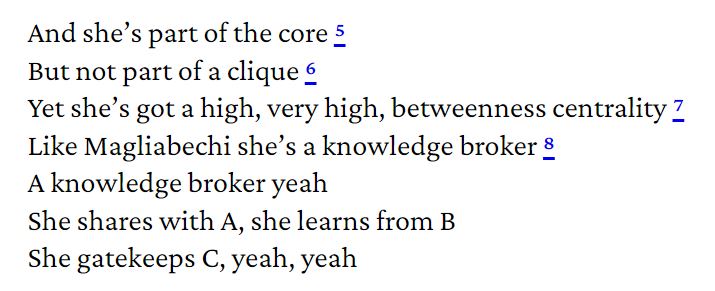
New song released for "What is #DigitalHumanities? The Album":

Epistolary (networks)

Read, sing along, or download the TEI at https://what-is-dh-the-album.netlify.app/vol-01/epistolary/

My favourite part of this one is the bridge. Many thanks to Dr Ingeborg van Vugt for providing the metrically perfect example of Magliabechi as a broker in the Republic of Letters.

#DigitalHumanities #TEI #RepublicOfLetters #Magliabechi #EpistolaryNetworks #NetworkAnalysis

Epistolary

A #DigitalHumanities song inspired by 'Suddenly I See', by KT Tunstall

@tomaashby Welcome! I’ve always been fascinated by the #RepublicOfLetters: www.republic of letters.stanford.edu