 Daniela Gawehns
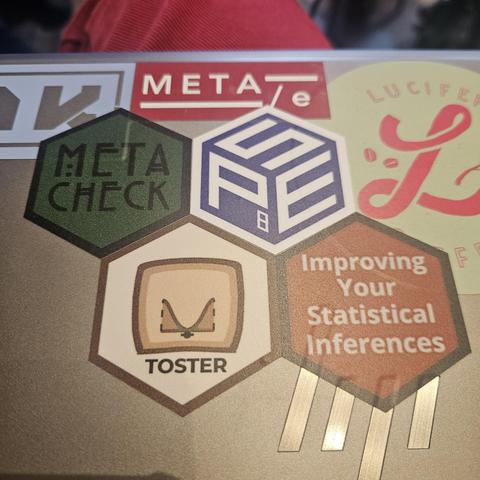
Thanks #pse8 for three days of error and the new sticker on my laptop!

On the way to #PSE8 this morning, I saw a Great Crested Grebe (Podiceps cristatus) and recorded it as an observation on #inaturalist . This could be seen as an assertion of the type <observer><observed><bird>
<timestamp><location><observation identifier>, much like in #nanopublications.

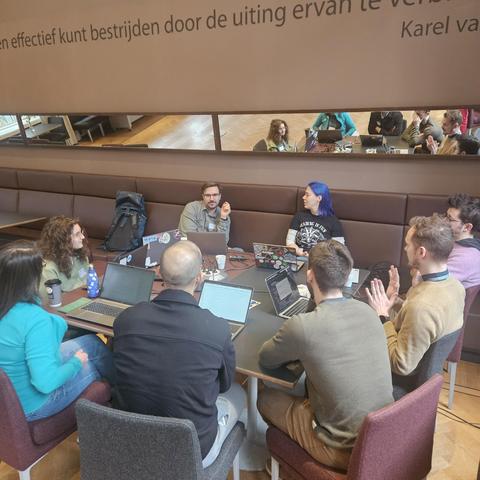
Of course, the #nanopublications #hackathon at #PSE8 has its own space in the nanopublication network, all built using nanopublications.
The slides are up for the #nanopublications session at the #PSE8 #hackathon today:
Making Errors and Uncertainty FAIR: A Nanopublications Hackathon for Machine-Actionable Scientific Error Reporting. Zenodo. https://doi.org/10.5281/zenodo.18627181
This repo contains the materials for the nanopublication hackathon at the "Perspectives on Scientific Error 2026" on 13 February 2026 in Leiden, The Netherlands. Abstract Communicating and reusing estimations of uncertainty and error is critical for interpreting scientifically relevant observations but currently hampered by poor consistency and documentation. These errors arise from diverse sources, including linguistic ambiguity, computational bugs, systematic biases, unstable measurements and missing data. Despite its central role in quality control, data integration, and decision-making, uncertainty is often underreported or informally expressed. Nanopublications offer an ideal, structured, and machine-actionable framework to address this challenge by providing a scalable solution that transcends traditional, narrative-based methods. Their design combines precise assertions with rich provenance, allowing researchers to clearly state an observation or claim (e.g., regarding an error or uncertain measurement) while simultaneously linking to its full supporting history and context. Expressed as interoperable RDF triples, nanopublications are openly published on a decentralized network as FAIR Digital Objects, making this essential information easily discoverable, integratable, and processable by automated systems across various scientific domains. The Metabolomics and Analytics Center (MAC) at Leiden Academic Center for Drug Research is developing a nanopublication-based reporting framework to capture three critical uncertainty types inherent in high-throughput mass spectrometry data: those related to detection limits/sensitivity, physical/chemical instabilities (such as evaporation or oxidation), and ambiguities from structural isomers. This hackathon will leverage the MAC's developments to explore nanopublications as a universal, scalable, and machine-actionable mechanism for communicating errors, uncertainty, and related concepts across scientific domains, using metabolomics as a core case study. Participants will be introduced to nanopublication principles and decentralized publication infrastructures through hands-on experience with user-friendly interfaces and templates. To lower barriers to participation, no technical prerequisites are assumed; participants only need to authenticate via ORCID in a browser [so come prepared with your ORCID credentials at hand!]. We'll show metabolomics examples from MAC that include uncertainty and error reporting. Participants are encouraged to bring their own examples of errors, uncertainties, and data quality issues from any scholarly domain. By the end of the hackathon, participants will have created and published nanopublications describing real error and uncertainty scenarios and gained practical experience with FAIR, machine-actionable error communication.
 Daniel Lakens
 Daniel Mietchen