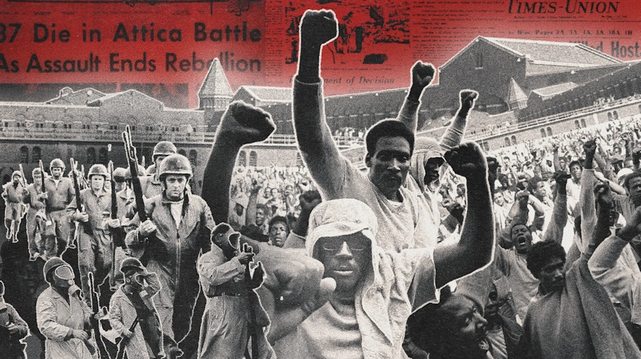
Attica: When Prisoners Revolted

Each August marks the annual commemoration of a month honoring the legacy of Black prisoners kept behind bars for political activism. Black August is a month to honor the history of struggles for Black liberation, in defiance of racial, colonial, and imperialist oppression, both inside and outside prison walls.

The 1971 Attica prison revolt, in which incarcerated people rose up in a struggle against oppression and inhumane conditions, and were subsequently repressed by state forces with horrifying brutality, is honored each year during Black August.

On September 9, 1971, Attica prisoners took over a part of the prison in an event especially notable for its mass participation. Out of roughly 2,200 men imprisoned at Attica, 1,281 seized control of the facility.

“​​We are men! We are not beasts and we do not intend to be beaten or driven as such. The entire prison populace, that means every one of us here, has set forth to change forever the ruthless brutalization and disregard for the lives of the prisoners here and throughout the United States,” said 21-year old prisoner Elliott James “L.D.” Barkley in a statement to the press. Barkley would later be killed when state forces recaptured the prison, days before he was scheduled to be released.

Prisoners held control for four days, during which officials conceded to 28 of the prisoners’ demands but rejected calls for the warden’s removal and full amnesty for those incarcerated.

On September 13, 1971, Governor Nelson A. Rockefeller sent state troopers armed with rifles and pistols to retake Attica from the prisoners. The four-day uprising ended in a hail of blood and gunfire that left 39 dead, among them 10 prison staff. Four more had already died earlier during the uprising.

With 43 men dead, the vast majority from the violence of state repression, the Attica prison uprising is still the deadliest prison uprising in US history.

Reform and revolution

For some involved in the Attica revolt, their motivations extended beyond simply struggling for better conditions. The year following the Attica uprising, prisoner Joseph Little told a government panel, “I’m not for no penitentiary reform. I’m for abolishing the whole concept of penitentiary reform.”

The conditions in New York State prisons were also reflected in the very demands of the prisoners, presented to New York State officials amid the revolt on September 11, 1971. They included “a change in medical staff and medical policy and procedure,” with prisoners claiming that medical personnel were making “mistakes” affecting their patients. Prisoners also called for an end to the “escalating practice of physical brutality” and more food and more access to drinking water during meals.

Prisoners also called for radical changes to the power structure within the prisons, making a bold argument for the self-determination and dignity of each prisoner. The very first demand was “the constitutional rights of legal representation at the time of all parole board hearings.” Prisoners also highlighted the political and free speech repression taking place within the prison, calling for “an end to the segregation of prisoners from the mainline population because of their political beliefs,” claiming that “Some of the men in segregation units are confined there solely for political reasons and their segregation from other inmates is indefinite.”

Revolt amid worldwide struggle

What other factors drove more than 1,000 prisoners to risk their very lives in open rebellion?

The Attica revolt took place during a time of heightened struggle and consciousness in the United States, as well as globally. The influence of the Black Panther Party (BPP) was reaching its all time high. The Black liberation movement more broadly was a formidable political force, led by organizations like the BPP, the Republic of New Afrika, and numerous local groups, the movement was not only demanding civil rights but also self-determination and community control.

The late 1960s and early 1970s saw an uptick in radical organizing across diverse sectors of society, with white and multiracial students, antiwar, feminist, and countercultural movements. Mass opposition to the Vietnam War was at its height, with groups like Students for a Democratic Society (SDS) and the broader student antiwar movement challenging US militarism. Some groups, like the Weather Underground, turned to underground actions against the state. Others focused on solidarity with Black liberation and Third World movements. Women’s liberation groups, and Chicano, Puerto Rican, and Indigenous activists expanded the terrain of struggle beyond campuses.

Globally, the late 1960s and early 1970s saw the collapse of Western colonial empire, especially on the African continent. In Angola, Mozambique, Guinea-Bissau, armed liberation wars against Portuguese colonial rule were at their height, led by movements like the MPLA (Angola), FRELIMO (Mozambique), and PAIGC (Guinea-Bissau). Anti-apartheid struggle in South Africa intensified, with the ANC and Pan Africanist Congress continuing underground organizing. Zimbabwe (then Rhodesia) also saw guerilla activity against white settler rule. Countries like Congo, which became independent in 1960, were navigating neocolonial intervention, often by the US and former European colonizers.

The political context of the time had imbued the people of the US with heightened mass consciousness, a phenomenon which did not exclude those behind prison walls. By the time of the Attica uprising, numerous smaller prison revolts had already occurred. In 1970 alone, multiple uprisings shook the New York City jail system, including at the Manhattan House of Detention, the Brooklyn House of Detention, the Queens facilities at Kew Gardens and Long Island City, and the Adolescent Remand Shelter on Rikers Island.

At the Manhattan House of Detention, prisoners held five guards hostage for eight hours until state officials pledged to hear their grievances and assured them there would be no retaliation. Yet despite those assurances, authorities singled out leaders, transferring them to state prisons where they were beaten, confined for months in solitary, and charged with new crimes. Meanwhile, at Auburn Correctional Facility in upstate New York, incarcerated people waged sustained confrontations with officials between November 2, 1970, and June 9, 1971. Prisoners who took part in the Auburn riot were later dispersed to various New York facilities, including Attica.

50 years later

During negotiations at the height of the Attica revolt, then Corrections Commissioner Russell Oswald accepted most of the prisoner demands. But over 50 years later, many of the same injustices and inhumane conditions persist in New York State prisons and US prisons more broadly.

Some of the demands agreed to during the heat of struggle never materialized, including paying prison workers a minimum wage, providing fresh produce to prisoners daily, and permitting access to outside dentists and doctors.

Notably, the brutality in New York’s prison system persists. Earlier this year, NYS prison guards went on an unauthorized strike, following some of their own ranks being charged for the brutal beating of Black prisoner Robert Brooks by white officers.

Shocking body camera footage of Brooks’ death showed multiple guards at Marcy Correctional Facility in upstate New York participating in the beating while the prisoner was handcuffed and bleeding. The video captures a chilling disregard for Brooks’ life. One officer shoved an object into his mouth as another gripped his throat, before several guards launched a brutal assault. At one point, two officers tried to lift Brooks by his shirt and throw him out of a window.

At the heart of their strike was the anger of prison guards over the HALT (Humane Alternatives to Long-Term Solitary Confinement) Act, which limited the right of prison authorities to torture inmates with impunity by reducing the use of solitary confinement. The strike ended in March, after which the state fired over 2,000 prison guards after failing to return to work after a deal was reached between the guards and the state of New York.

This article was originally published in People’s Dispatch.

https://abolitionmedia.noblogs.org/?p=21100

#attica #BlackAugust #blackLiberation #northAmerica #prisonResistance #repression #us
Strikng Back Against Prison Slavery – Reflections on the Sept 2016 Prison Strike

The following is an interview conducted with Kevin “Rashid” Johnson by James K. Anderson a member of the IWW Freelance Journalist Union.

JAMES ANDERSON: When did you first learn about the plan for the Sept 9, 2016 prison strike?

RASHID: I knew about it from its inception. I helped to organize and publicize it.

The strike was against prison slave labor. Sept 9th was chosen to commemorate the Sept 9, 1971 peaceful uprising at Attica State Prison, where prisoners of all races united in protest of the murder of George Jackson by guards in San Quentin the month before, and the inhumane conditions in Attica. Officials suppressed the Attica protest by murdering 29 prisoners and 10 civilians, then torturing hundreds more, sparking international outrage and exposure of the inhumane conditions in Amerikan prisons.

JAMES ANDERSON: What did you think then and what do you think now about the focus on prison labor/slavery and the emphasis on a prison work stoppage?

RASHID: Focusing on prison slave labor is a key part of the struggle against this global capitalist imperialist system that the U.S. empire presides over. Amerika was built by slave labor which continues. In fact the world’s industrial system was built on it. The Industrial Revolution was fueled by the cotton production based on Amerindian land theft and Black slave labor.

Slave labor continues inside U.S. prisons, which grew out of the old chattel slave system. When chattel slavery was abolished after the U.S. Civil War (1865), the prisons became the new plantations and the new site of racialized slavery. It was then that the U.S. saw its first wave of mass imprisonment and criminalization of Blackness.

The 13th Amendment was enacted at the war’s end which abolished slavery except for those convicted of crimes. The 13th Amendment was actually a compromise with the old slaveowners of the South, allowing slavery to continue but with the state taking ownership of the slaves instead of private individuals. This was done through criminalizing the newly freed Blacks.

Criminal laws were passed across the South to put Blacks back in servitude. Those laws, called the Black Codes, criminalized vagrancy, lack of employment, and such other conditions that the newly emancipated Blacks found themselves in, having been turned out from the plantations illiterate, poor, without land and resources, and created special racially separate courts. While at the same time white supremacists and vigilante groups, like the Ku Klux Klan and White Knights of Camellia, who desired to reclaim white dominance across the South sabotaged Black political and economic achievements and lynched and murdered Blacks seen to be ‘successful,’ and who persisted in trying to exercise any level of actual freedom.

Almost overnight the prisons were overflowing with Blacks, who were then contracted out by the state prison systems as free labor to private corporations and back to the old plantations. These work forces and chain gangs were seen across the South building and rebuilding everything.

The conditions of this new bondage were often much worse than when the slaves were privately owned, because with the Blacks no longer being private property and easily replaced from the endless pool of Blacks being imprisoned, those who exploited their labor didn’t care about their upkeep. So, they weren’t cared for, they were often not fed, many were literally worked to death. A condition that literally continues to exist in today’s prisons, in Texas prisons in particular.

In the Texas prison system today, ALL prisoners are forced to work without any pay at all. Many work in private and state-owned industries. They also produce most all the food eaten by Texas prisoners and staff. There are huge prison plantations of crops of various types of vegetables they grow, also cotton which they also use to make the guards’ and prisoners’ uniforms. There’s an egg plant. Also hog, cow and chicken farms where the prisoners raise these animals for food.

In this agricultural work they are given no modern tools or machinery. But are made to plant, tend and harvest the crops using nothing but handheld hoes. These work groups are derisively called, “Hoe squads.”

This reflects conditions that exist to a lesser or greater degree in prisons across the U.S., where prisoners are made to work for no pay at all or for only pennies, performing labor that sustains the prisons and enriches various corporations. This is labor that officials would otherwise have to employ people from society at minimum wage to do. So, the U.S. prison system is largely sustained and prison corporations reap trillions in profits from exploiting prison slave labor. This is what is known as the Prison Industrial Complex (PIC).

In this regard, prisoners are a large sector of the U.S. workforce, but enjoy none of the benefits and wages that workers in society receive, as inadequate as they are for even those workers. This is why they play an important role in the struggle against this capitalist imperialist system that exists upon the exploitation of workers in general.

JAMES ANDERSON: When did you start organizing/mobilizing for the 2016 strike, and what did that work look like?

RASHID: My involvement in organizing around the Sept 9th strike began after members of my Party, then the New Afrikan Black Panther Party (now the Revolutionary Intercommunal Black Panther Party), led a prison work strike in April 2016 at seven Texas prisons. This took place after an uprising in Alabama’s Holman prison, where the warden, Carter Davenport, who was notorious for physically abusing prisoners, ended up on the receding end of violence.

These two protest actions in early 2016 inspired the call across the U.S. for a countrywide prisoner strike beginning on Sept 9th. With the April 2016 strike in the Texas prisons, I became involved in agitating and uniting with the Alabama prisoners or the Free Alabama Movement (FAM) through IWOC, to stage the countrywide strike later that year.

I wrote articles and through media contacts and correspondences got other prisoners, my entire Party, and other allied groups involved. I was closely involved with IWOC Comrades in this effort, the late Karen Smith with the Florida IWOC and Fight Toxic Prisons (FTP) chapters in particular.

JAMES ANDERSON: Did you get involved with the Incarcerated Workers Organizing Committee (IWOC) prior to the buildup to the 2016 strike?

RASHID: Yes, I did. I had actually joined the Industrial Workers of the World (IWW) several years before, then, during mid-2015, led and formally announced an alliance between the NABPP and the IWW/IWOC. I wrote about it in my article, “Black Cats Bond: The Industrial Workers of the World and the New Afrikan Black Panther Party-Prison Chapter,” posted at http://rashidmod.com/?p=1251.

JAMES ANDERSON: Can you describe your work with/in IWOC prior to the buildup to the 2016 strike?

RASHID: I was involved in developing a strategy for the NABPP’s involvement in the IWW/IWOC and other worker’s groups and organizing worker’s strikes, and developing links between imprisoned workers and those in society.

I wrote position papers and corresponded with various people and Comrades on the inside and outside and media folks to help build awareness around, and support for and unity of prisoners and outside people and groups in, the strike.

JAMES ANDERSON: Where were you incarcerated in 2016?

RASHID: I was right there in Texas, confined at the Clements Unit in Amarillo.

JAMES ANDERSON: What sort of buildup and organizing took place inside the prison where you were incarcerated leading up to Sept 9, 2016?

RASHID: We communicated throughout the prison across the races and tribes to stage a work stoppage and to boycott the commissary.

JAMES ANDERSON: What happened on Sept 9th inside the prison where you were held, and what did you do specifically? What did other prisoners do? How many withheld labor or participated in other ways? What other forms of protest or disruption took place? Any details you can recall would be helpful.

RASHID: We actually didn’t do anything besides boycott the commissary, because officials locked the entire prison down on Labor Day, Sept 6, 2016, the day before the strike was to begin. I wrote about it in my article, “Texas Locks Down Prison on Labor Day to Avert Work Stoppage.” Which can be read at, http://rashidmod.com/?p=2219.

JAMES ANDERSON: Did guards/administrators at the prison where you were incarcerated know about the plans for the strike/disruption (and if so what did it entail)?

RASHID: Yes, they did. That’s why and how they were able to head off the work stoppage by locking everyone down starting the day before the strike was set to begin.

JAMES ANDERSON: How did guards and administrators inside the prison where you were held respond to the actions on Sept 9, 2016? Can you recount any details regarding retaliation?

RASHID: As said they locked the prison down, which meant they didn’t use prisoners in any work positions at all. Everyone was confined to their cells, and guards distributed the meals which consisted primarily of a disgusting PBJ and oil mixture on cornbread and prunes.

JAMES ANDERSON: What worked well in terms of preparing for and trying nationally to coordinate the strike in 2016?

RASHID: Having a wide unification of different outside groups and political tendencies support and help spread word throughout the prisons about the strike. Karen Smith proved in my opinion to be one of the most effective outside supporters and collaborators. She almost organically was able to accept prisoners in leading positions of the strike, she built large media support and involvement, she worked with every political tendency out there despite most having different views from her own Anarchist persuasion.

She was always humble and open to facilitate and follow prisoners’ ideas in a democratic manner, and was never inclined to the tendency I observed with many white leftists over the years of their trying to control the struggles and organizations of people of color and prisoners.

JAMES ANDERSON: What did not work well?

RASHID: The involvement of certain white leftists who DID act to coopt and divert the strike into what they wanted it to be. Namely, instead of a movement aimed to contest the 13th Amendment’s pro-slavery clause and prison slave labor, they converted its slogan and purpose into one of abolishing prisons. This was the trend that became the “Abolition Movement,” which was/is something different from the prisoner-led movement to abolish prison slave labor and the 13th Amendment.

The newly injected slogan of “Abolish prisons” came from the general Anarchist idea of “Abolish the state.” It was outside Anarchists who inserted this slogan into the movement in place of our slogan to “Abolish prison slavery,” that actually began in the early 2000s among prisoners on Texas’s death row. The NABPP took up this call shortly after we were founded in 2005. In fact it was introduced into our party by our first recruit, Hasan Shakur, a Texas death row prisoner, who we recruited that year, and was executed in August 2006. I wrote an article (and drew art) promoting this theme of abolishing prison slavery back in 2006, “A Modest Proposal for Abolishing Prison Slavery in Amerika in the 21st Century.” Which can be read at http://rashidmod.com/?p=478.

The idea and slogan of abolishing prison slavery became widely adopted by prisoners across the U.S. largely through our Party’s newsletters, RIGHT ON!, SERVE THE PEOPLE, and others, which were widely popular across U.S. prisons, where we continually promoted the idea and slogan for years leading up to 2016.

JAMES ANDERSON: What did you and others who participated learn from the Sept 9, 2016 efforts and the response?

RASHID: We learned that we had immense power in unity and the ability to unite in huge numbers around commonly shared oppressed conditions. Also that such struggles broke down the false stigma that officials projected against us that we are less than human and unworthy of equal consideration to those in society. That through principled struggle we can win broad public support and unity with our struggles against inhumane conditions and treatments.

JAMES ANDERSON: What did you make of the coverage of the Sept 9, 2016 strike – both corporate media, local/regular media and alternative media outlets?

RASHID: It was huge and extraordinary.

JAMES ANDERSON: What did you make of the social movement/radical media (and use of social media) in relation to the strike?

RASHID:That it was also huge and extraordinary. But it was also used by some outside white leftists to coopt our prisoner-led movement to abolish prisoner slave labor and to amend the 13th Amendment and convert it into a vague and amorphous “Abolitionist” movement.

JAMES ANDERSON: What did you make of the broader public response?

RASHID: It verified my prior belief that prisoners can build the huge public support against our oppression and exploitation by engaging in principled struggles.

JAMES ANDERSON: What did you think was the biggest impact of the Sept 9, 2016 strike?

RASHID: It humanized us and showed that we are people with whom outside workers must unite to advance their own struggle against wage slavery and economic exploitation by the capitalist bosses.

It also set a precedent for greater struggles that continued after 2016, which I and our Party were able to help organize and participate in, including the 2017 Florida statewide prison strike called Operation PUSH and the 2018 countrywide prison strike.

source: Kevin Rashid Johnson

https://abolitionmedia.noblogs.org/?p=17627

#blackPanther #kevinRashidJohnson #northAmerica #politicizedPrisoner #prisonResistance

Black Cats Bond: The Industrial Workers of the World and the New Afrikan Black Panther Party – Prison Chapter

I have, as an active leading member of the New Afrikan Black Panther Party - Prison Chapter (NABPP-PC), recently joined the Industrial Workers of the World (IWW) upon its founding the Incarcerated Workers Organizing Committee (IWOC). ((Article II, sec. 1.c. of the IWW Constitution permits membership to unpaid officers of political parties.)) The IWOC’s stated...

Rashid

James Kilgore & Victoria Law on Prison resistance to 'lethal COVID policies'

"Although their efforts attracted little media attention, their coordinated resistance for the next year and a half developed into a vibrant and effective form of self-organization that extended beyond prison walls."

#covid #prison #prisonresistance #selforganized #resistance #prisoners
https://truthout.org/articles/prison-covid-policies-fell-short-incarcerated-activists-fight-for-their-lives/

Prison COVID Policies Fell Short. Incarcerated Activists Are Fighting for Their Lives.

Incarcerated organizers are still in fight mode against lethal COVID policies.

Truthout