4 models, 5+ years, 8 institutes, 20 coauthors under the brilliant leadership of @drgilbz.bsky.social @hofsteengemarte.bsky.social + @dmidk Abraham Torres Alavez: The
evaluation of the #polarRES Antarctic climate model ensemble is finally published Great working with you all team!
And now for the Arctic...
https://tc.copernicus.org/articles/20/2629/2026/

The PolarRES dataset: a state-of-the-art regional climate model ensemble for understanding Antarctic climate

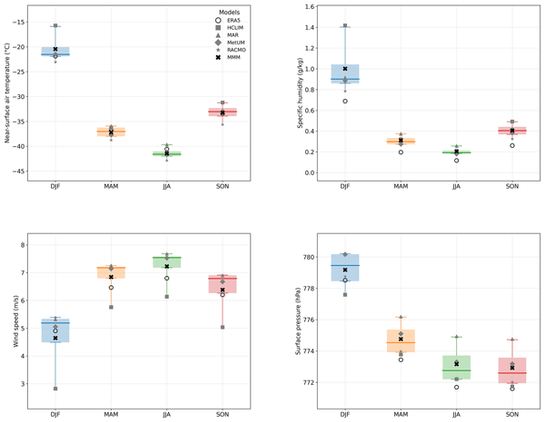
Abstract. Antarctica's weather and climate have global impacts, influencing weather patterns, ocean currents and sea levels worldwide. However, Antarctica is vast and complex, and the atmospheric processes that govern its climate are strongly influenced by its steep terrain, particularly around the coastal periphery. Our scientific understanding of this complex environment is hampered by the lack of reliable observations and gridded datasets at sufficiently high spatial and temporal resolution. High-resolution regional climate models, RCMs, can provide a solution to the sparsity of observational data and low resolution of reanalyses, facilitating more in-depth assessments of crucial climate variables like precipitation, wind and temperature that are strongly influenced by topography. Here we present and evaluate a comprehensive, high-quality, ∼ 11 km resolution RCM dataset, the PolarRES ensemble, for the period 2000–2019. We show that the ensemble largely out-performs ERA5, especially with regard to variables like coastal winds and precipitation. There are no consistent seasonal differences in biases, but there are persistent regional biases. Victoria Land and the Trans-Antarctic Mountains are the regions the RCMs and ERA5 struggle the most with, which suggests that further investigation and model development is needed in this area. Each RCM has strengths and limitations, but overall the ensemble captures the observed weather and climate of Antarctica well. The PolarRES ensemble offers a novel and exciting way of evaluating climate processes and features, and we encourage researchers to use the data, which are freely available, to explore pertinent climate questions of local, regional and global significance.
4 models, 5+ years, 8 institutes, 20 coauthors under the brilliant leadership of @[email protected] @[email protected] + Abraham Torres Alavez: The evaluation of the #polarRES Antarctic climate model ensemble is finally published Great working with you all team! And now for the Arctic.

The PolarRES dataset: a state-...
The PolarRES dataset: a state-of-the-art regional climate model ensemble for understanding Antarctic climate

Abstract. Antarctica's weather and climate have global impacts, influencing weather patterns, ocean currents and sea levels worldwide. However, Antarctica is vast and complex, and the atmospheric processes that govern its climate are strongly influenced by its steep terrain, particularly around the coastal periphery. Our scientific understanding of this complex environment is hampered by the lack of reliable observations and gridded datasets at sufficiently high spatial and temporal resolution. High-resolution regional climate models, RCMs, can provide a solution to the sparsity of observational data and low resolution of reanalyses, facilitating more in-depth assessments of crucial climate variables like precipitation, wind and temperature that are strongly influenced by topography. Here we present and evaluate a comprehensive, high-quality, ∼ 11 km resolution RCM dataset, the PolarRES ensemble, for the period 2000–2019. We show that the ensemble largely out-performs ERA5, especially with regard to variables like coastal winds and precipitation. There are no consistent seasonal differences in biases, but there are persistent regional biases. Victoria Land and the Trans-Antarctic Mountains are the regions the RCMs and ERA5 struggle the most with, which suggests that further investigation and model development is needed in this area. Each RCM has strengths and limitations, but overall the ensemble captures the observed weather and climate of Antarctica well. The PolarRES ensemble offers a novel and exciting way of evaluating climate processes and features, and we encourage researchers to use the data, which are freely available, to explore pertinent climate questions of local, regional and global significance.

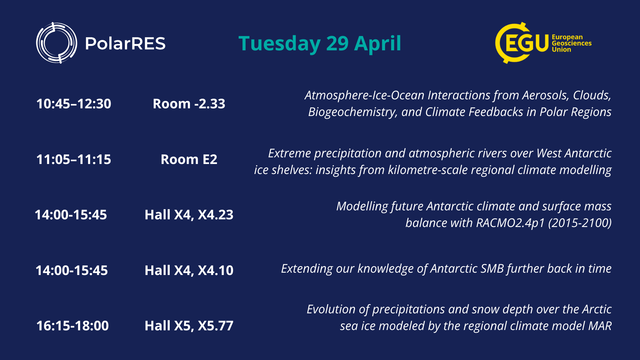
🇦🇹 Day 2 of #EGU25 is a big one for #PolarRES! We have got a packed line-up of exciting presentations from our team.

Come say hello and keep an eye out for more exciting updates throughout the event!

#H2020

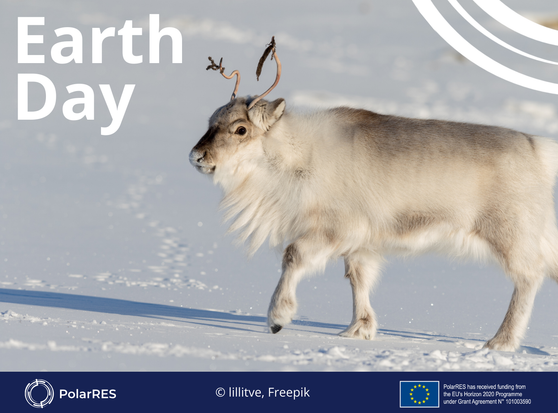
🌎 This #EarthDay, #PolarRES is delivering vital climate information for the Arctic & Antarctic — the fastest-warming parts of our planet.

We’re helping close knowledge gaps to develop reliable climate information for the future.

🎥 Learn about what we are doing: https://vimeo.com/877841046

#H2020

PolarRES_Priscilla Mooney

"PolarRES in the Spotlight" video series featuring Priscilla Mooney, Project Coordinator, explaining the main objectives of the project.

Vimeo

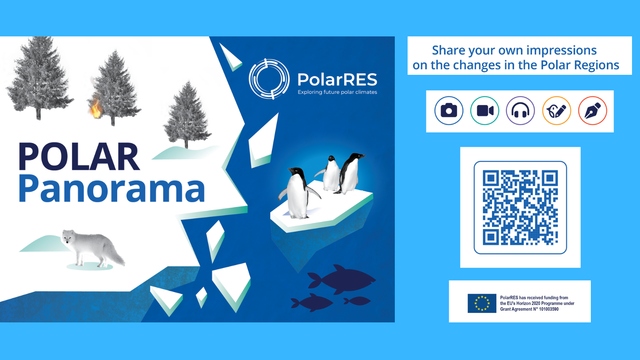
Wir laden euch herzlich ein, am Polar Panorama Projekt von #PolarRES teilzunehmen! Dieses gemeinschaftliche Vorhaben zielt darauf ab, das Bewusstsein für den menschengemachten #Klimawandel zu schärfen, indem wir persönliche Perspektiven und Erfahrungen aus den Polarregionen teilen.
Eure Beiträge werden in unserer Polar Panorama Galerie präsentiert.
Helft uns, das Bewusstsein zu erweitern und zum Handeln zu inspirieren!
#Arktis #Antarktis #Polarforschung

Mehr Infos:
https://polarres.eu/polar-panorama-a-citizen-science-project/

Polar Panorama – A Citizen Science Project - PolarRES

Exploring future polar climates

PolarRES

📸After an amazing panel meeting we had one last full squad photo with our incredible #ECRs at #PolarRES! As many finish up by the end of this year, we want to thank them all for their hard work, dedication, and great vibes👏❄️

We’ll miss you all!

#H2020

🌟Phase 3 of the #PolarRES project starts today - realising our potential and developing our legacy!

This week, we're meeting in Potsdam, Germany 🇩🇪 for the #GeneralAssembly to review progress across work packages, hosted by @AWI_Media.

👀Stay tuned for updates!

#H2020

📣 #DidYouKnow YOU can be part of #PolarRES?

All you need to do is share your observations (📸, 🎤, 🎨, 📝) of the #PolarRegions on our interactive tool, #PolarPanorama!

Read more about the Polar Panorama below👇
https://polarres.eu/polar-panorama-a-citizen-science-project/

#CitizenScience
#H2020
@awi

Polar Panorama – A Citizen Science Project - PolarRES

Exploring future polar climates

PolarRES

🌪️🔗How are the tropospheric (lowest atmospheric layer) precursors linked to the stratospheric (second lowest layer) polar vortex?

#PolarRES researcher Raphael Koehler explored these complex pathways! Check out the study here: https://wcd.copernicus.org/articles/4/1071/2023/wcd-4-1071-2023.html

#H2020 @awi

How do different pathways connect the stratospheric polar vortex to its tropospheric precursors?

Abstract. Processes involving troposphere–stratosphere coupling have been identified as important contributors to an improved subseasonal to seasonal prediction in the mid-latitudes. However, atmosphere models still struggle to accurately predict stratospheric extreme events. Based on a novel approach in this study, we use ERA5 reanalysis data and ensemble simulations with the ICOsahedral Non-hydrostatic atmospheric model (ICON) to investigate tropospheric precursor patterns, localised troposphere–stratosphere coupling mechanisms, and the involved timescales of these processes in the Northern Hemisphere extended winter. We identify two precursor regions: mean sea level pressure in the Ural region is negatively correlated with the strength of the stratospheric polar vortex for the following 5–55 d with a maximum at 25–45 d, and the pressure in the extended Aleutian region is positively correlated with the strength of the stratospheric polar vortex the following 10–50 d with a maximum at 20–30 d. A simple precursor index based on the mean pressure difference of these two regions is very strongly linked to the strength of the stratospheric polar vortex in the following month. The pathways connecting these two regions to the strength of the stratospheric polar vortex, however, differ from one another. Whereas a vortex weakening can be connected to prior increased vertical planetary wave forcing due to high-pressure anomalies in the Ural region, the pathway for the extended Aleutian region is less straightforward. A low-pressure anomaly in this region can trigger a Pacific–North American-related (PNA-related) pattern, leading to geopotential anomalies of the opposite sign in the mid-troposphere over central North America. This positive geopotential anomaly travels upward and westward in time, directly penetrating into the stratosphere and thereby strengthening the stratospheric Aleutian High, a pattern linked to the displacement towards Eurasia and subsequent weakening of the stratospheric polar vortex. Overall, this study emphasises the importance of the time-resolved and zonally resolved picture for an in-depth understanding of troposphere–stratosphere coupling mechanisms. Additionally, it demonstrates that these coupling mechanisms are realistically reproduced by the global atmosphere model ICON.

Representing the surface albedo 🌞🪞 of the #Arctic Ocean is challenging & crucial to ensure reliable climate predictions. #PolarRES researchers evaluated a regional climate model's predictions by comparing it with airborne and ground measurements.

Read the full article here: https://tc.copernicus.org/articles/18/1185/2024/

#H2020

Observations and modeling of areal surface albedo and surface types in the Arctic

Abstract. An accurate representation of the annual evolution of surface albedo of the Arctic Ocean, especially during the melting period, is crucial to obtain reliable climate model predictions in the Arctic. Therefore, the output of the surface albedo scheme of a coupled regional climate model (HIRHAM–NAOSIM) was evaluated against airborne and ground-based measurements. The observations were conducted during five aircraft campaigns in the European Arctic at different times of the year between 2017 and 2022; one of them was part of the Multidisciplinary drifting Observatory for the Study of Arctic Climate (MOSAiC) expedition in 2020. We applied two approaches for the evaluation: (a) relying on measured input parameters of surface type fraction and surface skin temperature (offline) and (b) using HIRHAM–NAOSIM simulations independently of observational data (online). From the offline method we found a seasonally dependent bias between measured and modeled surface albedo. In spring, the cloud effect on surface broadband albedo was overestimated by the surface albedo parametrization (mean albedo bias of 0.06), while the surface albedo scheme for cloudless cases reproduced the measured surface albedo distributions for all seasons. The online evaluation revealed an overestimation of the modeled surface albedo resulting from an overestimation of the modeled cloud cover. Furthermore, it was shown that the surface type parametrization contributes significantly to the bias in albedo, especially in summer (after the drainage of melt ponds) and autumn (onset of refreezing). The lack of an adequate model representation of the surface scattering layer, which usually forms on bare ice in summer, contributed to the underestimation of surface albedo during that period. The difference between modeled and measured net irradiances for selected flights during the five airborne campaigns was derived to estimate the impact of the model bias for the solar radiative energy budget at the surface. We revealed a negative bias between modeled and measured net irradiances (median: −6.4 W m−2) for optically thin clouds, while the median value of only 0.1 W m−2 was determined for optically thicker clouds.