 Splines
Explode the wedge on the top with curved faces and discard everything except the two faces.
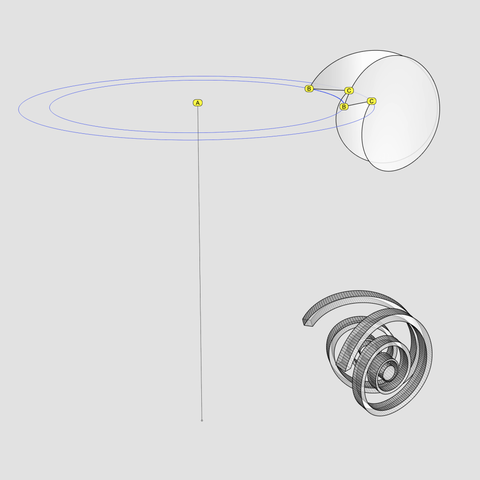
Centered on the column axis marked with A, draw two concentric circles parallel to the XY plane — one with radius AB and another with radius AC. Split both circles with the two wedge faces.
Using the edges of the two wedge faces as #rails and using the two arcs BB and CC as #sweepingCurves, perform a #sweepTwoRails operation to generate a concave surface. Join this concave surface with the two faces.
The shape we just produced still has an open hole between the two arcs BB and CC. Cap this #planarHole to create an #airtight wedge shape with curved faces. As always, check for #nakedEdges and #nonManifoldEdges.
Align the wedge shape and the two 16 units thick spirals from the previous post. Then rotate both 45° about the column axis. Rotate and copy them again at 90° about the column axis until you have the curved volutes on all four corners.

Splines (@[email protected])
Revolutionary #Volutes The two large blue circles at the bottom marked with A and B are from the floor plan for #ModernIonicCapital shown in https://pixelfed.social/p/Splines/807782440025967685. The larger one has a radius of 296 units, while the smaller one is 16 less, at 280. Both are centered at x = 416. Both are then rotated ±45° about the column axis to give us the four red circles. The small blue circle with radius 120 units is for the column neck. The two red circles in the back are shown extruded vertically as cylinders. The other two haven't yet been extruded because we want to see the rest of the structure from the front. The two tube or #torus-like structures are obtained by revolving the trimmed #spiral #volute outlines from https://pixelfed.social/p/Splines/808043616946914228 about the vertical axis located at x = 416. Only the bottom tube maintains the interior shape of the spiral. With this setup, vertically extrude the two remaining red curves in the front so they are at least as high as the top of the upper tube. Next, perform a #booleanDifference between the top tube and the two extrusions marked A. Keep the wedge shape of the top tube on the left side and discard the remaining portion of the tube from the right. Then, perform a boolean difference between the bottom tube and the two extrusions marked B. With the wedge shape of the bottom tube on the left side, perform a further #booleanIntersection with the two extrusions marked A. This will produce two curved spirals that are 16 units thick. Discard the remaining portions of the bottom tube as well as all the red extrusions. After these operations, we are left with one wedge shape with curved faces and two spirals that are 16 units thick, also with curved faces. The next step is to convert the outer surface of the wedge shape from convex to concave.