 Splines
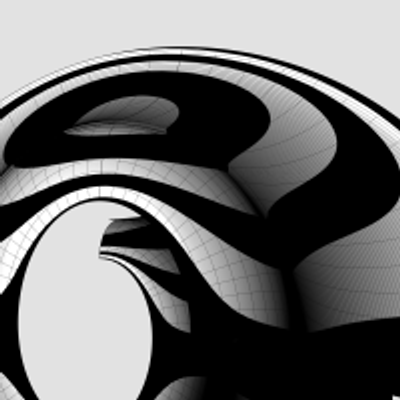
These curves will have sharp corners because we used straight cutting surfaces on the smooth scroll surface, and there will be many segments. Duplicate each one and connect them. This will give you two disconnected curves that have both straight and curved segments.
Next, join the front ends of both curves with a straight vertical line, and similarly join the rear ends of both curves with a straight horizontal line to get a 3-dimensional closed curve shown here in yellow. The curve lies directly on the L-shaped cutting surface.
Trim the copy of the cutting surface using the #edgeCurves we just created, and discard the outer portions. What you have left over is a #patchSurface that we join with the trimmed scroll surface from the previous step.
At this point you should have a single scroll surface, part of which is the patch surface. This scroll surface should have two #planarHoles — one in the front and the other in the rear.
Cap both planar holes to get a solid scroll object. Be sure to check the object for #nakedEdges and #nonmanifoldEdges to make sure that the object is airtight.


Splines (@[email protected])
To create an #airtight solid object from the smooth surface in https://pixelfed.social/p/Splines/794868875707070193 that is suitable for #integration in the classic #IonicCapital, we need to trim the surface at specific points. First draw an L shape that is 3 parts (24 units) wide and 6 parts (48 units) tall. The base of the L should align with the maxima of the last arc of the rear #spiral. The stem of the L should be 3/4 part (6 units) to the left of the maxima for the first arc of the front spiral, or 10 units to the left of the eye of the spiral. #Extrude the L-shaped curve to create an L-shaped #cuttingSurface (shown here in red) that extends past both the front and the rear of the scroll surface. Make a copy of the scroll surface so that you don't destroy the full original surface. Then, split the copy of the scroll surface with the cutting surface. From the outside portion of the scroll surface, discard the portion to the left of the cutting surface, From the inside portion of the scroll surface, discard the portion immediately above the base of the cutting surface. Save a copy of the cutting surface in case you need to repeat these steps, because in the next step we will carve out a portion of the cutting surface itself and join the flat faces of that carved out shape with the trimmed scroll surface.