 Kanishka Naik
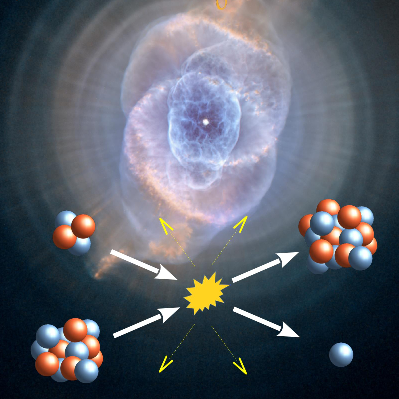
Stars shine by converting nuclear binding energy into light and heat. Neutrons, produced in the Big Bang as hydrogen and helium, become critical fuel in stellar nuclear reactions across cosmic time.
 Thomas Rauscher
#NuclearAstrophysics #conference this week::
Nuclei in the Cosmos XVIII, Girona, Spain
#NICXVIII
🧪🔭

International Symposium on Nuclei in the Cosmos XVIII (NIC XVIII)
*** If you have missed the registration deadline, contact the organizers at [email protected] Nuclei in the Cosmos (NIC) is a biennial series of Nuclear Astrophysics conferences. These interdisciplinary events gather together several hundred nuclear physicists, astrophysicists and cosmochemists, to review, share, and discuss recent advances (and challenges) in this field, covering broad areas, from the origin of the elements to the nuclear processes that power stars and their evolution. As...
#NuclearAstrophysics #conference this week::
Nuclei in the Cosmos XVIII, Girona, Spain
#NICXVIII
🧪🔭
International Symposium on Nuclei in the Cosmos XVIII (NIC XVIII)
*** If you have missed the registration deadline, contact the organizers at [email protected] Nuclei in the Cosmos (NIC) is a biennial series of Nuclear Astrophysics conferences. These interdisciplinary events gather together several hundred nuclear physicists, astrophysicists and cosmochemists, to review, share, and discuss recent advances (and challenges) in this field, covering broad areas, from the origin of the elements to the nuclear processes that power stars and their evolution. As...
#n_TOF winter school on Nuclear Physics, Saint Gervais, France, 21 - 24 January 2024
#NuclearPhysics #NuclearAstrophysics


The n_TOF Nuclear Physics Winter School 2024
The n_TOF Nuclear Physics Winter School 2024 is meant to cover some of the most significant topics related to nuclear science and applications. The School is specially addressed to n_TOF PhD students and young post-docs, but it is open to anyone interested in the fields covered. Four general topics are covered by the lectures: nuclear structure nuclear reactions nuclear astrophysics nuclear technologies Additional related topics are treated in specific lectures (see the Timetable).
#paper #published
The Nuclear Reaction Network WinNet
M. Reichert et al
ApJS 268 (2023) 66
doi.org/10.3847/1538-4…
ended today 😞
Nuclei in the Cosmos XVII, Daejeon, South Korea, Sep 18 - 22
coverage in local media: https://m.tv.naver.com/v/40524989


전 세계 석학 120여 명 중이온가속기 ‘라온’ 방문
starting today:
Nuclei in the Cosmos XVII, Daejeon, South Korea
September 18 - 22

Nuclei in the Cosmos (NIC XVII)
Nuclei in the Cosmos (NIC) is the most important international meeting in the field of nuclear astrophysics. It brings together nuclear experimentalists, nuclear theorists, astronomers, theoretical astrophysicists, cosmo-chemists, and others interested in the scientific questions at the interface of nuclear physics and astrophysics. These questions concern, for example, the origin of the elements in the cosmos and the nuclear reactions that occur in the Big Bang, in stars, and in stellar...
#n_TOF paper published:
Measurement of the 14N(n,p)14C cross section at the CERN n_TOF facility from subthermal energy to 800 keV
Pablo Torres-Sánchez et al. (The n_TOF Collaboration )
Phys. Rev. C 107, 064617
Measurement of the $^{14}\mathrm{N}(n,p)^{14}\mathrm{C}$ cross section at the CERN n_TOF facility from subthermal energy to 800 keV
Background: The $^{14}\mathrm{N}(n,p)^{14}\mathrm{C}$ reaction is of interest in neutron capture therapy, where nitrogen-related dose is the main component due to low-energy neutrons, and in astrophysics, where $^{14}\mathrm{N}$ acts as a neutron poison in the $s$ process. Several discrepancies remain between the existing data obtained in partial energy ranges: thermal energy, keV region, and resonance region.Purpose: We aim to measure the $^{14}\mathrm{N}(n,p)^{14}\mathrm{C}$ cross section from thermal to the resonance region in a single measurement for the first time, including characterization of the first resonances, and provide calculations of Maxwellian averaged cross sections (MACS).Method: We apply the time-of-flight technique at Experimental Area 2 (EAR-2) of the neutron time-of-flight (n_TOF) facility at CERN. $^{10}\mathrm{B}(\mathrm{n},\ensuremath{\alpha})^{7}\mathrm{Li}$ and $^{235}\mathrm{U}(n,f)$ reactions are used as references. Two detection systems are run simultaneously, one on beam and another off beam. Resonances are described with the $R$-matrix code sammy.Results: The cross section was measured from subthermal energy to 800 keV, resolving the first two resonances (at 492.7 and 644 keV). A thermal cross section was obtained ($1.809\ifmmode\pm\else\textpm\fi{}0.045$ b) that is lower than the two most recent measurements by slightly more than one standard deviation, but in line with the ENDF/B-VIII.0 and JEFF-3.3 evaluations. A 1/$v$ energy dependence of the cross section was confirmed up to tens of keV neutron energy. The low energy tail of the first resonance at 492.7 keV is lower than suggested by evaluated values, while the overall resonance strength agrees with evaluations.Conclusions: Our measurement has allowed determination of the $^{14}\mathrm{N}(n,p)$ cross section over a wide energy range for the first time. We have obtained cross sections with high accuracy (2.5%) from subthermal energy to 800 keV and used these data to calculate the MACS for $kT=5$ to $kT=100$ keV.
paper published:
Proton decays from α-unbound states in 22Mg and the 18Ne(α,p0)21Na cross section
J. W. Brümmer, P. Adsley, T. Rauscher, et al.
Phys. Rev. C 107, 055802 (2023)
https://doi.org/10.1103/PhysRevC.107.055802
Proton decays from $\ensuremath{\alpha}$-unbound states in $^{22}\mathrm{Mg}$ and the $^{18}\mathrm{Ne}{(\ensuremath{\alpha},{p}_{0})}^{21}\mathrm{Na}$ cross section
Background: Type I x-ray bursts provide an opportunity to constrain the equation of state of nuclear matter. Observations of the light curves from these bursts allow the compactness of neutron stars to be constrained. However, the behavior of these light curves also depends on a number of important thermonuclear reaction rates. One of these reactions, $^{18}\mathrm{Ne}(\ensuremath{\alpha},p)^{21}\mathrm{Na}$, has been extensively studied but there is some tension between the rate calculated from spectroscopic information of states above the $\ensuremath{\alpha}$-particle threshold in $^{22}\mathrm{Mg}$ and the rate determined from time-reversed measurements of the cross section.Purpose: The time-reversed measurement of the cross section is only sensitive to the ground state-to-ground state contribution. Therefore, corrections must be made to this reaction rate to account for the contribution of branches to excited states in $^{21}\mathrm{Na}$. At present this is done with statistical models which may not be applicable in such light nuclei. Basing the correction of the time-reversed cross section on experimental data is much more robust.Method: The $^{24}\mathrm{Mg}(p,t)^{22}\mathrm{Mg}$ reaction was used to populate states in $^{22}\mathrm{Mg}$. The reaction products from the reaction were analysed by the K600 magnetic spectrometer at iThemba Laboratories, South Africa. Protons decaying from excited states of $^{22}\mathrm{Mg}$ (${S}_{p}=5502$ keV) were detected in an array of five double-sided silicon strip detectors placed at backward angles. The branching ratio for proton decays to the ground state of $^{21}\mathrm{Na}, {B}_{{p}_{0}}$, was determined by comparing the inclusive (triton-only focal-plane) and exclusive (focal-plane gated on a specific proton decay) spectra.Results: The experimental proton decay branching ratio to the ground state of $^{21}\mathrm{Na}$ from excited states in $^{22}\mathrm{Mg}$ were found to be a factor of about two smaller than the ratios predicted by Hauser-Feshbach models. Using the experimental branchings for a recalculation of the $^{18}\mathrm{Ne}(\ensuremath{\alpha},{p}_{0})^{21}\mathrm{Na}$ cross section leads to a considerably improved agreement with previous reaction data. Updated information on the disputed number of levels around ${E}_{x}\ensuremath{\approx}9$ MeV and on the possible $^{18}\mathrm{Ne}(\ensuremath{\alpha},2p)^{20}\mathrm{Ne}$ cross section at astrophysical energies is also reported.Conclusions: The proton decay branching of excited states in $^{22}\mathrm{Mg}$ to the ground state of $^{21}\mathrm{Na}$ have been measured using the K600 Q2D spectrometer at iThemba Laboratories coupled to the double-sided silicon-strip detector array CAKE. Using these experimental data, the modeling of the $^{18}\mathrm{Ne}(\ensuremath{\alpha},{p}_{0})^{21}\mathrm{Na}$ cross section has been improved. The result is not only in better agreement with previous cross section data but also consistent with a recent direct measurement of $^{18}\mathrm{Ne}(\ensuremath{\alpha},p)^{21}\mathrm{Na}$. This strengthens the case for the application of statistical models for these reactions.
paper published:
Nuclear Reactions in Evolving Stars (and Their Theoretical Prediction)
F.-K. Thielemann, T. Rauscher;
in "Handbook of Nuclear Physics" (Springer, Singapore 2023) ISBN 978-9811963445