Dear collegues, I would like to invite you to have a walk "On the Footsteps of Active Faults from the #SaronicGulf to the #EasternCorinthGulf: Application of #TomographicInversion Using Recent #Seismic Activity"
https://mdpi.com/2882562
#mdpiapplsci
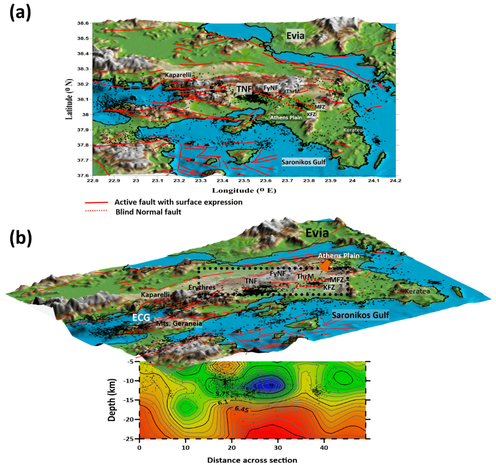

On the Footsteps of Active Faults from the Saronic Gulf to the Eastern Corinth Gulf: Application of Tomographic Inversion Using Recent Seismic Activity
This study examines the body-wave velocity structure of Attica, Greece. The region is located between two major rifts, the Gulf of Corinth and the Euboekos Gulf, and has experienced significant earthquakes throughout history. The distribution of seismic activity in the area necessitates a thorough investigation of geophysical properties, such as seismic velocities, to reveal the extent of significant fault zones or the presence of potential hidden faults. This case study utilized over 3000 revised events to conduct a local earthquake tomography (LET). P- and S-wave travel-time data were analyzed to explore small- to medium-scale (~10 km) anomalies that could be linked to local neotectonic structures. The study presents a detailed 3-D seismic velocity structure for Attica and its adjacent regions. The results of the study revealed strong lateral body-wave velocity anomalies in the upper crust were related to activated faults and that a significant portion of the observed seismicity is concentrated near the sites of the 1999 and 2019 events.
Just Out! Our new paper on how surfactant chemicals affect interactions between grazing snails and Intertidal Microbial #Biofilms https://mdpi.com/2001790 #mdpiapplsci via
@Applsci
Led by my former PhD candidate (now Dr) Steph Gill with Colleagues QueensMarineLab
#biofilm #ecotoxicology

Rhamnolipids Mediate the Effects of a Gastropod Grazer in Regards to Carbon–Nitrogen Stoichiometry of Intertidal Microbial Biofilms
Microbial biofilms have co-evolved with grazing animals, such as gastropods, to develop mutually beneficial relationships. Although microbial biofilms demonstrate resilience and resistance to chemical exposure, pre-existing relationships can be negatively affected by chemical input. In this study, we determined how the grazer, Littorina littorea (common periwinkle sea snail), and a biological surfactant (rhamnolipid) interact on a phototrophic marine biofilm. Biofilms were cultured in 32 twenty-liter buckets at the Queen’s University Marine Laboratory in Portaferry, Northern Ireland on clay tiles that were either exposed to 150 ppm of a rhamnolipid solution or that had no chemical exposure. L. littorea were added into half of the buckets, and biofilms were developed over 14 days. Biofilms exposed to grazing alone demonstrated high tolerance to the disturbance, while those growing on rhamnolipid-exposed substrate demonstrated resistance but experienced slight declines in carbon and stoichiometric ratios. However, when exposed to both, biofilms had significant decreases in stoichiometry and declined in productivity and respiration. This is problematic, as continuing marine pollution increases the likelihood that biofilms will be exposed to combinations of stressors and disturbances. Loss of biofilm productivity within these areas could lead to the loss of an important food source and nutrient cycler within the marine ecosystem.
 Andreas Karakonstantis
 Billy Hunter