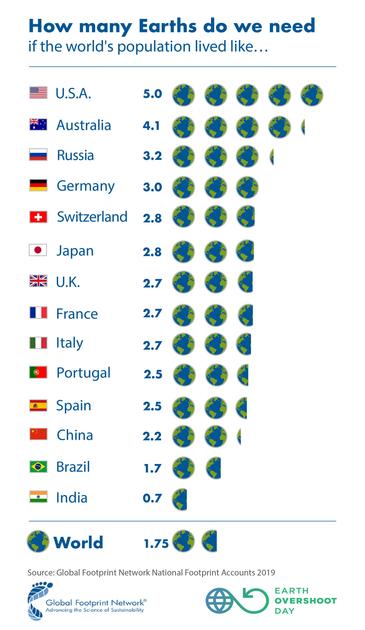
"humanity is currently using nature 1.75 times faster than our planet’s ecosystems can regenerate."

Currently we are globally using over 100 billion tonnes of material every year.

#sdg12 #materialfootprint #earth #sdgs

Read:
https://overshoot.footprintnetwork.org/newsroom/press-release-2025-english/

Help! Does anyone know the source of the often quoted "50Gt/y material footprint is the sustainable maximum"?

Another user here asked about this a while back but I don't think anyone found it.

@gerrymcgovern found this:

https://ayhoekstra.nl/pubs/Hoekstra-Wiedmann-2014-EnvironmentalFootprint.pdf

Which relies on this:

M. Dittrich, S. Giljum, S. Lutter, C. Polzin, “Green economies around the world? Implications of resource use for development and the environment”
(Sustainable Europe Research Institute, Vienna, Austria, 2012).

https://www.researchgate.net/publication/301790657_Green_economies_around_the_world_Implications_of_resource_use_for_development_and_the_environment/link/572895b508ae0acc4f497c9b/download

on page 37 they say:

"with regard to the environment, it could be argued that nature has limited resources, and therefore, global resource extraction should be frozen at the level of one base year, for example 1992, the year of the first Rio Summit at around
50 billion tonnes."

Is 50Gt really just a guess? Does it/should it include biomass, and sand and gravel?

#MF #MaterialFootprint #ClimateChange #ClimateCrisis #Degrowth #LessIsMore

> That household total, 50 tons, represents a #CarbonFootprint of about 25 tons per person. It’s a figure that eclipses the global median by a factor of five and is nowhere close to where it needs to be if you — we — want to stave off the worst of warming’s effects: around two tons per person.
The task of shrinking our societal footprint is the most urgent problem of our era — and perhaps the most intractable.
https://www.nytimes.com/2022/10/05/magazine/uruguay-renewable-energy.html?unlocked_article_code=AAAAAAAAAAAAAAAACEIPuonUktbfqYhlSFUbBibQVNcuvByAiL_S2qEzm3bvaTKYTztdxu4RDs2N_UrXarslZ8c2237TYu59B4IVZa44yP5DbQsqQhO0o5CAldNVeXhk9N25ACZnj5nHGO1mrTGvPjiyJKJ2lOXi4UnbbDa6DKHPwDZ2clYe1JhudFip2HcP1_2FRrYzgo8iqK9nUpNqRj4AZz2Jvu3qDHh8OdaEZhLd6momSr0TGGGTzZPHteV2IEgFAknGTXh__W4-9NheXdoVN6_0JBQgE9HsiQJRtx-SXnrAThEwajHf2A&smid=nytcore-ios-share&referringSource=articleShare
#MaterialFootprint #USA
/ht @babelcarp
What Does Sustainable Living Look Like? Maybe Like Uruguay

No greater challenge faces humanity than reducing emissions without backsliding into preindustrial poverty. One tiny country is leading the way.

The New York Times
> Results for 12 selected countries at different stages of their socioeconomic development and with broad geographical coverage are presented in Fig. 1. MF results for 2008 for all countries studied are presented in SI Text and Dataset S1.
https://www.pnas.org/doi/10.1073/pnas.1220362110
#ThomasOWiedmann #MaterialFootprint
From now on MFers means MaterialFootprinters, people that use up more than their just share of resources. Good fit with original? meaning of rapist slave owners, they weren't just either.