While the more in depth information that I've been posting here isn't part of this video, you can see more of the motion.

If you want to see this in person and are in New York City: SATURDAY (May 6) 3-9pm ET at The Arm letterpress shop in Brooklyn.

It is an exhibition of work from our paper engineering class and an exploration of new interactive forms. The projects are from an amazingly brilliant group of people.

Also: snacks & drinks

#logicalelegance
#paperengineering
#patternsandtextures

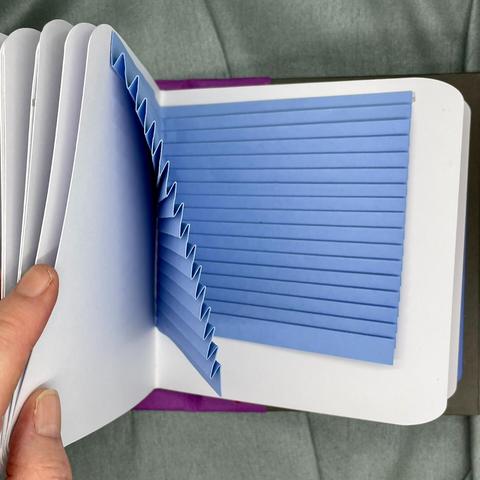
P11: Knife Pleats

It is all straight lines, why do the knife pleats bow out of the page?

This one isn't my favorite but the curve is interesting.

#logicalelegance
#paperengineering
#patternsandtextures

P10: Pleat Spiral

This is another pleat spiral like the last but with a lower angle between the horizontal mountains and the diagonal valleys so the twist happens more slowly.

This is the basis of the fold I use to make snails.

#logicalelegance
#paperengineering
#patternsandtextures

P9: Pleat Spiral

Another cylinder rising into a spiral. However, the crease patterns for this is much simpler.

If want to try textural fold, this is the one. You don't need to be very exact: horizontal lines as mountains, connecting diagonals (all angled the same way) as valleys.

While these are well-known, I was introduced to them by origami artist Tomoko Fuse who uses this type of pattern to create nautilus shells.

#logicalelegance
#paperengineering
#patternsandtextures

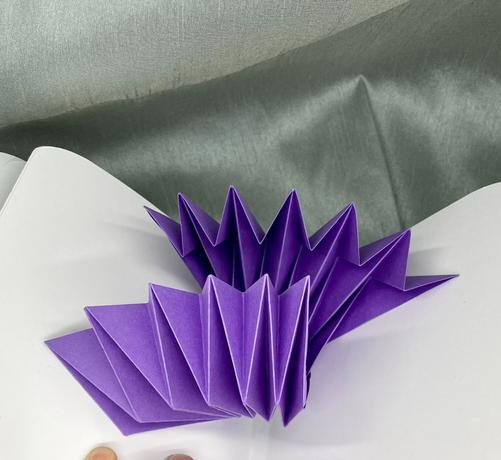
P8: Yoshimura coil, a=10

This is another Yoshimura pattern. Instead of a rectangle, this one starts as a parallelogram before it is folded.

The result is a flat cylinder that stretches into a helix.

(This one is my favorite, don’t tell the others.)

#logicalelegance
#paperengineering
#patternsandtextures

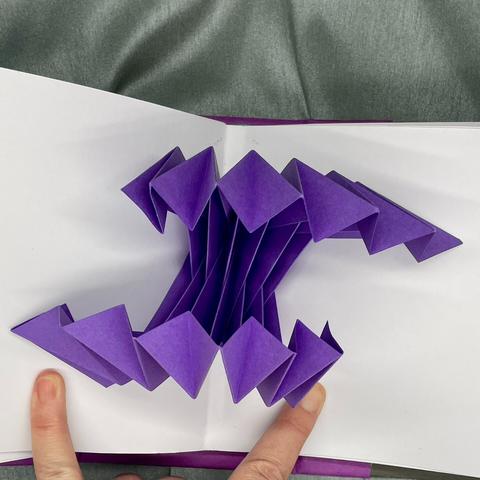
P7: Yoshimura, a= 30

Nicknamed "The Chomper" by @stoneymonster.

This is another Yoshimura pattern. The lower angle between vertical and diagonal lines means it doesn't fold over on itself as quickly as the previous one leaving an opening to see the bellows-like interior.

#logicalelegance
#paperengineering
#patternsandtextures

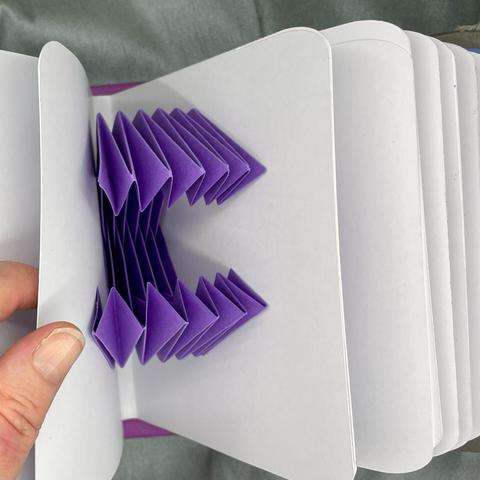
P6: Yoshimura, a= 45 with verso

When folded in this pattern, flat papers want to curl up, the higher the angle, the more they want to curl. While my edges here are straight (the paper is rectangular), putting a zigzag cut on the edges is a great way to create teeth that open as the page opens.

Alternatively, if edges overlapped, they could be glued together to make a compressible polygonal tube.

#logicalelegance
#paperengineering
#patternsandtextures
4d

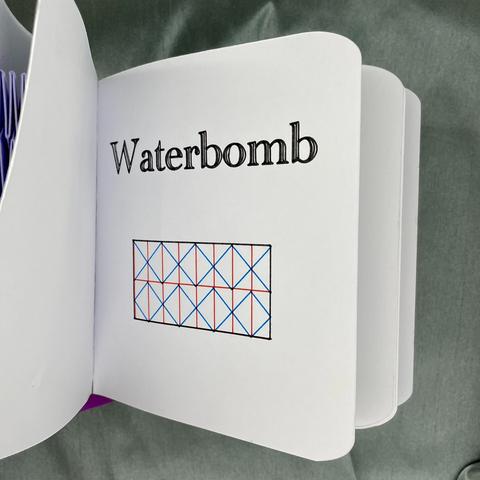
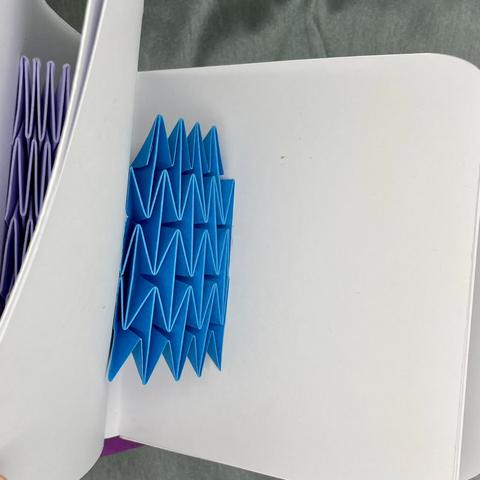
P4: Waterbomb pattern

Waterbomb is a classic origami pattern that, with a puff of breath, creates a little box (that can be filled with water or air or jellybeans).

This tessellation pattern is made up of connecting waterbomb bases.

Similar to the Miura-ori, this folds down compactly and has points that zigzag. But the crease patterns are different: the waterbomb is always 45 degree diagonal folds (for rigid flat foldable).

#logicalelegance
#paperengineering
#patternsandtextures

P3: Second Miura-ori pattern

This one has a different angle between the zigzag elements and the straight lines (vertical in the fold, horizonal on the pattern).

The angle controls the density of the folds. It also folds thicker and has more springiness.

Another interesting feature of the general Miura-ori pattern is that you can use it for lenticular lensing where you see an image change by slightly rotating the page.

#logicalelegance
#paperengineering
#patternsandtextures

Miura-ori is a rigid flat foldable pattern used in engineering contexts such as satellites and packaging.

If you pull in the horizontal direction, it expands in the vertical direction as well (negative Poisson ratios). That means expanding a solar array in space requires fewer actuators.

This one has an angle of 60 degrees between the zigzags and the straight lines (vertical in the folded model, horizontal in the pen pattern).

#logicalelegance
#paperengineering
#patternsandtextures