 Terraso
RE: https://fosstodon.org/@terraso/116375540243678175
If you work with soil pH, we want to hear from you.
RE: https://fosstodon.org/@terraso/116375540243678175
If you work with soil pH, we want to hear from you.
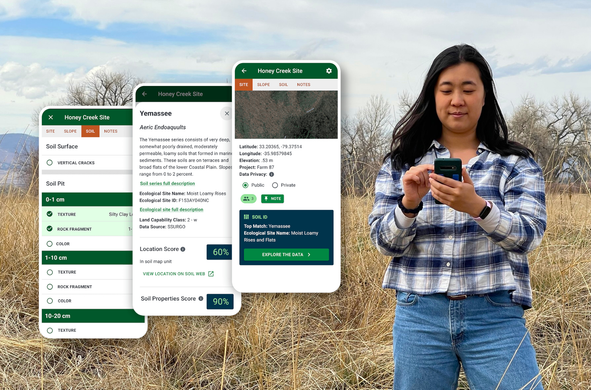
As 2026 begins, the latest version of LandPKS Soil ID delivers exciting new features: data export, a new soil review experience for easier soil identification, and translation to new languages. Read more about the feature on our website: https://landpks.terraso.org/landpks-soil-id-adds-data-export-french-and-georgian-translations-and-rate-match/

As 2026 begins, we are excited to share a major update to LandPKS Soil ID, the premier app for ground-truthed soil data collection and identification in the field. Version 1.4.2 delivers new features, including data export, a new soil review experience for easier soil identification, and translation to new languages. Export your soils data Ground-truthed ... Read more
We are excited to announce that LandPKS Soil ID now enables you to collect soil observations and identify soils in the field anywhere in the world. https://landpks.terraso.org/landpks-soil-id-goes-global/
Ukraine's rare and uniquely fertile black Chernozem soils possess extraordinary self-healing capacity. So does Ukraine's scientific community.
Our Senior Designer, Courtney Tiberio, wrote this case study to tell the story of Professor Yuriy Dmytruk's partnership with the #LandPKS Soil ID team—how a free mobile app is helping Ukrainian soil scientists continue critical research and education despite damaged infrastructure and farmlands. 🌾🇺🇦
Hi all. We're excited to share we've published a new, free, open source soil science application: #LandPKS Soil ID!
Soil ID makes it simple to identify the soil beneath your feet. Gather observations about the soil and compare your data to possible soils from local soil maps.
We're launching in the U.S. to start with, with soils outside the U.S. coming soon thereafter.
Learn more: https://landpks.terraso.org/take-to-the-field-with-landpks-soil-id/
"In general, local soil classification has two components: a physical (morphological) and a perceptual (non-morphological) dimensions (Ettema, 1994)... Four sets of classification criteria have been globally identified: 1) color and texture; 2) consistence and soil moisture; 3) organic matter, stoniness, topography, land use, and drainage; and 4) fertility, productivity, workability, structure, depth and soil temperature."
#LandPKS uses color and texture, among other attributes.
"Although INEGI’s cartography accounts for almost 100% of the national territory, it lacks of a significant impact on some potential users, such as farmers, because the information is not easily accessible, useful, accurate or current."
Since I started work on #LandPKS, this has been a huge lesson for me. Science has produced a wealth of knowledge, but there is a barrier to land stewards accessing and interpreting the knowledge.


 Derek Caelin is writing a book