 WPS News
Alternate Wetting and Drying: Producing Rice With Less Water
By Cliff Potts, CSO, and Editor-in-Chief of WPS News
Baybay City, Leyte, Philippines — June 30, 2026
Rice has traditionally been grown under continuous flooding. While this method is familiar and reliable, it is also water-intensive and increasingly costly. As irrigation systems age and water competition increases, producing the same amount of rice with less water has become a practical necessity rather than a theoretical goal.
Alternate Wetting and Drying, commonly known as AWD, is one method that addresses this challenge without reducing yields when applied correctly.
What AWD Is
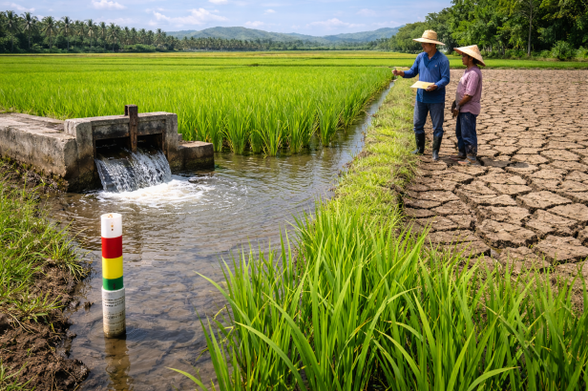
AWD is a water-management practice in which rice fields are allowed to dry to a safe level before being re-flooded. Instead of keeping paddies continuously submerged, farmers monitor field water depth and re-irrigate only when soil moisture reaches a defined threshold.
This approach does not deprive rice plants of water during sensitive growth stages. It simply avoids unnecessary flooding when the crop does not require it.
Why Continuous Flooding Persists
Flooding has long been used to suppress weeds and simplify management. It reduces the need for precise timing and allows farmers to compensate for uneven water delivery. In systems where irrigation schedules are unpredictable, keeping fields flooded is often a defensive strategy rather than an efficiency choice.
AWD works best when irrigation delivery is reliable and farmers receive clear guidance on when to re-flood fields.
Water Savings Without Yield Loss
Research and field experience show that AWD can reduce irrigation water use significantly without lowering yields, provided it is implemented properly. By limiting water during non-critical stages, farmers reduce pumping costs, canal losses, and pressure on shared irrigation systems.
Lower water use also improves fertilizer efficiency. Nutrients are less likely to be washed away, allowing plants to absorb more of what is applied.
Management and Training Matter
AWD is not simply a matter of letting fields dry. It requires basic monitoring, clear thresholds, and coordination with irrigation schedules. If drying occurs during sensitive stages such as flowering, yields can be reduced.
For this reason, AWD is best introduced through extension support rather than informal imitation. Clear guidelines and simple field indicators allow farmers to apply the method safely.
System Benefits Beyond the Field
When many farms adopt AWD, the benefits extend beyond individual fields. Reduced peak water demand lowers stress on canals and pumps. Water saved upstream becomes available downstream, improving equity across irrigation systems.
AWD also reduces methane emissions associated with continuous flooding, offering environmental benefits alongside cost savings. While emissions are not the primary concern for most farmers, reduced input costs and improved reliability are immediate advantages.
Why AWD Fits a Cost-Focused Strategy
AWD does not require new seed, machinery, or major infrastructure investment. It works within existing systems and focuses on management rather than expansion. For this reason, it is one of the few interventions that can reduce costs while maintaining output at scale.
When water is treated as a limited resource rather than an unlimited input, AWD becomes a practical tool. Used correctly, it helps stabilize production, lower costs, and extend the usefulness of existing irrigation systems.
References
Bouman, B. A. M., & Tuong, T. P. (2001). Field water management to save water and increase its productivity in irrigated lowland rice. Agricultural Water Management, 49(1), 11–30.
Bouman, B. A. M., Humphreys, E., Tuong, T. P., & Barker, R. (2007). Rice and water. Advances in Agronomy, 92, 187–237.
International Rice Research Institute. (2013). Alternate wetting and drying (AWD): A water-saving technology for rice. IRRI.
Lampayan, R. M., Rejesus, R. M., Singleton, G. R., & Bouman, B. A. M. (2015). Adoption and economics of alternate wetting and drying water management for irrigated lowland rice. Field Crops Research, 170, 95–108.
#alternateWettingAndDrying #AWDRice #climateSmartRice #farmCosts #irrigationEfficiency #PhilippineAgriculture #riceProductionSystems #waterManagement #WPSNews