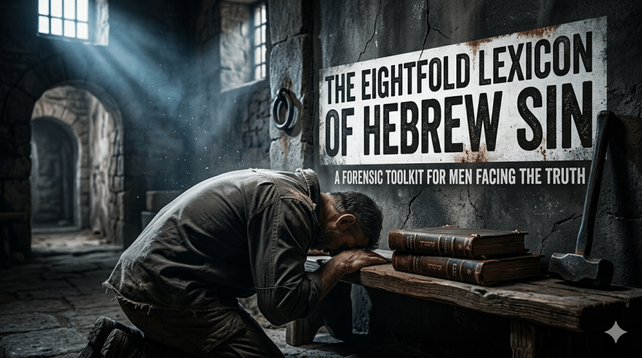
The Eightfold Lexicon of Hebrew Sin
2,025 words, 11 minutes read time.
The Hebrew language does not play games with the concept of human failure. While modern culture treats “sin” like a vintage relic or a therapeutic “mistake,” the ancient Hebrew lexicon functions like a high-precision forensic kit. It offers eight distinct, surgical terms that strip away the comfort of ambiguity and force a man to look at the wreckage he has created. This is not about feeling bad; it is about the cold, hard mechanics of spiritual rot. The Eightfold Lexicon—comprising Chata, Ra’, Pasha, Awon, Shagag, Asham, Rasha, and Taah—reveals that sin is a multi-dimensional catastrophe involving the will, the intellect, and the very structure of a man’s soul. To understand these words is to stop hiding behind the generic excuse of being “only human” and to finally face the specific, lethal ways that a life is dismantled by rebellion and neglect.
The Architecture of Failure and the Mechanics of Chata Ra and Pasha
The most common entry point into this lexicon is Chata, or Chatta’ah, which is routinely sanitized in modern English as “missing the mark.” In its raw Hebrew context, this is not a polite “almost.” It is a failure of aim that results in a total loss of purpose. If the target is the righteous standard set by a Holy God, then Chata is the definitive proof of a man’s incompetence or refusal to train his soul for the shot. It encompasses everything from the small ethical compromise in business to the massive moral collapses that destroy families. But the lexicon quickly escalates from missing the mark to Ra’, a term that represents the active, intense presence of evil. Ra’ is not a passive absence of good; it is the “imagination of the heart” turned into a weapon of opposition against the Creator. It is the drive toward idol worship and the engagement in anti-God activities that disrupt the natural order. When a man moves from failing to meet a standard to actively working against it, he has entered the territory of Ra’, where the heart becomes a factory for disaster and the soul begins to mirror the chaos of the abyss.
Building upon this internal depravity is the concept of Pasha, often translated as “willful transgression” or “rebellion.” In the technical landscape of Hebrew covenantal thought, Pasha is the language of treason. It is a deliberate breach of trust within a relationship that was supposed to be foundational. This is not a man who tripped and fell; this is a man who saw the line, recognized the Authority that drew it, and spat on the ground before stepping over it. It is the ultimate “gutless” move—taking the benefits of God’s grace while actively conspiring against His laws. This term highlights the political and relational nature of sin, stripping away the lie that a man’s choices only affect himself. Pasha proves that every act of deliberate disobedience is a declaration of war against the King of Kings. It is a rebellion that demands a reckoning, as it moves beyond the “mistake” and enters the realm of a calculated coup against the divine order of the universe.
The Structural Rot of Awon Shagag and Taah in the Human Soul
Beyond the act of rebellion lies the structural consequence of sin, captured perfectly by the word Awon. Frequently rendered as “iniquity,” Awon describes a moral distortion or a perversion of the law. This is the “crookedness” that settles into a man’s character after years of compromise. It refers to the inherent corruption that makes a straight path look wrong and a bent path look right. The most terrifying aspect of Awon is its dual meaning in Hebrew thought: it refers to both the crooked act and the heavy burden of guilt and punishment that inevitably follows. A man does not just “commit” Awon; he becomes it. He carries the weight of his own perversion until it crushes him. This is the technical explanation for why a life of compromise feels so heavy—the structural integrity of the soul has been compromised by a persistent, internal “bending” of the truth that God established as the only way to stand upright.
In contrast to the heavy, deliberate weight of Awon, the Hebrew lexicon provides Shagag and Taah to describe the different ways a man loses his way. Shagag refers to sinning through ignorance or error—the wandering of a distracted mind. It is the “reckless endangerment” of one’s own soul through sheer inattentiveness. It is the man who wakes up one day and wonders how his life became a wasteland, failing to realize that his casual neglect of spiritual discipline was a slow drift into enemy territory. However, the lexicon offers no “get out of jail free” card for the ignorant. Even wandering is a violation of the path. This becomes even more lethal in the case of Taah, which means to “go astray” or wander away deliberately. Unlike the distracted wandering of Shagag, Taah is a choice to leave the trail, even if the man refuses to acknowledge where that path leads. It is the height of arrogance to wander away from God’s protection and then act surprised when the wolves arrive. Both terms serve as a brutal reminder that whether through laziness or a “need for space,” leaving the path is a death sentence.
The Legal Reality of Asham and the Desolation of the Rasha
The final pillars of the Eightfold Lexicon deal with the hard legalities of sin and the ultimate state of the man who refuses to repent. Asham is a term rooted in the sanctuary, specifically tied to the “guilt offering.” It addresses the objective reality of guilt before God, regardless of how a man feels about it. In a world obsessed with “shame” as a psychological feeling, Asham reminds us that guilt is a legal fact. It is the debt incurred when a man’s actions cause damage to God’s holiness or his neighbor’s well-being. This is “meat-and-potatoes” logic: if you break it, you owe for it. The principle of Asham demands a settlement. It is the realization that no amount of self-help or positive thinking can erase the ledger of a man who has offended the Almighty. Without the sacrificial restoration that Asham implies, a man is simply a debtor waiting for the debt collector to arrive at the door of his life.
The culmination of this lexicon is Rasha, the term for “wicked.” In the wisdom literature and the Psalms, the Rasha is the direct, polarized opposite of the “righteous” man. This is the final state of the man who has ignored Chata, embraced Ra’, lived in Pasha, and become bent by Awon. The Rasha is someone who has turned entirely from God’s ways and has been declared “guilty” in the court of heaven. It is the description of a life lived outside the boundaries of the covenant—a life that is “loose” and un-tethered from the truth. There is no middle ground here. You are either moving toward the righteousness of God or you are settling into the status of the Rasha. The wreckage of a life lived as a Rasha is not a tragedy to be mourned with soft words; it is a warning to be heeded with fear. It is the end result of a man who refused to face the mirror and acknowledge the specific, technical nature of the sin that was rotting his soul from the inside out.
The Eightfold Lexicon of Hebrew sin is a mirror that reflects the absolute disaster of a life lived apart from God. There is no room for “churchy” platitudes or the soft, gutless excuses of modern existence when faced with the precision of these words. If you find yourself wandering, you are in Taah. If you are rebelling, you are in Pasha. If your character is crooked, you are drowning in Awon. The reality is simple and brutal: your life is rotting because you have neglected the standard of the Creator. You are currently standing in a state of Asham—legal guilt—and the only response that matters is to hit your knees and demand a soul-level change before the debt is called in. Stop hiding behind the vagueness of “imperfection” and start addressing the specific rebellion that is killing you. The truth of the Hebrew lexicon cuts deeper than any modern comfort—face it now or keep rotting in the mediocre, godless existence you’ve built for yourself.
Call to Action
The time for intellectual curiosity is over. You’ve seen the forensic breakdown of your own failure—now you have to decide if you’re going to keep walking toward the grave or turn around.
Stop hiding behind the “nobody’s perfect” lie. That’s the language of the gutless. If you are breathing, you are currently operating in one of these eight states of rot. You are either missing the mark, wandering like a distracted animal, or actively rebelling against the King who gave you life. Every second you spend “considering” this truth is another second you spend sinking deeper into the structural corruption of Awon.
Get on your knees.
This isn’t a suggestion; it’s an order for the survival of your soul. Face the legal debt of your Asham. Admit to the treason of your Pasha. There is no middle ground, no “safe” level of compromise, and no therapy that can fix a spirit that is intentionally wandering away from its Creator.
Here is your mandate:
- Audit your life tonight. Strip away the excuses and label your actions with these eight Hebrew words. Call your rebellion what it is.
- Repent with violence. Not physical violence, but a violent rejection of the mediocrity and sin you’ve tolerated. Kill the habits that are killing your connection to God.
- Restore the damage. If your sin has caused debt—financial, relational, or spiritual—pay it.
The wreckage of your life is screaming for a Master. Either you submit to the One who defined righteousness, or you continue to rot as a Rasha. Choose today, or the choice will be made for you when the debt comes due. Move.
SUPPORTSUBSCRIBECONTACT ME D. Bryan King
Sources
Disclaimer:
The views and opinions expressed in this post are solely those of the author. The information provided is based on personal research, experience, and understanding of the subject matter at the time of writing. Readers should consult relevant experts or authorities for specific guidance related to their unique situations.
#ancientHebrewMeanings #AshamMeaning #authoritativeBiblicalTeaching #AwonMeaning #biblicalEthics #BiblicalHamartiology #biblicalLaw #biblicalLexicon #biblicalManhood #biblicalRebellion #biblicalScholarship #biblicalTheologyForMen #biblicalTruth #breachOfTrust #CharlesRyrie #ChataMeaning #ChattaAh #ChristianGhostwriter #Christianity #covenantRelationship #debtBeforeGod #deliberateWandering #divineStandard #EightfoldLexiconOfHebrewSin #forensicKitForSin #forensicTheology #godlessExistence #grittyFaith #guiltOffering #hardboiledTheology #heartDepravity #HebrewLanguage #idolWorship #iniquityDefinition #masculineFaith #mentorForMen #missingTheMark #moralDistortion #moralFailure #OldTestamentSinWords #originalLanguageSin #overcomingMediocrity #PashaMeaning #perversionOfLaw #Pesha #PsalmsWisdomLiterature #RaMeaning #RashaMeaning #recklessEndangerment #religiousPlatitudes #repentance #righteousAnger #ShagagMeaning #soulLevelChange #spiritualAnatomy #SpiritualGrowth #spiritualRot #spiritualUrgency #structuralSin #TaahMeaning #theologicalDepth #truthForMen #unintentionalSin #wickedVsRighteous #willfulTransgression #wordStudy Hebrew by Inbal

 Bryan King