
The Dunning-Kruger Disaster: Why Your Emergency Radio Plan Will Fail Your Family

2,205 words, 12 minutes read time.

The room is pitch black. You are trapped in the basement of a collapsed house, the heavy joists of the floor above pinning you down, or sealing the only exit with hundreds of pounds of shattered drywall and splintered timber. Your family is terrified, someone is bleeding in the dark, and you need immediate assistance just to breathe the air on the other side of that ruin.

Let’s hit a straight-up, unvarnished fact that the sanitized manuals love to gloss over: during a major disaster, people die. And a terrifying number of them pass away after the initial event has cleared, while they are sitting in the wreckage awaiting the arrival of emergency services that simply cannot reach them.

FEMA officially tells the public to be prepared for three days of total isolation. Reality calls that number a fairy tale. In a true regional catastrophe, first responders are entirely overwhelmed, roads are choked with debris, and you need to be prepared to survive for days—or even weeks—on your own merits.

In a dark world where help is a distant luxury, amateur radio is not a magic wand, but it is one of the definitive tools to tilt the odds of survival back in your family’s favor. It is one of many critical pillars of preparedness, right alongside water filtration, medical supplies, and structural tools. The number one priority is getting your spouse, your kids, and your neighbors the medical help, the extraction team, or the resources they need to survive a prolonged isolation. If you actually love your family, you will step up, put the fragile ego away, and master the technical reality of this craft before the sky turns purple.

Checking the box on a FEMA Community Emergency Response Team (CERT) program or sitting through a basic amateur radio licensing course doesn’t make you ready.

Those are introductory baselines—they teach you how to put on a green vest, hold a flashlight, and repeat a scripted preamble on a local repeater. When the sky fell on Michigan, sitting on a local Skywarn weather watch net wasn’t a game; it was a front-row seat to how fast a localized communications footprint can degrade under heavy weather. In a real crisis, you have to go way beyond the elementary slide decks.

Most operators are suffering from a severe case of the Dunning-Kruger effect. They buy a radio, pack a basic dual-band go-kit with a charged 12V battery, hit a repeater twenty-five miles away during a few field deployments, and their brains trick them into believing they have disaster communications completely mastered. They are entirely blind to their own ignorance until an 80-mph gust snaps their cheap feedline like a twig. The absolute first thing to die in a catastrophic collapse is this illusion of easy communication. I have been out in the field with my setup multiple times, and the truth is an ugly pill to swallow: having a kit tucked into a bag does not mean you are fully ready. Until you strip that illusion away, you are just a parasite on the local repeater network, completely dependent on someone else’s engineering, someone else’s power grid, and someone else’s mountaintop tower.

Nature doesn’t negotiate, physics doesn’t care about your feelings, and the ionosphere will not bend its laws because you have good intentions. You either know how to transcend the basic classroom theories to rip a signal through the spectral filth with raw math and scarred knuckles, or you sit in the dark and watch your family suffer while waiting for a rescue crew that is weeks away. True emergency communication isn’t a hobby or a social club where everyone gets a ribbon; it is a brutal, high-stakes discipline of survival where your ignorance is a literal death sentence for the people depending on you.

The Concrete Truth of Dead Repeaters and Simplex Violence

When the towers twist and snap under ninety-knot winds or run out of diesel, the repeater network dies, and the appliance operators are instantly castrated.

This is where basic CERT training fails you; it assumes a functioning localized infrastructure where you can just check into a staging area over a clear channel.

When the infrastructure shatters, you are thrown headfirst into the violence of simplex operation, where your signal has to fight the raw terrain face-to-face. Simplex is a zero-sum game of path loss and line-of-sight reality. If your emergency plan relies entirely on a 2-meter or 70-centimeter go-kit, you are operating on a razor-thin margin. If you are standing inside a reinforced concrete bunker or a collapsed basement keying up a stock rubber-duck antenna, your five-watt signal isn’t escaping the room; it’s bouncing off the earth and the rebar, cooking your own skull while your family waits for a rescue that isn’t coming. To survive, you have to know how to build an antenna out of scavenged garbage, throw a wire through a basement window or vent line into a tree in a driving rainstorm, and force a wave to propagate horizontally over the ridges. If you cannot calculate the exact radiation pattern of a random wire cut to an arbitrary length based on the velocity factor of whatever coaxial cable you dragged out of the debris, your transmitter will fold back its power to zero to save its own internal circuitry. You will be screaming into a void, sitting on a pile of useless silicon, because you were too lazy to master the physics of knife-edge diffraction before the world broke.

The Carnage of Line Loss and the Math of Punching Through

Disaster zones do not possess a clean radio spectrum; they are a toxic sludge of electromagnetic interference. Every failing transformer, every unshielded generator engine, and every short-circuiting electrical main is screaming white noise across the bands, raising the localized noise floor to terminal levels. To pierce that wall of spectral filth with a low-power emergency rig requires an uncompromising, mathematical assault on your link budget.

Basic radio courses don’t prepare you for this level of electronic warfare. If you think your station is pushing power just because the digital display says so, you are a fool. Every single millimeter of oxidized copper, every poorly crimped connector, and every foot of cheap, weathered feedline is a vampire sucking the decibels out of your signal. A three-decibel loss in your coax means half of your transmitter’s power is vaporized as heat before it ever reaches the air. This requires you to sit in the dirt, with a freezing wind howling around you, cutting and soldering PL-259 or N-type connectors with a butane iron, ensuring absolute, microscopic isolation between the shield and the center conductor. You don’t use a digital auto-tuner that guesses the match; you crank a heavy, manual inductor wheel on an analog SWR bridge until the impedance hits exactly fifty ohms. You force every single watt into the atmosphere because you understand that in a high-noise environment, a fraction of a decibel is the difference between an emergency medical manifest getting through or your family’s coordinate data being swallowed by the static.

Digital Interfacing and the Cold Extraction of Clean Data

When the voice channels become a chaotic, screaming nightmare of panic and redundant traffic, the adult in the room switches to digital modes. Basic training tells you to speak clearly into the microphone, but voice communication is fragile, deeply subjective, and completely prone to human error when an operator is shivering and under duress. Running high-frequency data protocols like Winlink under catastrophic conditions is a clinical, detached exercise in data integrity. But you don’t just plug a USB cable into a laptop and expect magic. If you don’t understand the exact audio gain structure between your computer’s sound card and the balanced input of your transceiver’s modulator, you will overdrive the final amplifier stages. The moment you overdrive a digital signal, you aren’t making it stronger; you are generating non-linear distortion that splatters a wide band of digital garbage across adjacent frequencies, blinding every other emergency station within fifty miles. You become the enemy. Tactical data transmission requires an icy mastery of automated repeat request parameters and real-time solar physics. If you cannot look at a solar flux index, calculate the maximum usable frequency against the current state of a decaying D-layer, and immediately shift your digital packets to a band that can actually punch through the ionospheric absorption, you are just burning through your battery reserves to heat up the air while the clock ticks down on the people you love.

The Ticking Clock of Amp-Hours and the Law of the Ground Rod

When the commercial grid goes black, your station enters a terminal countdown determined solely by the chemical storage of your battery bank. There is no wall outlet coming to save you. If you have spent your entire amateur career as an appliance operator who thinks electricity just happens when you flip a switch, the direct-current reality will break you within twelve hours. You have to manage your amp-hour consumption like a starving man rations water. A standalone 12V battery pack is a finite clock; you must know the exact current draw of your receiver’s squelch circuit versus the massive, predatory current spike required to push a carrier on a high-frequency band. If you drop a lithium iron phosphate battery past its critical voltage threshold, its internal management system will trip, the internal relays will disconnect, and your station is dead forever. You have to know how to string up solar arrays in partial shadow, calculate the precise efficiency of a pulse-width modulation charge controller, and balance the load to prevent parasitic drain from killing your cells in the dark. And if you haven’t driven a solid, eight-foot copper ground rod deep into the bedrock and bonded your chassis with heavy, low-impedance copper braid, you are sitting on a lightning-induced time bomb. The first major atmospheric static discharge will send a high-voltage pulse straight through your microphone into your teeth, or incinerate the front-end field-effect transistors of your receiver. Build it right, ground it to the earth, and monitor the meters with ruthless discipline—or get off the air and let a real operator take the frequency.

Call to Action

I didn’t write this to offend you. I didn’t write this to generate generic, HR-approved pat-on-the-back commentary for a hobbyist forum. I wrote this as a cold, clinical assessment of reality based on watching the sky fall, seeing infrastructure rip apart in real-time, and looking at the single points of failure in my own gear. If your skin is thin, you’ll stop reading here, leave a defensive comment, and go back to clicking your local repeater from your couch.

But if you actually love the people depending on you, you’ll take this as your roadmap. Go down to your shack right now. Disconnect the wall power and run your rig on battery until it dies.

Take down your commercial antenna and try to build a working dipole out of an old extension cord. Find the gaps in your setup before a disaster finds them for you. Step up, master the physics, and become the technical asset your family will need when the dark day comes.

Tell me in the comments below: what is the single biggest single point of failure in your go-kit right now, and what are you doing to fix it today?

SUPPORTSUBSCRIBECONTACT ME

D. Bryan King

Sources

Disclaimer:

The views and opinions expressed in this post are solely those of the author. The information provided is based on personal research, experience, and understanding of the subject matter at the time of writing. Readers should consult relevant experts or authorities for specific guidance related to their unique situations.

#2mSimplexRange #amateurRadioEmergencyCommunications #analogSwrBridgeTuning #buildingADipoleAntenna #cellTowerFailureSurvival #communityEmergencyResponseTeamRadio #disasterPreparednessTips #dunningKrugerEffectInPrepping #effectiveRadiatedPowerMath #emergencyCommunicationsPlan #emergencyRadioSetup #femaCertTrainingCritique #gridDownCommunication #hamRadioDisasterPrep #hamRadioGoKit #homeDisasterCommunicationSurvival #knifeEdgeDiffractionRfPropagation #lifepo4BatteryForHamRadio #lineOfSightSimplexCommunication #longTermGridFailureTools #offGridCommunications #portableHamRadioBattery #powerOutageCommunicationsGear #rfGroundingSafety #skywarnStormSpotter #stormDamageMichiganWind #tacticalRadioDataIntegrity #tacticalRadioKit #vhfUhfRadioEmergency #winlinkHfDigitalModes
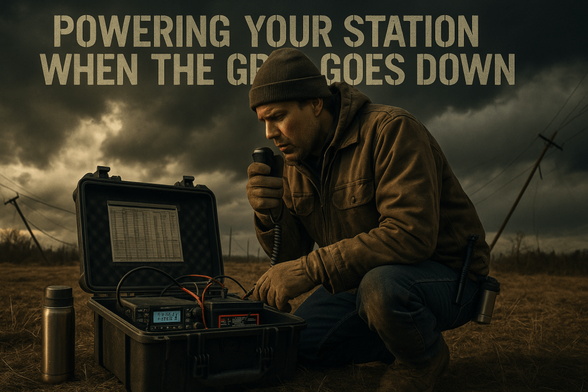
Powering Your Station When the Grid Goes Down — The Ham Operator’s Ultimate Backup Playbook

2,890 words, 15 minutes read time.

Let me ask you something.

What if, tomorrow, everything went dark?

No lights. No cell service. No internet. No sirens. Just silence — broken only by the wind, your own breathing, and maybe the distant sound of someone yelling for help.

Now imagine this: You flip a switch. A red LED glows to life. You key your mic. And within seconds, you’re talking to another human being 50 miles away — no grid, no infrastructure, just raw skill and gear that you made work.

That’s not fantasy. That’s amateur radio.

And the secret weapon? Power. Not just any power — your power. Controlled. Portable. Reliable. Independent.

This isn’t about getting licensed. Not yet. This is about building the mindset, the muscle memory, and the gear stack that will make you unstoppable when the world goes quiet. Because when you understand how to keep your station alive off-grid, you’re not just preparing for emergencies — you’re laying the foundation to pass your Technician exam without breaking a sweat.

I’ve been in this game for over two decades — from hurricanes on the Gulf Coast to blizzards in the Rockies. I’ve run stations off car batteries in ditches, solar panels strapped to pickup hoods, and generators humming through 3 a.m. ice storms. I’m not here to impress you with jargon. I’m here to show you how to be the guy who doesn’t panic — the guy who gets on air while everyone else is staring at dead phones.

So let’s get into it. Deep. Practical. No fluff.

Why Power Matters More Than You Think

You don’t need me to tell you the grid is fragile. One transformer blows in the wrong place, one cyberattack hits the wrong substation, one hurricane slams the wrong coastline — and suddenly, millions are cut off. Emergency services overwhelmed. Hospitals running on fumes. Families stranded without word.

In those moments, amateur radio operators become lifelines. We’re not heroes. We’re just guys with radios and the know-how to keep them running. But that know-how starts — and ends — with power.

Think about it: Your shiny new Yaesu or Icom is useless without juice. Doesn’t matter how good your antenna is. Doesn’t matter how clear your voice. Dead battery? Dead station.

The Federal Communications Commission doesn’t require you to have backup power to get licensed. But real-world experience screams otherwise. In Hurricane Maria, Puerto Rico lost 95% of its cell towers. Hams running low-power HF rigs off solar-charged batteries became the only link between isolated towns and relief agencies. Same story during the Texas deep freeze of 2021 — operators running QRP stations out of sheds and garages kept critical info flowing when nothing else could.

As KB6NU puts it in his no-nonsense guide: “If you can’t power your radio, you’re not an operator — you’re a spectator.”

This isn’t about hoarding gear or prepping for doomsday. It’s about self-reliance. About being the guy who shows up with solutions instead of questions. About knowing that when the lights go out, you’ve still got a voice — and the power to use it.

The Reality of Grid Failure (And Why You Should Care)

We like to think modern infrastructure is bulletproof. It’s not.

In 2003, a single software bug in Ohio triggered a cascade failure that blacked out 50 million people across the Northeast U.S. and Canada. In 2021, a ransomware attack crippled the Colonial Pipeline, causing gas shortages and panic buying across the Southeast. And in 2023, a geomagnetic storm knocked out HF propagation for hours — but also reminded us that nature doesn’t care about our schedules.

Grid failures aren’t rare. They’re inevitable.

And when they happen, three things die fast: cell towers, internet routers, and landlines. All three rely on commercial power — and most have only a few hours of battery backup. After that? Silence.

Amateur radio doesn’t play by those rules. Our frequencies don’t need corporate infrastructure. Our signals don’t route through data centers. All we need is a radio, an antenna, and — you guessed it — power.

I’ve spent more than a few long nights sitting beside snapped power lines after violent storms rolled through, rain drumming on my hood, boots sunk in mud, part of a CERT team trying to hold things together while the grid stayed dead. What sticks with me isn’t the wind or the wreckage — it’s how many people had nothing. No working flashlight. No spare batteries. Phones bricked by noon. Families huddled in basements with candles, hoping someone would tell them what was happening. Meanwhile, I had my Yaesu FT-1802 keyed up on 2 meters, fed by a homemade “Go Kit” I built myself — a 12v battery, fused leads, clean connectors, all packed in a small metal case that fit . That radio kept me locked in with storm spotters calling out weather conditions, and patched me straight through to the National Weather Service when sirens fell silent. No cell towers. No Wi-Fi. Just clear, calm comms cutting through the noise. While others waited for help, I stayed in the loop — not because I’m some hero, but because I bothered to build something that works when nothing else does.

That’s the difference between waiting for help and being part of the solution.

You don’t need to predict the next blackout. You just need to be ready for it. And that starts with understanding what your gear needs — and how to feed it when the plug’s been pulled.

Understanding Your Radio’s Appetite: Power Requirements 101

Let’s cut through the confusion. Radios don’t eat watts. They drink amps.

Volts? That’s the pressure. Amps? That’s the flow. Watts? That’s the total energy consumed — volts times amps. Simple math, but critical to get right.

Most mobile and handheld VHF/UHF rigs run on 12-14 volts DC — same as your car. Base stations? Often 13.8V regulated. HF rigs? Some draw 20 amps or more when transmitting at full power. QRP (low-power) rigs? As little as half an amp.

Here’s the rule of thumb I teach new guys:

If you’re running 100 watts output on HF, assume you’re pulling about 20-25 amps at 13.8V. That’s roughly 275-345 watts of DC input power. Efficiency losses, folks.

But don’t panic. You don’t need 100 watts to be effective. In fact, during emergencies, low power is often better — less drain, less heat, less attention from interference.

A 5-watt QRP rig? Might pull only 2 amps on transmit. That means a 20Ah battery could give you 10 hours of continuous TX time — and weeks of standby. Add receive-only listening? You’re golden.

Know your radio’s specs. Dig into the manual. Look for “current drain” under transmit and receive modes. Write it down. Tape it to your shack wall.

My Yaesu FT-7250D? Rock-solid workhorse. On receive, it sips just 0.8 amps — barely a whisper off the battery. Flip to transmit at full 50 watts, and it pulls about 11 amps at 13.8 volts. Not bad for a rig that’ll punch through storm static and reach repeaters 50 miles out. Now, if I’m running a heavy op — say, 50% of the time transmitting, 50% listening — my average current draw settles around 5.9 amps. Do the math: a 50Ah deep-cycle battery, respecting the 50% discharge rule to keep it healthy, gives me 25 usable amp-hours. Divide that by 5.9? Roughly 4.2 hours of hard, mixed-use operation. Stretch that to a more realistic 20% TX / 80% RX duty cycle — typical during spotter nets or NWS check-ins — and you’re looking at over 9 hours on a single charge. That’s not theory. That’s what kept me live through an all-night derecho event, calling in damage reports while everyone else’s phones went dark. Good to know before the sky breaks open.

Start small. Start simple. But start with numbers. Guesswork kills batteries — and missions.

Battery Basics: Your First Line of Defense

If you learn nothing else from this guide, learn this: Not all batteries are created equal. And no, you can’t just yank the one out of your ’98 Camry and call it good.

Car batteries? Designed for short, high-current bursts to turn over an engine. Not for slow, steady discharge over hours. Drain one below 50% a few times, and it’ll sulfate up and die. Fast.

What you want is a deep cycle battery. Built to be drained and recharged — repeatedly. Two main flavors: Flooded Lead-Acid (FLA) and Absorbed Glass Mat (AGM). Later, we’ll talk lithium — but for now, stick with lead.

FLA batteries are cheap. Heavy. Require maintenance — checking water levels, cleaning terminals, venting hydrogen gas. But they last. I’ve got one from 2008 still kicking.

AGM? Sealed. Maintenance-free. Can be mounted sideways. More expensive, but worth it for portable ops. Less risk of acid spills. Faster recharge. Better for cold weather.

Then there’s LiFePO4 — lithium iron phosphate. Lighter than lead. Holds charge longer. Handles deeper discharges. No memory effect. But costs 2-3x more. And requires a special charger. For serious operators? Absolutely worth it. For starters? Maybe overkill.

Capacity is measured in Amp-hours (Ah). A 20Ah battery can theoretically deliver 1 amp for 20 hours — or 20 amps for 1 hour. Reality? You’ll get less due to Peukert’s Law (the faster you drain, the less total capacity you get). So derate by 20% for safety.

Rule: Never drain a lead-acid below 50%. Lithium? You can go to 20% or lower — check manufacturer specs.

Maintenance tip: Always recharge immediately after use. Store fully charged. Keep terminals clean and tight. Use dielectric grease to prevent corrosion. Ventilate FLAs — hydrogen is no joke.

One more thing: Fuses. Put a fuse within 12 inches of your battery’s positive terminal. Seriously. A shorted cable can melt insulation, start fires, or weld tools to chassis. Seen it happen. Not pretty.

Solar Power: Silent, Renewable, and Manly Reliable

Solar isn’t magic. It’s physics. And it’s perfect for radio ops.

Panels convert sunlight to DC voltage. A charge controller regulates that voltage so you don’t fry your battery. And your battery stores the juice for when the sun dips below the trees.

Start small. A 20-watt panel costs less than $50. On a sunny day, it’ll push about 1.2 amps into a 12V system. That’s enough to trickle-charge a 20Ah battery in half a day — or keep a QRP station running indefinitely if you’re smart with usage.

Myth: “You need a roof covered in panels.” Nope. For emergency comms, you’re not powering a fridge or AC unit. You’re keeping a radio alive. Even 10 watts of solar can sustain a low-draw station if managed well.

Charge controllers matter. Don’t skip this. A PWM (Pulse Width Modulation) controller is fine for small setups. MPPT (Maximum Power Point Tracking)? More efficient — especially in low light or cold temps — but pricier. For under 100W, PWM works.

Mounting? Magnetic mounts for vehicles. Tripods for field ops. Roof brackets for permanent installs. Angle matters — face true south (in the Northern Hemisphere), tilt equal to your latitude for year-round average.

Pro tip: Pair your panel with a foldable briefcase-style unit. Toss it in your truck. Unfold it at camp. Angle it toward the sun. Done.

Solar won’t save you in a week-long blizzard. But for 90% of grid-down scenarios — storms, quakes, regional outages — it’s silent, reliable, and endlessly renewable. Plus, there’s something deeply satisfying about harvesting sunlight to send your voice across continents.

As Backwoods Home Magazine notes: “Solar-powered ham radio isn’t just practical — it’s poetic. You’re turning photons into phonemes.”

Generators, Inverters, and Other Options

Sometimes, batteries and solar aren’t enough. Maybe you’re running high power for hours. Maybe clouds won’t break. Maybe you’re supporting a group op with multiple stations.

Enter the generator.

Gasoline generators are loud, smelly, and thirsty — but they deliver. A 2000-watt inverter generator can run a 100W HF rig, a laptop, a small fridge, and charge batteries simultaneously. Honda EU2200i is the gold standard — quiet, fuel-efficient, reliable. Costs about $1,000 new. Worth every penny if you’re serious.

Diesel? More torque, better fuel economy, longer lifespan — but heavier and pricier. Propane? Cleaner burn, easier storage — but less energy per gallon.

Biggest mistake new guys make? Running a generator 24/7. Don’t. Charge your batteries during daylight, then shut it down. Run your station off batteries at night. Quieter. Safer. More fuel-efficient.

Inverters? These convert 12V DC to 120V AC. Useful if your radio or accessories need wall power. Pure sine wave inverters are best — modified sine can fry sensitive electronics. Size appropriately: Add up wattage of all devices, multiply by 1.5 for surge, pick an inverter that exceeds that.

Alternative ideas? Wind turbines — niche, noisy, inconsistent. Pedal generators — great for fitness, terrible for sustained power. Vehicle alternators — yes, you can charge a battery while driving, but don’t drain your starter battery. Use an isolator.

Bottom line: Generators are force multipliers. But they’re tools — not crutches. Master batteries and solar first. Then add gas when you need brute force.

Building Your Own Emergency Power Kit (Step-by-Step)

Let’s build something real.

Starter Kit (150–150–250):

  • 20Ah AGM battery (e.g., Mighty Max or Renogy)
  • 20W folding solar panel with built-in PWM controller
  • 10A inline fuse holder + 10A fuse
  • 12V cigarette lighter socket (for charging phones/lights)
  • Anderson Powerpole connectors (standard in ham radio)
  • 10ft 12AWG red/black cables with ring terminals
  • Battery box or rugged plastic case

Total weight: Under 20 lbs. Fits in a backpack. Deploy time: 5 minutes.

Mid-Tier Kit (400–400–700):

  • 50Ah LiFePO4 battery (e.g., EcoFlow River 2 or Dakota Lithium)
  • 100W briefcase solar panel with MPPT controller
  • 300W pure sine wave inverter
  • Digital voltmeter / battery monitor
  • Fuse block with 4 circuits
  • Heavy-duty case with wheels

Adds runtime, efficiency, and versatility. Can run laptops, LED lights, small CPAP machines. Still portable.

Pro Tier ($1,000+):

  • Dual 100Ah LiFePO4 batteries with automatic parallel switching
  • 400W solar array (portable or roof-mounted)
  • 2000W inverter generator (Honda or Champion)
  • Automatic transfer switch (grid → battery → generator)
  • Bluetooth battery monitor with smartphone app
  • EMP-shielded enclosure (optional, for extreme preppers)

This setup can run a full shack — transceiver, tuner, computer, lighting — for days. Redundant. Remote-monitored. Battle-ready.

Budget hacks? Hit hamfests. eBay. Craigslist. Old UPS batteries? Often still 80% capacity. Car jump starters with USB/12V outputs? Surprisingly useful for HTs and flashlights. Salvage solar garden lights? Wire ten together, and you’ve got a 5V charging bank.

Build it yourself. Learn every connection. Label everything. Practice assembly blindfolded. You’ll thank yourself later.

Safety First: Don’t Fry Yourself or Your Gear

Power is respect. Not fear — respect.

One slip with a wrench across battery terminals? Boom — 500 amps of arc flash. Seen a guy lose eyebrows that way. Not fun.

Always disconnect negative first. Reconnect negative last. Wear eye protection. Keep metal tools away from live terminals.

Fuses aren’t optional. They’re mandatory. Size them for your wire gauge and load. 10A fuse for 16AWG wire. 20A for 12AWG. 30A for 10AWG. Don’t guess.

Lithium batteries? Treat them like loaded guns. Puncture = fire. Overcharge = fire. Short circuit = fire. Use only matched cells, proper BMS (Battery Management System), and certified chargers.

Ventilation. Lead-acid batteries off-gas hydrogen when charging — explosive in confined spaces. Keep them in garages, sheds, or vented boxes. Never indoors unless sealed AGM.

Grounding. Even off-grid, ground your station. Lightning doesn’t care if you’re plugged into the wall. Drive an 8-ft copper rod. Bond your radio chassis, power supply, and antenna mast to it. Saves gear. Saves lives.

Quick pre-op checklist:

  • Terminals clean and tight?
  • Fuse installed and correct rating?
  • Polarity confirmed? (Red = positive. Always.)
  • Ventilation clear?
  • Fire extinguisher nearby? (Class C for electrical.)

Safety isn’t sexy. But neither is third-degree burns or melted transceivers.

Practice Like You Play: Drills and Dry Runs

Knowledge rusts without use.

Schedule a monthly “Blackout Saturday.” Unplug everything. Run your station off battery only. Time how long it takes to get on air. Track your battery voltage every 30 minutes. Note when performance drops.

Try different modes: SSB voice. CW. Digital FT8. See which gives you longest runtime.

Test range. Can you hit a repeater 30 miles away on 5 watts? Can you bounce an NVIS signal off the ionosphere to someone 200 miles north? Document it.

Involve your family. Make it a competition. Who can assemble the kit fastest? Who can copy the most morse code characters? Reward with steak dinner. Builds buy-in — and skills.

Field Day? Join it. Every June, thousands of hams set up temporary stations in parks, fields, rooftops — running entirely off-grid. Best training you’ll ever get. Find your local club. Show up. Ask questions. Bring beer.

Dry runs expose flaws. Maybe your solar panel doesn’t angle right. Maybe your cables are too short. Maybe your battery monitor lies. Fix it now — not at 2 a.m. during a flood.

As the Northwest Radio Association says: “The best emergency plan is the one you’ve practiced until it’s boring.”

Looking Ahead: This Prep Helps You Pass Your License Too

Here’s the beautiful part: Everything you’re learning now — batteries, solar, fuses, voltage, current — is straight out of the Technician exam pool.

Question T5C08: “What is the formula used to calculate electrical power in a DC circuit?”
Answer: Power (P) equals voltage (E) times current (I). P = E × I.

Question T6D06: “What component is commonly used to change 120V AC house current to a lower AC voltage for other uses?”
Answer: Transformer — but you’re using an inverter to go the other way. Same principles.

Question T0A07: “What is the safest way to recharge a lead-acid battery?”
Answer: Slow charge with a regulated charger — which you now know how to set up.

Studying power systems now means less memorization later. You’re not cramming facts — you’re building intuition. When you see “Ohm’s Law” on the test, you’ll picture your multimeter reading 13.8V across a 10A load. Real. Tangible. Yours.

Download KB6NU’s free Technician study guide. Take practice exams at HamRadioLicenseExam.com. You’ll fly through the power and safety sections — because you’ve lived them.

The license? It’s just paperwork. What you’re building now — competence, confidence, capability — that’s what makes a real ham.

D. Bryan King

Sources

Disclaimer:

The views and opinions expressed in this post are solely those of the author. The information provided is based on personal research, experience, and understanding of the subject matter at the time of writing. Readers should consult relevant experts or authorities for specific guidance related to their unique situations.

Related Posts

Rate this:

#12VRadioSystem #50WattMobileRig #50AhBatteryUse #AGMVsLithium #amateurRadioBatterySetup #AndersonPowerpole #antennaGrounding #ARESRACESTraining #ARRLPowerGuide #backupPowerForRadio #BackwoodsHomeSolar #batterySafetyHam #blackoutComms #BluetoothBatteryMonitor #CERTDeploymentRadio #CERTRadioCommunications #chargeControllerSetup #competenceBeforeLicense #deepCycleBatteryHam #DIYPowerKit #dryRunDrill #dutyCycleRadio #eHamBatteryTips #emergencyCommsPrep #emergencyDrillRadio #EMPShieldingRadio #familyHamPractice #fieldDayPower #FieldDayPrep #foldableSolarBriefcase #fuseBlockHam #fuseSizingWireGauge #generatorForHamRadio #groundingOffGridStation #HamRadioAcademy #hamRadioEmergencyPower #hamRadioGoKit #hamRadioRuntime #hamRadioRuntimeCalculator #hamRadioSolarPanel #hamRadioStarterPower #hamRadioWithoutLicense #hamfestsGear #hydrogenVentingBattery #inverterForRadio #K0PIRYouTube #KB6NUStudy #leadAcidMaintenance #LiFePO4RadioPower #lithiumBMS #lowPowerQRP #maleHamRadioAudience #menGettingHamLicense #NWRAPowerSystems #NWSRadioLink #offGridHamRadio #OffGridLifeHam #OhmSLawHamRadio #pedalPowerRadio #PeukertSLaw #polarityProtection #portableHamStation #powerCalculationHamRadio #powerMonitorHam #practicalHamSkills #prepperHamRadio #PrepperWebsiteRadio #pureSineWaveInverter #QRZPower #realWorldHamOps #receiveCurrentDraw #RigPixBatteries #selfReliantRadio #solarPowerHamRadio #stormResponseRadio #stormSpotterRadio #survivalComms #TechnicianExamPowerQuestions #transmitCurrentDraw #vehicleAlternatorCharging #VHFUHFEmergency #voltmeterShack #windTurbineHam #YaesuFT7250DPowerDraw