Today managed to move from a prototype that had #ClaudeCode produce some #smalltalk code with a test to having it one shot the first stab at a tool to explore the 'iterations' and 'stories' that result from working iteratively and incrementally with #ClaudeCode on #QwanTracker.

Things are now tracked as json, and if we have tools to navigate hierarchies, display numbers as charts etc, we can stop generating markdown. Saving time and tokens, while providing clarity.
#GlamorousToolkit

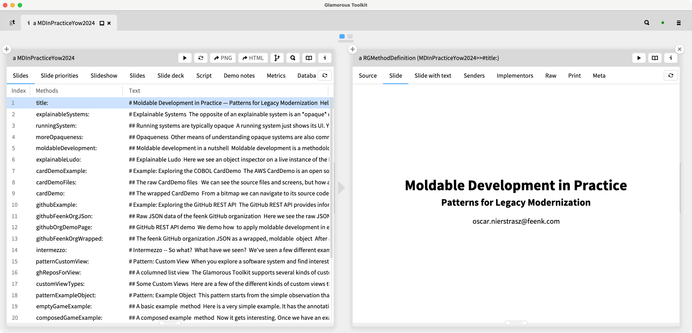
Moldable development can be applied to any development task. I author a “slideshow” using a moldable object inspector on the live slides, augmented with tiny custom tools. I'll be presenting this one on “Moldable Development in Practice” at Yow! Australia in Melbourne, Brisbane and Sydney this December.
#glamorousToolkit #moldableDevelopment

Experimenting with #GlamorousToolkit (AKA #pharo with more bling). Slowly getting the hang of things by exploring the interactive examples, inspecting things, fixing code, creating new methods, etc. Then I come across a seemingly innocent example of #smalltalk message syntax using basic arithmetic:

3 factorial raisedTo: 2 squared; squared

I expect it to return a huge number, but instead it's 36. Eventually it dawns upon me that I may have an integer overflow, so I spend around 10 minutes working around it, eventually manage to figure out how to promote the intermediate result to a LargeInteger, evaluate it and the IDE locks up and is killed by an OoM error...

Never expected to miss #scheme and its numeric tower after being handed everything else it lacks on a silver platter, but here we go 

GlamorousToolkit and Pharo are incredible. I've been hacking together a simple DSL for synths (for constructing CSound/SuperCollider synths in Pharo/Smalltalk), and it's taken me around an hour to prototype something surprisingly sophisticated.

#Pharo #GlamorousToolkit

“Embracing Software Variability to build Explainable Systems” is an invited talk at #VAMOS2024, in which I show how moldable tools are dynamically extended with numerous context-specific features (custom tools) during the development process, using a moldable IDE such as #GlamorousToolkit, to create software systems that are explainable.

https://youtu.be/KsAq25yT-CU

Embracing Software Variability to build Explainable Systems

YouTube

@draft13 In my opinion, as a long-time #smalltalk programmer and fan, it's still one of the most productive environments. #pharo continues to innovate, and #GlamorousToolkit pushes the envelope even further.

Learning any new programming language is a chance to see things differently. Learn Smalltalk and you may never look back.

Learning: Moldable Development

@wilfredh #GlamorousToolkit (https://gtoolkit.com/) introduces "examples" that take the place of tests. The main difference is that they return results, and thus call each other. Results are also inspectable, which is often very valuable.
Glamorous Toolkit

Glamorous Toolkit is the Moldable Development Environment.

Glamorous Toolkit
@qualmist Interesting perspective. If I understand it correctly, some #Smalltalk systems fulfill your criteria for liveness + richness + composability. The one I use, #GlamorousToolkit (https://gtoolkit.com/), is probably the most advanced one in this respect.
Glamorous Toolkit

Glamorous Toolkit is the Moldable Development Environment.

Glamorous Toolkit

Honorable mention: #GlamorousToolkit, which is not a browser development toolset, but it gets the basic idea right for its domain. It uses Miller columns to let you drill down in an object graph and switch between multiple viewers—plus create your custom viewers on-the-fly.

Every debugger should ship with this kind of tightly integrated inspector framework to let probe whatever you want that's in scope like this when stopped at a breakpoint.

<https://gtoolkit.com/>

Glamorous Toolkit

Glamorous Toolkit is the Moldable Development Environment.

Glamorous Toolkit