Integrals of inverse functions!
Proof without words (see image; credit: Jonathan Steinbuch, CC BY-SA 3.0, via Wikimedia Commons)...
For any montonic and invertible function \(f(x)\) in the interval \([a,b]\):
\[\displaystyle\int_a^bf(x)~ \mathrm dx+\int_{f(a)=c}^{f(b)=d}f^{-1}(x)~\mathrm dx=b\cdot f(b)-a\cdot f(a)=bd-ac\]
If \(F\) is an antiderivative of \(f\), then the antiderivatives of \(f^{-1}\) are:
\[\boxed{\displaystyle\int f^{-1}(y)~\mathrm dy=yf^{-1}(y)-F\circ f^{-1}(y)+C}\]
where \(C\) is an arbitrary constant (of integration), and \(\circ\) is the composition operator (function composition).
For example:
\[\begin{align*}\displaystyle\int \sin^{-1}(y) \, \mathrm dy &= y\sin^{-1}(y) - (-\cos(\sin^{-1}(y)))+C\\ &=y\sin^{-1}(y)+\sqrt{1-y^2}+C\end{align*}\]
\[\displaystyle\int \ln(y) \, dy = y\ln(y)-\exp(\ln(y)) + C= y\ln(y)-y + C.\]
#Function #InverseFunction #InverseFunctions #Functions #Integral #Integrals #Antiderivative #Integration #Calculus #FunctionComposition #CompositeFunction)
 Python Peak
 Pustam | पुस्तम | পুস্তম🇳🇵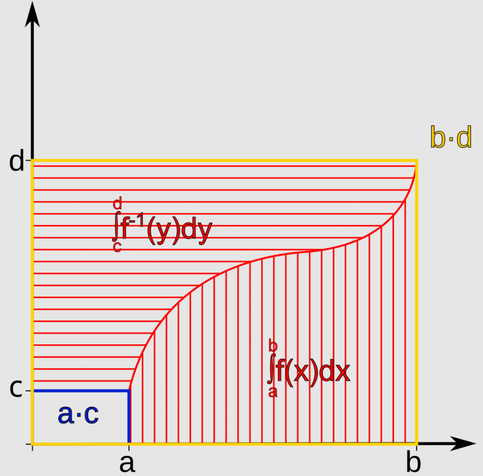
 Clément Boudereau🦀