#FindsFriday #Celtic: `Architectural remains of farms and rural dwellings, although incomplete, demonstrate the wide variety of these establishments. This is particularly evident in the size of their enclosing ditches. While the structures appear comparable at first glance, this superficial similarity conceals their differing functions, and a complex social hierarchy. Smaller farms often survived for only one or two generations while, at the other end of the scale, more extensive establishments which could almost be described as ranches, grew ever larger over time, with some developing into imposing rural fortresses.`
Source: Centre d'interprétation Alesia
#FindsFriday #Celtic: `In rural sites it is extremely rare to find large numbers of coins, but occasionally hoarded collections are discovered. Where did this money come from? In his writings, Caesar mentions particularly wealthy local aristocrats collecting customs duties from merchants. It is possible that some of the hoards discovered are revenue from tax collectors who made money not simply from agriculture.
Source: Centre d'interprétation Alesia
#FindsFriday #Celtic: `Typical of the farms of the second century BC, La Voie Neuve farm was located on a low rise on the Seine's alluvial plain, close to the Seine's confluence with the Yonne. The farm was defined by a ditch, reinforced by banks, which enclosed a trapezoid-shaped area of approximately 75 by 54m.`
Source: Centre d'interprétation Alesia
#FindsFriday #Celtic: `Iron age structures consisted of wooden frames and wattle and daub walls. As the wood rotted and disappeared over time, there are few clues to help with reconstruction.
Several stages were involved in the establishment of an iron age farm. First, a ditch would be dug out, to surround the buildings. Next, post-holes for the buildings would be bedded in foundation trenches, fences would be erected using stakes driven into the ground and silos would be dug out for the storage of crops. When ditches, foundations, post-holes and stake holes were filled in, the earth used would be mixed with darker plant material and debris.
This differently coloured earth can reveal human intervention which is absent in the surrounding area. Details of historic land use can be discovered by mapping and excavating these darker patches of soil, and by studying whether they are far apart or closely spaced, deep or shallow. Finding these negative prints left behind on the ground allows us to identify Gallic farms.`
Source: Centre d'interprétation Alesia
Kathleen Kenyon was a trailblazer and the archaeologist excavating Jewry Wall. Now her notebook has ended up as an object in the exhibition at Jewry Wall. Every archaeologist needs a good notebook! The golden ring was identified by her as an important find. #FindsFriday
#FindsFriday #Celtic: `Fibulae were indispensable accessories in antiquity for fastening garments. They exist in various sizes and shapes. A group of small fibulae (nos. 1 to 4) in the shape of animals probably comes from the same workshop. They are made of tinned bronze, giving them a silvery appearance. The recesses are inlaid with niello. Niello is a black substance that can be used to highlight decorations. Fibulae nos. 5 and 6 appear more colorful because the recesses in the bronze were enamelled.`
Source: Centre d'interprétation Alesia
#FindsFriday #Celtic: `It is uncertain whether the approximately life-size bird figure on top of the helmet of Ciumeşti in Romania is a raven or another bird. This remarkable helmet has a parallel in a depiction on the Gundestrup cauldron found in Denmark. On the so-called inner plate E, on the left is a large figure that seems to dip a small figure into a cauldron. The rest of the plate is divided in two: below is a procession of foot soldiers marching towards the large figure, above four mounted warriors moving away from the large figure. The foremost of these four mounted warriors wears a helmet with a bird figure mounted on it. Equally interesting in this context, although no longer seen in connection with a helmet with bird appliqué, is the so-called outer plate f. It apparently shows a goddess with a bird in her right hand and two birds of prey on each side of her head (cf. Hatt 1980; Nielsen et al. 2005; Kaul/Mertens 1995). `
Source: Anna und Fritz Preinfalk, Eine latènezeitliche Grube mit Dohlenknochen aus Haselbach, Gem. Perschling. In: P. C. Ramsl, K. Rebay-Salisbury, P. Trebsche (Hrsg.); Schichtengeschichten.
Universitätsforschungen zur Prähistorischen Archäologie 328, Bonn 2019, 205 - 225.
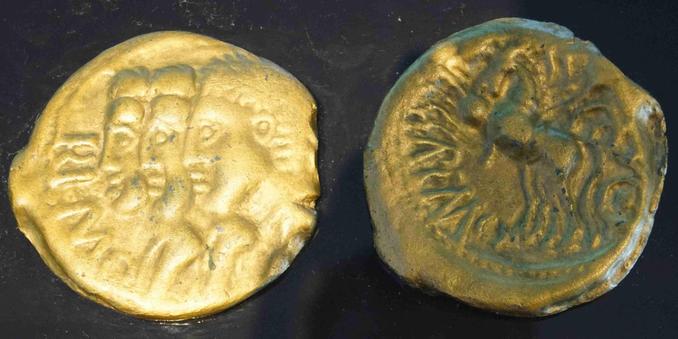
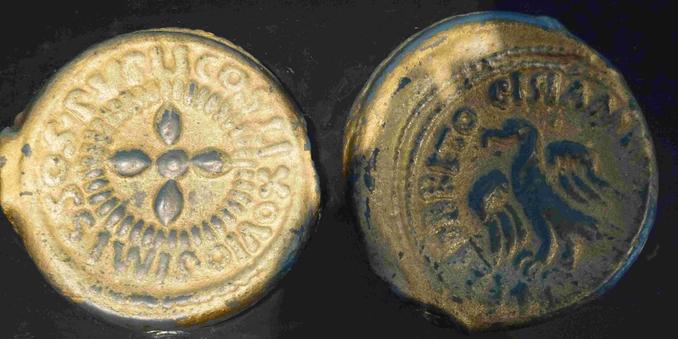
#FindsFriday: `#Celtic coins provide excellent iconographic documentation relating to the second Iron Age. This paper reports research made for a PhD thesis which, through iconography, archaeology and texts, studied images on coins and their evolution over nearly three centuries in East Central Gaul. Coin imagery informs us about the thought and the codes used by the elites, how they represented themselves in society and the way they perceived themselves. It also reveals the importance of coinage to anthropological study.`
Source: https://journals.openedition.org/rae/7612?lang=en
#FindsFriday: Truth or propaganda? The helmet is #Celtic!
1/9
#FindsFriday: Truth or propaganda? The helmet is #Celtic!
"When here the Romans stood quietly at their posts, a Gaul stepped forward, distinguished by his size and armor, and when he had called for silence by striking his shield, he called through an interpreter one of the Romans to fight with him. Marcus Valerius, then a high-ranking military office, a young man who trusted himself to be as worthy of such honor as Titus Manlius, first obtained the consul's consent and then stepped armed into the middle. The less conspicuous fight of the two men was glorified by an intervening decree of the gods. Suddenly a raven settled on the helmet of the already attacking Roman, turned against the enemy. The tribune joyfully took this immediately for a sign sent from heaven and commended himself in prayer to the gracious protection of the god or goddess who had sent him the winged messenger of luck. Wonderful! The bird did not remain alone on the once taken place, but with every course of the fight he rose with his wings and drove with beak and claws into the enemy's face and eyes, until this one, frightened by the sight of such a monster and hardly still master of his eyes and senses, was stabbed by Valerius. The raven, vanishing from sight, flew away towards morning." (quoted after: Livy VII, 26). The story of Valerius Corv(in)us is one of the best-known and most famous Roman legends. Not only in Livy, but also in other preserved text fragments this narrative is found. Andreas Hofeneder, however, sees the report as unhistorical, especially regarding the appearance of the raven, and sees in it merely an etymological name explanation of the cognomen of the Corvi branch of the Valerians (Hofeneder 2013/14, 5).`
Source: Anna und Fritz Preinfalk, Eine latènezeitliche Grube mit Dohlenknochen aus Haselbach, Gem. Perschling. In: P. C. Ramsl, K. Rebay-Salisbury, P. Trebsche (Hrsg.); Schichtengeschichten.
Universitätsforschungen zur Prähistorischen Archäologie 328, Bonn 2019, 205 - 225.