#DMIDK:
1.4 km out at 5100 ft - heading SW with 247.0 km/h.
https://globe.adsbexchange.com/?icao=3FFC3A
7000 β€’ 12:01:39
#GWT #EDXW #adsb
#DMIDK:
17.7 km out at 4000 ft - heading S with 247.0 km/h.
https://globe.adsbexchange.com/?icao=3FFC3A
7000 β€’ 10:43:03
#GWT #EDXW #adsb
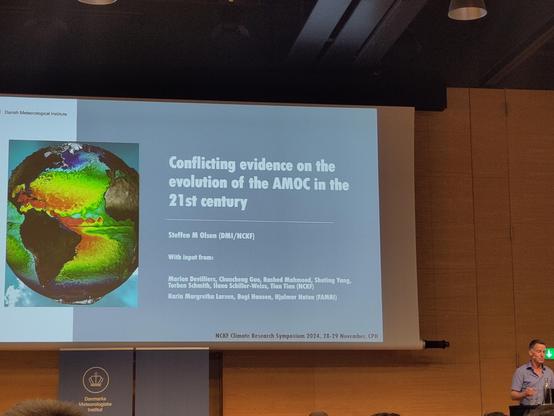
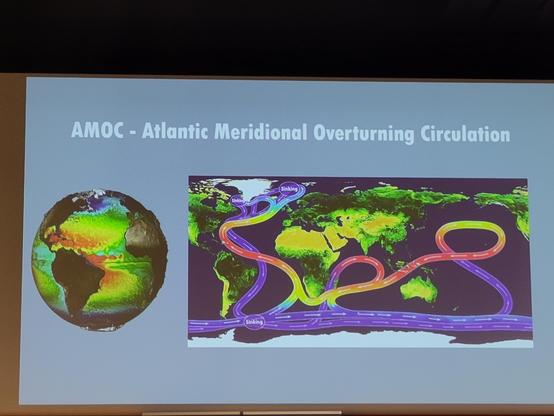
My ace #DMIdk colleague Steffen Malskjær Olsen opening day 2 of the #NCKFSymposium with a balanced look at the future of the #AMOC under #ClimateChange
Looking forward to welcoming the @OceanIceEU community to #DMIdk today for our annual meeting. I think I'm correct in saying it's the first time we have had such a large gathering of #Antarctic focused #Science here at the institute, though I doubt it will be the last
#SeaLevelRise #Ocean #IceSheet
Looking forward to welcoming the @oceaniceEU community to #DMIdk today for our annual meeting. I think I'm correct in saying it's the first time we have had such a large gathering of #Antarctic focused #Science here at the institute, though I doubt it will be the last #SeaLevelRise #Ocean #IceSheet
My #DMIdk colleague Kjeld Qvistgaard of the #Ice service talking on stage at #EPSW24 on the importance of high quality accessible products. People don't actually care I'd you use #AI to make the ice charts or not, as long as they get easy access to high quality information!
1/2
πŸ’¨ Hvis man er interesseret i vejr og vind, er det her meget cool.
https://www.windy.com/
#vejret #dmidk
Professional weather forecast

50+ weather layers, weather radar and satellite

Windy.com/

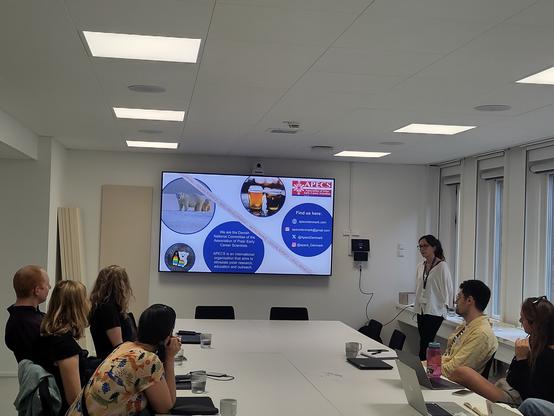
Kicking off European polar science week with a fringe event at DMI in collaboration with the APECS organization of #ECRs on how to write proposals...

#NCKF #DMIdk #APECS

An unforecast rain storm, not even in the nowcast suddenly starts right over DMI's building, leading to murmurings in the #DMIdk research dept....

Beautiful example of convective shower and how difficult they are to forecast. And how annoying when you use the radar to plan your commute #Wx

Proud to say that we have a paper out in #TC about the 2016 #Melt event over the Ros ice shelf #Antarctica we have evaluated how well models capture this extreme melt event.
Read it here https://doi.org/10.5194/tc-18-2897-2024
#DMIdk @Ruth_Mottram
The importance of cloud properties when assessing surface melting in an offline-coupled firn model over Ross Ice shelf, West Antarctica

Abstract. The Ross Ice Shelf, West Antarctica, experienced an extensive melt event in January 2016. We examine the representation of this event by the HIRHAM5 and MetUM high-resolution regional atmospheric models, as well as a sophisticated offline-coupled firn model forced with their outputs. The model results are compared with satellite-based estimates of melt days. The firn model estimates of the number of melt days are in good agreement with the observations over the eastern and central sectors of the ice shelf, while the HIRHAM5 and MetUM estimates based on their own surface schemes are considerably underestimated, possibly due to deficiencies in these schemes and an absence of spin-up. However, the firn model simulates sustained melting over the western sector of the ice shelf, in disagreement with the observations that show this region as being a melt-free area. This is attributed to deficiencies in the HIRHAM5 and MetUM output and particularly a likely overestimation of night-time net surface radiative flux. This occurs in response to an increase in night-time downwelling longwave flux from around 180–200 to 280 W mβˆ’2 over the course of a few days, leading to an excessive amount of energy at the surface available for melt. Satellite-based observations show that this change coincides with a transition from clear-sky to cloudy conditions, with clouds containing both liquid water and ice water. The models capture the initial clear-sky conditions but seemingly struggle to correctly represent cloud properties associated with the cloudy conditions, which we suggest is responsible for the radiative flux errors.