
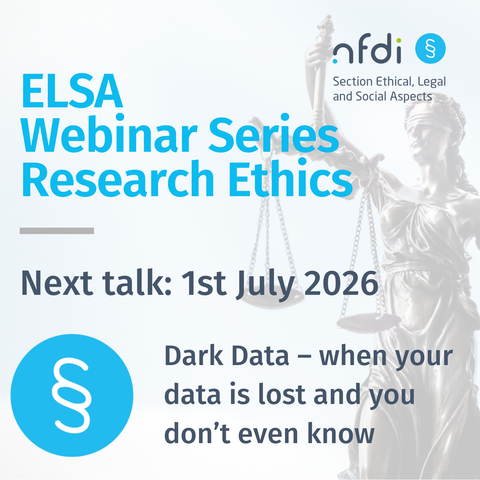
Our last talk of the ELSA Webinar Series on Research Ethics before the summer break is coming up. ⚖️ 📣

Dr.-Ing. Björn Schembera, Universität Stuttgart, will present “Dark Data – when your data is lost and you don’t even know” on Wednesday, 1st July from 16:00 to 17:00 h.

➡️ No registration is required: https://www.nfdi.de/section-elsa/webinar-series-research-ethics/?lang=en
#rdm #fdm #researchdata #darkdata

"Because the supply chain is opaque... [companies] are unlikely to know the precise origins of the lead they use," writes Peter S Goodman, Will Fitzgibbon and Samuel Granados in @newyorktimes https://www.nytimes.com/interactive/2025/11/18/world/africa/lead-poisoning-car-battery.html #darkdata
The Auto Industry’s Lead Recycling Program is Poisoning People

We documented the toxic fallout of a green technology.

The New York Times
🔍 Did you know there's a hidden digital world lurking in plain sight? Enter #darkdata - the vast amount of unused digital info silently consuming storage and resources. From old emails to forgotten IoT sensor logs, up to 90% of org data never sees the light of day. 📈 This silent digital mountain isn't just a storage issue - it's a security risk 🚨 and environmental challenge 🌍 (1/3)
"Many organisms important to human health... haven't even been named, let alone studied," reports Ewen Callaway in @nature.com, citing Nicola Segata at University of Trento https://www.nature.com/articles/d41586-025-00038-x #darkdata
These are the 20 most-studied bacteria — the majority have been ignored

Model microbes such as Escherichia coli hog scientists’ attention, leaving most known bacteria with few publications devoted to them.

Q: What is #DarkData about? A: See: (without inference & reasoning). #Nanotation #LinkedData #SemanticWeb #BigData
Q: What is #DarkData about? A: See: (owl:sameAs reasoning & inference invoked). #LinkedData #SemanticWeb #SmartData
Current climate data "don’t reflect recent changes such as newer pollution controls, volcanic eruptions or even the effects of Covid," writes @climateofgavin and @hausfath in @newyorktimes https://www.nytimes.com/2024/11/13/opinion/climate-change-heat-planet.html #darkdata
Opinion | Climate Science Can’t Keep Up With the Warming Planet

We need more timely updates in response to the rapid changes to the climate.

The New York Times
Data on items transiting US ports is ostensibly public, but "it's not free, and it's unusable in the format that it comes in," according to Michael Kanko at ImportGenius, interviewed by Amanda Aronczyk on Planet Money https://www.npr.org/2024/10/11/1210938268 #darkdata
"Hidden debts accumulate when economies are booming, and are more likely to be exposed when growth slows," reports the Economist, citing the World Bank, the University of Duisburg-Essen and the University of Notre Dame https://www.economist.com/finance-and-economics/2024/10/03/a-tonne-of-public-debt-is-never-made-public #darkdata
A tonne of public debt is never made public

New research suggests governments routinely hide their borrowing

The Economist
"We cannot calculate with missing data, just as we can't divide by zero,” says Stef van Buuren and reported by Matt von Hippel in @quantarss https://www.quantamagazine.org/when-data-is-missing-scientists-guess-then-guess-again-20241002 #darkdata
When Data Is Missing, Scientists Guess. Then Guess Again. | Quanta Magazine

Across the social and biological sciences, statisticians use a technique that leverages randomness to deal with the unknown.

Quanta Magazine