Weekly Update from the Open Journal of Astrophysics – 02/05/2026

Here we are, on schedule, with another update of activity at the Open Journal of Astrophysics. Since the last update we have published a further seven papers, bringing the number in Volume 9 (2026) to 94 and the total so far published by OJAp up to 542. I checked the corresponding update for last year (on 3rd May 2025), and we’ve had an increase from 54 to 94 in papers published (about 74%) between the first four months of 2025 and the first four months of 2026.

I will continue to include the posts made on our Mastodon account (on Fediscience) to encourage you to visit it. Mastodon is a really excellent service, and a more than adequate replacement for X/Twitter (which nobody should be using); these announcements also show the DOI for each paper.

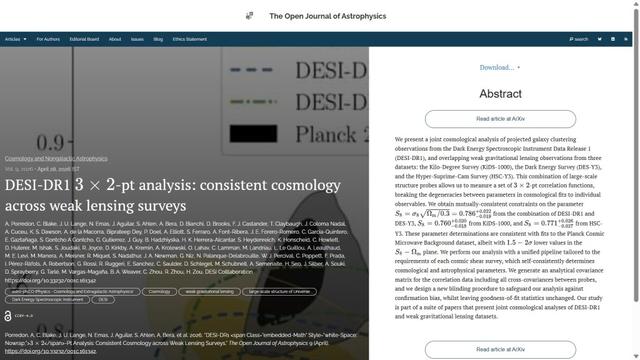
The first paper to report this week is “DESI-DR1 3 × 2-pt analysis: consistent cosmology across weak lensing surveys” by Anna Porredon (CIEMAT, Madrid, Spain) and 72 others (DESI Colllaboration). This paper was published on Tuesday 28th April in the folder Cosmology and Nongalactic Astrophysics. This paper presents a joint cosmological analysis of galaxy clustering and gravitational lensing observations, providing consistent constraints on cosmological parameters. The analysis also introduces a new blinding procedure to prevent confirmation bias. See this post for news of an important DESI milestone.

The overlay for this paper is here

You can find the officially accepted version on arXiv here and the announcement on Fediverse here:

https://fediscience.org/@OJ_Astro/116480407578621011

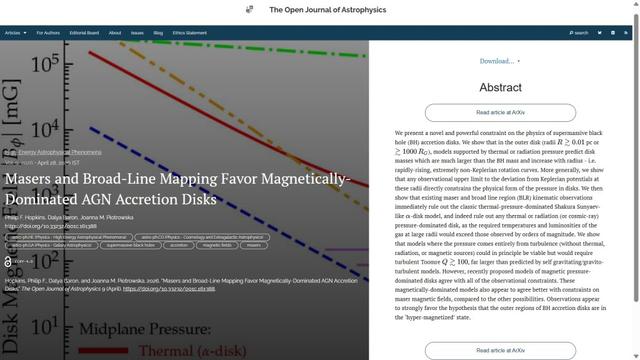
The second paper for this week, also published on Tuesday 28th April but in the folder High-Energy Astrophysical Phenomena is “Masers and Broad-Line Mapping Favor Magnetically-Dominated AGN Accretion Disks” by Philip F. Hopkins (Caltech, USA), Dalya Baron (Stanford U., USA) and Joanna M. Piotrowska (Caltech). This one presents a new constraint on supermassive black hole accretion disks physics, suggesting that outer regions are likely in a ‘hyper-magnetized’ state, as thermal or radiation pressure models appear inconsistent.

The overlay for this one is here:

The official version of the paper can be found on arXiv here and the Fediverse announcement here:

https://fediscience.org/@OJ_Astro/116480505354195181

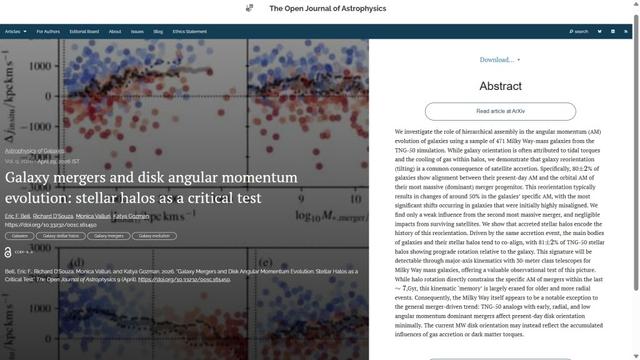
Next one up, the third paper of the week, is “Galaxy mergers and disk angular momentum evolution: stellar halos as a critical test” by Eric F. Bell (U. Michigan, Ann Arbor, USA), Richard D’Souza (Vatican Observatory), Monica Valluri & Katya Gozman (U. Michigan). This was published on Wednesday 29th April in the folder Astrophysics of Galaxies. The paper argues that satellite accretion impacts the angular momentum evolution of galaxies, often causing significant reorientation. This process is detectable in Milky Way-mass galaxies so the idea is testable observationally.

The overlay for this one is here:

The final, accepted version can be found on arXiv here and the Mastodon announcement is here:

https://fediscience.org/@OJ_Astro/116486649450860283

The fourth paper this week, published on Thursday April 30th, is “Time-Dilation Methods for Extreme Multiscale Timestepping Problems” by Philip F. Hopkins and Elias R. Most (Caltech, USA). This paper is in the folder Instrumentation and Methods for Astrophysics: it presents a new method for astrophysical simulations that modulates time evolution with a variable dilation/stretch factor, improving efficiency and accuracy in modeling processes across different scales.

The overlay is here:

The finally accepted version of this paper can be found here and the Mastodon announcement follows:

https://fediscience.org/@OJ_Astro/116492226856595031

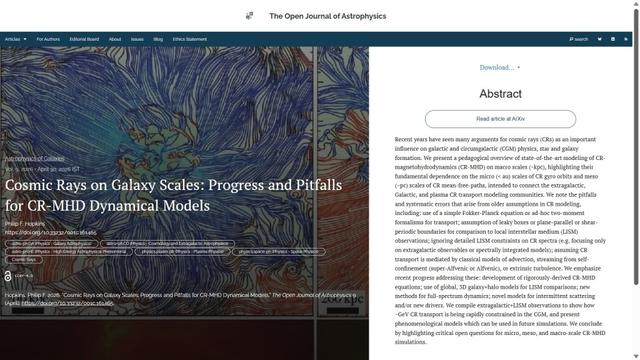
The fifth article of this week was also published on Thursday 30th April, but in the folder Astrophysics of Galaxies. The title is “Cosmic Rays on Galaxy Scales: Progress and Pitfalls for CR-MHD Dynamical Models” and the author is Philip F. Hopkins (Caltech, USA) who has three papers featured this week. The paper presents an overview of cosmic ray (CR) modeling, highlighting its influence on galactic physics and star formation. It addresses previous modeling errors and presents new methods for full-spectrum dynamics.

The overlay is here:

You can find the authorized version of this paper on arXiv here and the Fediverse announcement is here:

https://fediscience.org/@OJ_Astro/116492282488422075

The sixth paper of the week is “Baryonification III: An accurate analytical model for the dispersion measure probability density function of fast radio bursts” by MohammadReza Torkamani (Universität Bonn, Germany) and 8 others based in Germany, Switzerland, UK and Sweden. This article was also published on Thursday April 30th in the folder Cosmology and Nongalactic Astrophysics. It presents a framework for predicting dispersion measures of fast radio bursts using the baryonification model, providing a cost-effective alternative to hydrodynamical simulations. The model’s accuracy is validated through full numerical simulations. The overlay is here:

You can find the officially-accepted version on arXiv here and the Mastodon announcement here:

https://fediscience.org/@OJ_Astro/116492403170125062

Seventh and finally for this week we have “The stellar and dark matter distributions in early-type galaxies measured by stacked weak gravitational lensing” by Momoka Fujikawa and Masamune Oguri (Chiba University, Japan). This study uses weak gravitational lensing to investigate stellar mass and dark matter density in red galaxies, suggesting a stronger feedback effect than current simulations predict. This was published on Friday 1st May 2026 in the folder Astrophysics of Galaxies. The overlay is here:

You can find the officially-accepted version on arXiv here and the Fediverse announcement is here:

https://fediscience.org/@OJ_Astro/116497987401632687

And that concludes this week’s update. I’ll do another one at the end of next week. Will Vol. 9 have reached a hundred by then?

P.S. Just a reminder that, thanks to the efforts of a member of our Editorial Board, the Open Journal of Astrophysics now has a Wikipedia page.

#32PtAnalysis #ActiveGalacticNuclei #AGN #arXiv250907104v2 #arXiv251009756v2 #arXiv251209342v2 #arXiv251215960v3 #arXiv260106253v2 #arXiv260118784v2 #arXiv260424965v1 #AstrophysicsOfGalaxies #baryonification #ComputationalAstrophysics #cosmicRays #CosmologyAndNonGalacticAstrophysics #DarkEnergySpectroscopicInstrument #DESI #DiamondOpenAccess #DiamondOpenAccessPublishing #DispersionMeasures #fastRadioBursts #galacticCosmicRays #galaxyEvolution #galaxyFormation #galaxyMergers #HighEnergyAstrophysicalPhenomena #InstrumentationAndMethodsForAstrophysics #magnetohydrodynamics #masers #MilkyWay #OpenAccess #OpenAccessPublishing #SolarAndStellarAstrophysics #SolarCorona #supermassiveBlackHoles #VeraCRubinObservatory #weakGravitationalLensing #wikipedia
Weekly Update from the Open Journal of Astrophysics – 18/04/2026

It is Saturday morning, and therefore time for yet another update of activity at the Open Journal of Astrophysics. Since the last update we have published a further six papers, bringing the number in Volume 9 (2026) to 82 and the total so far published by OJAp up to 530.

I will continue to include the posts made on our Mastodon account (on Fediscience) to encourage you to visit it. Mastodon is a really excellent service, and a more than adequate replacement for X/Twitter (which nobody should be using); these announcements also show the DOI for each paper.

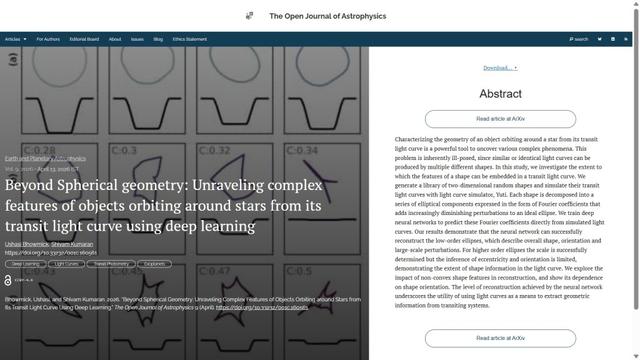
The first paper to report this week is “Beyond Spherical geometry: Unraveling complex features of objects orbiting around stars from its transit light curve using deep learning” by Ushasi Bhowmick & Shivam Kumaran (Indian Space Research Institute, Ahmedabad, India). This study uses deep neural networks to predict the shape of objects orbiting stars based on their transit light curves, demonstrating the potential to extract geometric information from these systems. It was published on Monday 13th April in the folder Earth and Planetary Astrophysics and the overlay can be seen here:

You can find the officially accepted version on arXiv here and the announcement on Fediverse here:

https://fediscience.org/@OJ_Astro/116395992732332356

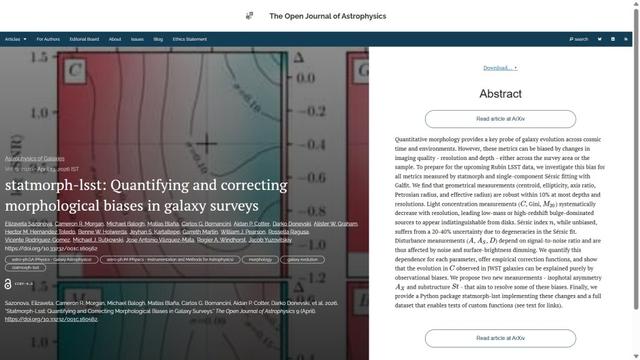
The second paper for this week, also published on Monday 13th April but in the folder Astrophysics of Galaxies, is “statmorph-lsst: Quantifying and correcting morphological biases in galaxy surveys” by Elizaveta Sazonova (U. Waterloo, Canada) and an international cast of 18 others. This paper presents an investigation of potential biases in quantitative morphology metrics used in galaxy evolution studies, proposing two new measurements to resolve biases, and provides a related Python package (statmorph-lsst), which can be found here on github.

The overlay for this one is here:

The official version of the paper can be found on arXiv here and the Fediverse announcement here:

https://fediscience.org/@OJ_Astro/116396069424189312

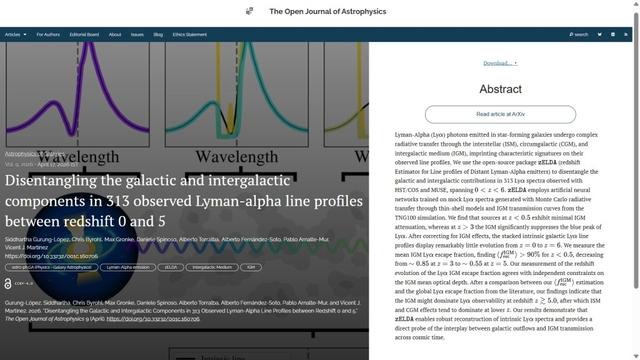
Next one up, the third paper of the week, one of four published on Friday 17th April, is “Disentangling the galactic and intergalactic components in 313 observed Lyman-alpha line profiles between redshift 0 and 5” by Siddhartha Gurung-López (Universitat de València, Spain) and 7 others based in Spain and Germany. Published in the folder Astrophysics of Galaxies, this paper uses the zELDA package to analyze Lyman-alpha photons from star-forming galaxies, revealing IGM effects dominate Lyman-alpha observability at high redshifts, while galactic outflows become more important at lower z.

The overlay for this one is here:

The final, accepted version can be found on arXiv here and the Mastodon announcement is here:

https://fediscience.org/@OJ_Astro/116418831864134501

The fourth paper this week, also published on Friday 17th April is “Using Symbolic Regression to Emulate the Radial Fourier Transform of the Sérsic Profile for Fast, Accurate and Differentiable Galaxy Profile Fitting” by Tim B. Miller (Northwestern University, USA) and Imad Pasha (Yale University, USA). This one is published in the folder Instrumentation and Methods for Astrophysics: it develops an emulator for galaxy profile fitting in Fourier space, improving speed by 2.5 times with minimal accuracy loss, aiding in managing increasing data flow.

The overlay is here:

The finally accepted version of this paper can be found here and the Mastodon announcement follows:

https://fediscience.org/@OJ_Astro/116418855010158656

The fifth paper for this week is “The THESAN project: Lyman-alpha emitters as probes of ionized bubble sizes” by Meredith Neyer (MIT, USA) and 6 others based in the USA, Colombia, Canada, Japan and UK. The study uses THESAN simulations to explore how Lyman-alpha emitters (LAEs) trace ionized bubble sizes during the Epoch of Reionization, providing a framework for interpreting LAE surveys. This was published on Friday 17th April in the folder Astrophysics of Galaxies.

The overlay for this one is here:

You can find the authorized version of this paper on arXiv here and the Fediverse announcement is here:

https://fediscience.org/@OJ_Astro/116418887225003954

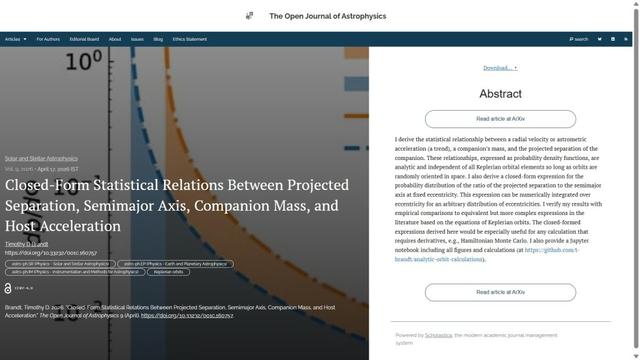
The sixth and final paper for this week is “Closed-Form Statistical Relations Between Projected Separation, Semimajor Axis, Companion Mass, and Host Acceleration” by Timothy D Brandt (Space Telescope Science Institute, USA). This was published on Friday 17th April in the folder Solar and Stellar Astrophysics. In this paper the author derives statistical relationships between radial velocity, a companion’s mass, and projected separation, useful for calculations requiring derivatives. The results are verified with empirical comparisons to existing literature.

The overlay for this one is here:

You can find the officially-accepted version on arXiv here and the Mastodon announcement here:

https://fediscience.org/@OJ_Astro/116418938017199814

And that concludes this week’s update. I’ll do another one at the end of next week.

P.S. Just a reminder, for those of you into LinkedIn, that we now have a page there.

#arXiv250303824v4 #arXiv250820266v2 #arXiv250914875v2 #arXiv251018946v2 #arXiv251109644v2 #arXiv260114688v2 #AstrophysicsOfGalaxies #binaryStars #ComputationalAstrophysics #CosmologyAndNonGalacticAstrophysics #DiamondOpenAccess #DiamondOpenAccessPublishing #EarthAndPlanetaryAstrophysics #EpochOfReionization #galaxyFormation #GalaxyMorphology #galaxyProfiles #InstrumentationAndMethodsForAstrophysics #IntergalacticMedium #Ionization #LAEs #lightCurves #LSST #LymanAlphaEmitters #OpenAccess #OpenAccessPublishing #Orbits #SérsicProfile #SolarAndStellarAstrophysics #statmorphLsst #stellarHalos #strongGravitationalLensing #THESAN #zELDA

Weekly Update from the Open Journal of Astrophysics – 11/04/2026

With permission, I have time for yet another Saturday morning update of activity at the Open Journal of Astrophysics. Since the last update we have published a further five papers, bringing the number in Volume 9 (2026) to 76 and the total so far published by OJAp up to 524.

I will continue to include the posts made on our Mastodon account (on Fediscience) to encourage you to visit it. Mastodon is a really excellent service, and a more than adequate replacement for X/Twitter (which nobody should be using); these announcements also show the DOI for each paper.

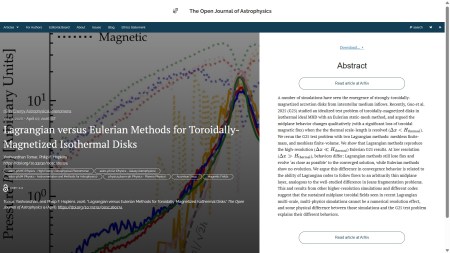
The first paper to report this week is “Lagrangian versus Eulerian Methods for Toroidally-Magnetized Isothermal Disks” by Yashvardhan Tomar and Philip F. Hopkins (California Institute of Technology, USA). This study re-evaluates previous research on toroidally-magnetized disks, using two Lagrangian methods. The results suggest that sustained midplane toroidal fields in recent simulations are not a numerical artefact. It was published on Tuesday April 7th 2026 in the folder High-Energy Astrophysical Phenomena.

The overlay is here:

You can find the officially accepted version on arXiv here and the announcement on Fediverse here:

https://fediscience.org/@OJ_Astro/116362395042011770

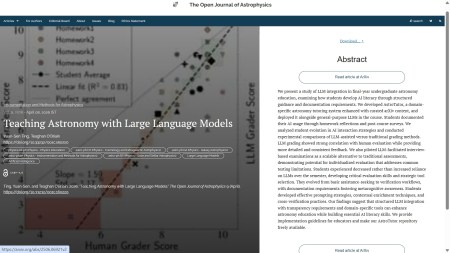
The second paper for this week, published on Wednesday 8th Apil in the folder Instrumentation and Methods for Astrophysics, is “Teaching Astronomy with Large Language Models” by Yuan-Sen Ting and Teaghan O’Briain (Ohio State University, USA). The paper introduces AstroTutor, an AI-enhanced astronomy tutoring system, to improve undergraduate astronomy education and AI literacy. It found that structured AI integration can enhance learning and critical evaluation skills. The primary classification on arXiv for this paper is physics.ed-ph but it is cross-listed on astro-ph which qualifies it for consideration.

The overlay for this one is here:

The official version of the paper can be found on arXiv here and the Fediverse announcement here:

https://fediscience.org/@OJ_Astro/116368195945602700

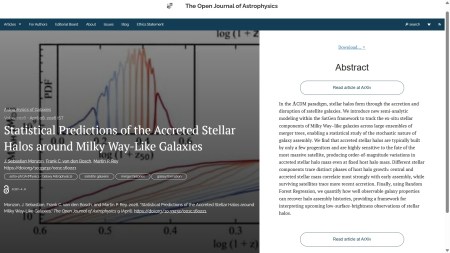
Next one up, the third paper of the week, also published on Wednesday 8th April, is “Statistical Predictions of the Accreted Stellar Halos around Milky Way-Like Galaxies” by J. Sebastian Monzon & Frank C. van den Bosch (Yale University, USA) and Martin P. Rey (University of Bath, UK). This one was published in the section Astrophysics of Galaxies; it describes new model to track formation of stellar halos in Milky Way-like galaxies, revealing their sensitivity to the fate of the largest satellite and whether accretion is early or late.

The overlay for this one is here:

The final, accepted version can be found on arXiv here and the Mastodon announcement is here:

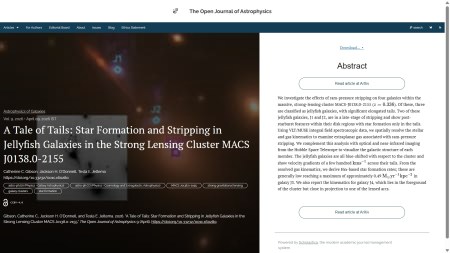
The fourth paper this week, published on Thursday 9th April is “A Tale of Tails: Star Formation and Stripping in Jellyfish Galaxies in the Strong Lensing Cluster MACS J0138.0-2155” by Catherine C. Gibson, Jackson H. O’Donnell and Tesla E. Jeltema (UC Santa Cruz, USA). This investigates the effects of ram-pressure stripping on four galaxies, focusing on their stellar and gas kinematics, star formation rates, and galactic structure and is published in the folder marked Astrophysics of Galaxies.

The overlay is here:

The finally accepted version of this paper can be found here and the Mastodon announcement is here:

https://fediscience.org/@OJ_Astro/116374103962641944

The fifth and final paper for this week is “Investigating ionising sources and the complex interstellar medium of GHZ2 at z=12.3” by M. Castellano (INAF Osservatorio Astronomico di Roma, Italy) and 29 others based all around the world. This was also published on Thursday 9th April in the folder Astrophysics of Galaxies. The paper uses deep observations of galaxy GHZ2 to explore the sources of ionising radiation and interstellar medium properties at cosmic dawn. Findings suggest a stratified environment and a hard ionising radiation component.

The overlay for this one is here:

The officially-accepted version of this one can be found on arXiv here and the Mastodon announcement is here

https://fediscience.org/@OJ_Astro/116374246020924265

That concludes this week’s update. I’ll do another one at the end of next week, when the Easter vacations will be over.

P.S. For those of you into LinkedIn, we now have a page there.

#accretion #accretionDisks #arXiv250606921v2 #arXiv250820173v2 #arXiv251205194v2 #arXiv251208490v2 #arXiv260118954v2 #AstronomyEducation #AstrophysicsOfGalaxies #ComputationalAstrophysics #CosmologyAndNonGalacticAstrophysics #DiamondOpenAccess #DiamondOpenAccessPublishing #EulerianMethods #galaxyClusters #galaxyFormation #GHZ2 #haloModels #HighEnergyAstrophysicalPhenomena #InstrumentationAndMethodsForAstrophysics #InterstellarMedium #ionisation #jellyfishGalaxies #LagrangianMethods #LargeLanguageModels #MACSJ013802155 #OpenAccess #OpenAccessPublishing #stellarHalos #strongGravitationalLensing

📄 Comparing Models of Rapidly Rotating Relativistic Stars Constructed b…

Quicklook:
Stergioulas, Nikolaos et al. (1995) · The Astrophysical Journal
Reads: 100 · Citations: 521
DOI: 10.1086/175605

🔗 https://ui.adsabs.harvard.edu/abs/1995ApJ...444..306S/abstract

#Astronomy #Astrophysics #ComputationalAstrophysics #ComputerizedSimulation #NumericalAnalysis

Comparing Models of Rapidly Rotating Relativistic Stars Constructed by Two Numerical Methods

We present the first direct comparison of codes based on two different numerical methods for constructing rapidly rotating relativistic stars. A code based on the Komatsu-Eriguchi-Hachisu (KEH) method (Komatsu et al. 1989), written by Stergioulas, is compared to the Butterworth-Ipser code (BI), as modified by Friedman, Ipser and Parker. We compare models obtained by each method and evaluate the accuracy and efficiency of the two codes. The agreement is surprisingly good. A relatively large discrepancy recently reported (Eriguchi et al. 1994) is found to arise from the use of two different versions of the equation of state. We find, for a given equation of state, that equilibrium models with maximum values of mass, baryon mass, and angular momentum are (generically) all distinct and either all unstable to collapse or are all stable. Our implementation of the KEH method will be available as a public domain program for interested users.

ADS

The Algorithmic Eye: How Artificial Intelligence is Discovering New Worlds

Artificial Intelligence: AI and the Discovery of New Worlds: How Machine Learning is Mapping Thousands of Exoplanets and Redefining Astronomy in 2026 | The Boreal Times

For centuries, the discovery of a new planet was a rare, monumental event, often the result of a lone astronomer spending years peering through glass and calculating orbits by hand. Today, we are in the midst of a cosmic census that has identified over 5,500 exoplanets—worlds orbiting stars other than our Sun. This explosion of discovery is not due to a sudden increase in the number of telescopes, but rather a revolution in how we process information. Artificial Intelligence (AI) and Machine Learning (ML) have become the indispensable partners of modern astrophysics, acting as an “algorithmic eye” capable of seeing patterns in the dark that human observers simply cannot perceive.

The empirical challenge of modern astronomy is one of volume. Telescopes like NASA’s TESS (Transiting Exoplanet Survey Satellite) and the European Space Agency’s Gaia mission generate petabytes of data, capturing the brightness of millions of stars simultaneously. Somewhere in that sea of noise is the tiny, periodic dip in light that signals a planet passing in front of its star. Finding that needle in a digital haystack requires the speed and precision that only AI can provide.

Beyond Human Perception: Neural Networks in the Light Curve

The primary method for finding exoplanets is “Transit Photometry.” When a planet passes between Earth and its host star, it blocks a minuscule fraction of the star’s light. Humans are naturally good at pattern recognition, but we are slow and prone to fatigue. Furthermore, the signal of a small, Earth-sized planet is often buried under “stellar noise”—the natural flickering and sunspots of the star itself.

Empirical research has shown that Deep Learning models, specifically Convolutional Neural Networks (CNNs), are exceptionally effective at distinguishing these subtle planetary signals from random noise. In 2017, NASA announced the discovery of Kepler-90i, the eighth planet in its system, which was found not by a human, but by a neural network trained to scan Kepler mission data. This confirmed that AI could find “hidden” planets in old data that had already been searched by conventional means. By 2026, these algorithms have evolved to be 100 times more efficient, allowing researchers to re-process decades of archival data to find worlds we never knew existed.

AI as a Filter: Managing the Data Deluge

The upcoming Vera C. Rubin Observatory in Chile is expected to produce 20 terabytes of data every single night. If humans had to review every “alert” or change in the sky detected by such an instrument, it would take centuries. AI serves as a critical filter, categorized as “Automated Transient Classification.”

These systems automatically identify whether a change in brightness is a supernova, an asteroid moving through the field, a variable star, or a potential exoplanet transit. By the time a human astronomer arrives at their desk in the morning, the AI has already discarded the 99% of “noise” and presented a curated list of high-priority targets. This synergy allows the scientific community to focus on the “why” and “how” of these worlds, rather than the tedious “where.”

Characterizing Habitability: The Search for Biosignatures

Finding a planet is only the first step. The next, more difficult frontier is determining what that planet is made of. The James Webb Space Telescope (JWST) uses spectroscopy to analyze the chemical composition of exoplanet atmospheres. This process produces complex spectra with thousands of overlapping lines representing different elements like water, methane, and carbon dioxide.

AI is now being used to perform “Spectral Retrieval.” These algorithms compare the observed data against millions of simulated atmospheric models in seconds. This allows scientists to identify potential “biosignatures”—chemical combinations that might suggest the presence of life. While AI has not yet confirmed extraterrestrial life, it is the tool that makes the search feasible by calculating the probability of certain gases existing in equilibrium.

The Convergence of AI, Technology, and Private Enterprise

The rise of AI in space discovery mirrors the themes of “Technological Supremacy” and “AI Colleagues” frequently discussed in The Boreal Times. Private companies are now entering the fray, developing proprietary algorithms to mine public space data for potential commercial or scientific value.

This creates a new era of “Computational Astrophysics,” where the most valuable asset a space agency possesses is not just its hardware, but its training datasets. As AI becomes more autonomous, we are approaching a point where telescopes may be able to self-direct their observations—identifying an anomaly and re-targeting themselves in real-time to capture a once-in-a-lifetime event without waiting for human intervention.

Citizen Science and the AI-Human Partnership

Despite the power of machine learning, the human element remains vital. Programs like Planet Hunters TESS allow members of the public to classify light curves. Interestingly, the best results often come from a “Hybrid Approach,” where AI performs the bulk of the classification, and humans review the “edge cases” where the algorithm is uncertain. This teaches the AI to be better, while allowing humans to use their intuition to spot anomalies that the algorithm might have been programmed to ignore.

For enthusiasts, this is the most accessible era of astronomy. You do not need a multi-million dollar observatory to contribute; you need a computer and an understanding of data. Learning Python or basic data science is now as fundamental to astronomy as knowing how to align a telescope.

A New Map for a New Era

Artificial Intelligence has transformed the universe from a collection of distant, blurry points of light into a detailed map of potential homes. We are no longer limited by the biological constraints of our eyes or the short duration of a human life. AI allows us to see the cosmos through the lens of mathematics and probability, revealing a galaxy teeming with diversity.

As we continue to refine these “Algorithmic Eyes,” the question is no longer if we will find an Earth-like world, but when. In the vast archives of our digital telescopes, the answer is already waiting. We just need the right code to unlock it.

References and Empirical Studies

👉 Share your thoughts in the comments, and explore more insights on our Journal and Magazine. Please consider becoming a subscriber, thank you: https://borealtimes.org/subscriptions – Follow The Boreal Times on social media. Join the Oslo Meet by connecting experiences and uniting solutions: https://oslomeet.org

#AIInAstronomy #artificialIntelligence #ComputationalAstrophysics #DataScience #DeepSpaceExploration #ExoplanetDetectionAlgorithms #MachineLearningSpaceData #TESSMissionAI

📄 On the Orbit Structure of the Logarithmic Potential

Quicklook:
Miralda-Escude, Jordi et al. (1989) · The Astrophysical Journal
Reads: 0 · Citations: 118
DOI: 10.1086/167333

🔗 https://ui.adsabs.harvard.edu/abs/1989ApJ...339..752M/abstract

#Astronomy #Astrophysics #ComputationalAstrophysics #OrbitalMechanics #StellarMotions

On the Orbit Structure of the Logarithmic Potential

The consequences of replacing centrophilic box orbits with centrophobic boxlets in the scale-free logarithmic potential are examined. Particular attention is given to the possibility that exact triaxial self-consistent dynamical models do not exist for density figures corresponding to the logarithmic potential. It is suggested that the central cusp of the logarithmic potential destroys the box orbits at high energy and replaces them with boxlets which are too wide to reproduce the triaxial density figure of the model in a self-consistent manner.

ADS
Our online workshop, "Challenges and Innovations in #ComputationalAstrophysics IV" #CHAICA4 starts this morning. First session very interesting; now hearing from Rony Keppens about MHD turbulence modelling. Already heard about the promise of #QuantumComputing for gravity calculations, cosmological modelling, and AGN outflows in clusters of Galaxies. You can still register and check out the programme here: https://dias.ie/chaica4/
ChaICA-IV: Challenges and Innovations in Computational Astrophysics > Home

@mattwoodget That is awesome, it is never too late! I recall being completely enamored with all the ways and places our understanding of Newtonian physics breaks down. However, once I got into #computationalastrophysics and learned #python I realize now it was only a matter of time before I ended up in #enterprisesoftware