Two Battles Among the Piikani

Some of the nations of North America fought with bows, arrows, spears, and shields before the gun. The following is a story from Saukamappee of the Nahathaway Nation (some kind of Cree) who was living with the Peigan or Piikani in the northern Great Plains. He passed it to David Thompson the fur trader and surveyor who wintered in his lodge around 1787/8 (Thompson had lost track of the years by the time he wrote down his memories). Thompson thought that Saukamappee looked 75 or 80 years old, so he would have been sixteen around 1725 or 1730. Saukamappee said that at this time neither his people nor the Snake Indians had horses.

The Peeagans were always the frontier Tribe, and upon whom the Snake Indians made their attacks, these latter were very numerous, even without their allies; and the Peeagans had to send messengers among us to procure help. Two of them came to the camp of my father, and I was then about his age (pointing to a Lad of about sixteen years) he promised to come and bring some of his people, the Nahathaways with him, for I am myself of that people, and not of those with whom I am. My father brought about twenty warriors with him. There were a few guns amongst us, but very little ammunition, and they were left to hunt for the families; Our weapons was (sic) a Lance, mostly pointed with iron, some few of stone, A Bow and a quiver of Arrows; the Bows were of Larch, the length came to the chin; the quiver had about fifty arrows, of which ten had iron points, the others were headed with stone. He carried his knife on his breast and his axe in his belt. Such was my fathers weapons, and those with him had much the same weapons. I had a Bow and Arrows and a knife, of which I was very proud. We came to the Peeagans and their allies. They were camped in the Plains on the left bank of the (Bow -ed.) River (the north side) and were a great many. We were feasted, a great War Tent was made, and a few days passed in speeches, feasting and dances. A war chief was elected by the chiefs, and we got ready to march. Our spies had been out and had seen a large camp of the Snake Indians on the Plains of the Eagle Hill, and we had to cross the River in canoes, and on rafts, which we carefully secured for our retreat. When we had crossed and numbered our men, we were about 350 warriors (this he showed by counting every finger to be ten, and holding up both hands three times and then one hand) they had their scouts out, and came to meet us. Both parties made a great show of their numbers, and I thought that they were more numerous than ourselves.

After some singing and dancing, they sat down on the ground, and placed their large shields before them, which covered them: We did the same, but our shields were not so many, and some of our shields had to shelter two men. Theirs were all placed touching each other; their Bows were not so long as ours, but of better wood, and the back covered with the sinews of the Bisons which made them very elastic, and their arrows went a long way and whizzed about us as balls do from guns. They were all headed with a sharp, smooth, black stone (flint) which broke when it struck anything. Our iron headed arrows did not go through their shields, but stuck in them; On both sides several were wounded, but none lay on the ground; and night put an end to the battle, without a scalp being taken on either
side, and in those days such was the result, unless one party was more numerous than the other. The great mischief of war then, was as now, by attacking and destroying small camps of ten to thirty tents, which are obliged to separate for hunting (pp. 328-330)

Joseph Burr Tyrell, ed., David Thompson’s Narrative of his Explorations in Western America, 1784-1812 (Greenwood Press: New York, 1968) https://archive.org/details/davidthompsonsna00thom/page/328/mode/2up

Ancient Babylonians also carried both spear and bow. Robert Gardner also noticed that Papuans were rarely killed or disabled by an arrow, but more often wounded.1 While a bow for war will easily shoot through a man and send the arrow out the other side at close range if its drawn to the length of the shaft and loosed smoothly, many shots were not at close range, and many were not drawn properly or were shot from trembling hands. Armour and shields also stopped or slowed many arrows. Saukamappee noted that stone arrowheads broke when they hit anything hard, and some nations used armour of wooden or bone slats and splints until they encountered guns and iron-headed arrows. Since arrows only travel about 40-70 metres per second, someone a hundred meters away has a whole second to see them coming and step aside or duck behind a shield. One of the insidious aspects of firearms is that gunshot and shell fragments fly too fast to see and dodge, so the only defense is to be small or take cover.

Saukamappee tried to guess which army was larger. Greek writers like Thucydides were also very interested in the relative size of armies, although there was also a strong tradition that a hundred good soldiers could easily beat a thousand faint hearts.

Saukamappee mentions that some bows were backed with sinews. These were common in many cultures although less famous than bows with horn on the belly (the side towards the archer’s body which compresses) and sinew on the back (the side away from the archer’s body which stretches). Even some Scythian bows may have just been sinew-backed but not horn-wood-sinew composites.2

Saukamappee does not explain how the shields were supported when they rested on the ground. Were they propped up by the lance stuck in the earth, or held by the warrior? If so how did the warrior managed both shield and bow? Were they also used in hand-to-hand combat?

Saukamappee seemed to think that the main line of shields was men side by side but not in files behind each other. These armies were small and rarely moved quickly or came to close quarters. Large armies, armies which move quickly across the field and armies that fight in close quarters usually find that the line breaks up if everyone is in front. He does not explain whether some warriors waited behind the shields, perhaps men who were tired, wounded, or looking for new arrows.

Wayne Lee has written about war as ethnic cleansing in The Cutting-Off Way. After Europeans arrived, warfare in much of North America was about suddenly attacking isolated communities and killing or taking everyone in them so their neighbours would move away and the attackers would have new hunting grounds. This was a very different type of warfare than in Europe or Mexico where riches came from forcing the enemy’s peasants to pay rent and taxes to you. Most nations in North America did not know how to subjugate people and use them that way, although they took slaves in small numbers and sometimes adopted captives.

Saukamappee describes a later battle where his people had a few muskets and the enemy had none. This passage mentions some numbers.

Our eyes were all on the tall Chief and his motions, which appeared to be contrary to the advice of several old Chiefs, all this time we were about the strong flight of an arrow from each other. At length the tall chief retired and they formed their long usual line by placing their shields on the ground to touch each other, the shield having a breadth of full three feet or more. We sat down opposite to them and most of us waited for the night to make a hasty retreat. The War Chief was close to us, anxious to see the effect of our guns. The lines were too far asunder for us to make a sure shot, and we requested him to close the line to about sixty yards, which was gradually done, and lying flat on the ground behind the shields, we watched our opportunity when they drew their bows to shoot at us, their bodies were then exposed and each of us, as opportunity offered, fired with deadly aim, and either killed, or severely wounded, every one we aimed at.

“About the strong flight of an arrow” or “a bowshot” is a practical measure. Any two armies might be able to shoot different distances depending on the wind, the weather, and the skill of the archers, but as soon as they can reach each other they have to be cautious. It does not matter exactly how many yards that is.

These shields were about as large as a Viking Age shield, an Agive shield, or a Roman round shield from Dura-Europos, and much smaller than the great Mesopotamian siege shields made from bundles of reeds. They were bigger than the pavises used by crossbowmen in late medieval Bohemia. Saukamappee does not mention shooting through the shields with bows or guns. A gunshot might penetrate, but without the ability to see the man behind the shield it could easily miss. Before the 20th century, armies could not provide soldiers with hundreds of projectiles each, so they had to use each shot carefully or run out. Canada conquered the Metis of Batoche when they ran out of ammunition and could no longer defend their firing pits. One reason that many shields were not very thick may be that a thin shield still provides concealment.

Saukamappee’s people shot their guns while lying on the ground, while their enemies had to stand up behind their shields to shoot their bows. While its hard to load a muzzle-loading gun while lying on the ground, its easy to shoot one while prone, supine, or kneeling. It is hard to shoot a long bow in the same positions, so gunners can use cover which bowmen cannot. In a battle between two static lines, gunners will make smaller targets than bowmen, especially bowmen with simple wooden or sinew-backed bows. This is one reason why crossbows and guns were very popular in sieges.

Many sources remark that guns were more deadly than bows. A bow is limited by the strength of the archer’s muscles, but firearms can be as powerful as the shooter wants. Most of the nations of North America were skeptical of matchlocks and their smelly, easily extinguished matches but very excited by guns which made their own fire such as flintlocks.

In other posts I have written about battles in medieval Europe and nineteenth-century Afghanistan.

Saukamappee has many things to tell us about another way that battles with bows and arrows could work.

Don’t let me get cut off or replaced by new technology! If you can, please support this site on Patreon or elsewhere.

Edit 2026-02-19: corrected statement on Saukamappee’s nationality

Further Reading

  • This is best known from the documentary Dead Birds (1963) but there is also a book https://www.youtube.com/watch?v=bjZCTGnrjf4 ↩︎
  • Godehardt, Erhard et al., “The Reconstruction of Scythian Bows.” In Barry Molloy ed., The Cutting Edge, Tempus: Stroud, 2007, pp. 112-133 ↩︎
  • #CanCon #comparativeEvidence #modern #NorthAmerica #source
    David Thompson's narrative : Thompson, David, 1770-1857 : Free Download, Borrow, and Streaming : Internet Archive

    Originally published as Champlain Society publication XII.

    Internet Archive

    There Was No Typical Polis

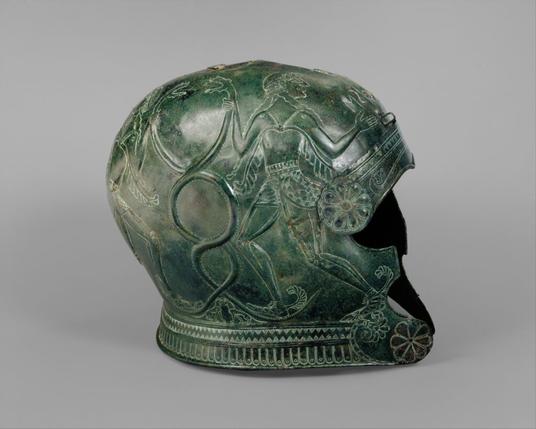
    An embossed bronze helmet from Crete around 650-600 BCE. Metropolitan Museum of Art, object 1989.281.50

    Bret Devereaux recently published a strong post in his series on the hoplite wars. This was an especially strong post because it drew on his research focus. His current book creates financial and demographic models of the Roman Republic, Carthage, and the Hellenistic kingdoms and argues that the Romans were able to get citizens and allies to contribute more military service, arms, and armour than their rivals, while some of their rivals had higher incomes in silver. Victor Davis Hanson and Hans van Wees also created detailed models of early Greek farms and how the men with panoplies (hoplites and horsemen) fit into ancient Greek societies: how many of them were there, how wealthy were they, and where did their incomes come from? Even in Athens the sources are not as good as Polybius and Livy on the Roman Republic, but Hans van Wees was able to believe in them because he came from Homeric studies where the evidence is even worse. van Wees has long suspected that there was no hoplite class, but a leisure class who could easily afford a panoply and a group of small farmers and shopkeepers who could afford it at the cost of suffering. This week I will go over some of the ideas in Devereaux’ post from a slightly different perspective and show where they lead me. This post has consumed two days of writing time and is not as polished as I wish it was.

    Empires Make Things Simple

    Its hard to write history outside the context of an empire or a powerful state. Everything goes in different directions, one story does not have a clear connection to another, and there are so many names and relationships to learn. So since classical antiquity, and again since the nineteenth century, people have tried to simplify early Greek military practices into a single story. Thucydides and Aristotle try to tell the story of how the armies and navies of their times might have developed in the misty past, even though nobody wrote Greek prose at that time so they cannot have known what really happened. This trope is related to another Greek custom of describing foreigners in ethnographic terms. Athenian writers present Spartans as exotic and write more about their customs than they write about other kinds of Hellenes. Macedonians received similar attention during the reign of Philip of Macedon. If you take this approach to history, you can signal out some peoples as exotic and alien, while implying (without actually saying) that everyone you do not describe is like you. Just like histories tend to be about men unless the authors deliberately include women, many introductions to ancient Greece give the impression that ancient Greece was like Athens except for Sparta and Macedon which were different, and they achieve this by not saying much about parts of the Greek world far from Athens.

    As Devereaux says, the Roman Republic spent several hundred years engineering Italy to provide the SPQR as many well-equipped infantry as possible. When it conquered nations in Italy, it often confiscated some of their land and divided it into small equal plots for a colony of Roman citizens. When it elbowed them into being ‘allies’ (socii) it demanded that they provide armies similar to a Roman legion. One of the main taxes on citizens, the tributum, was a tax on families who owned property but did not have a man in the army that year. While there are many questions about how exactly this worked (the Romans did not mint coins at all until the third century BCE, and for a long time just minted whenever they ran short rather than every year) the Romans engineered Italy to produce families which could provide a well-equipped man for the army. So we can speak in general about Italian armies and Italian society, even though we know very little about allied forces.

    The Neo-Babylonian kings, Teispids, and Achaemenids had a policy of expanding irrigation in Babylonia. While no source tells us why they did this, the obvious answer was that large numbers of people clustered along canals provided more labour and taxes than small numbers of people drifting across the steppes of Iraq. We can also speak in general about armed force in Neo-Babylonian, Teispid, and Achaemenid Babylonia although we have no solid numbers for population and income.

    The Greek World was Anarchic

    However, Archaic and Classical Greece had no Roman Republic and no Great King who forced them to contribute to a single military system. They were a glorious anarchy of independent communities and clans which were sometimes organized into a league or under a hegemon. I have written before about how in some Iron Age Greek cemeteries, early steel swords are daggers 40 cm long, while in other cemeteries they are great slashing things a meter long. The first Greeks to use steel swords did not all want them for the same purpose. By the fifth and fourth century BCE, when we have written sources, we see that different Greek societies had very different armed forces.

    Thessaly had many serfs, an elite of horseowners, and a modest number of light-armed peltasts with spears and cheap shields. Crete was divided into many little feuding cities whose men used distinctive bows and arrows and small bronze-faced shields. Laconia had an elite of leisured Spartiates who fought as spearmen on foot and bossed around their neighbours and helot serfs. Their city of Sparta was proudly unwalled and lacked the impressive monuments of cities like Athens or Corinth. Thessalians, Cretans, and Laconians were all Greeks (Hellenes), but they did not fight the same way. The wider Greek world from Massilia among the Celts, Sicily facing Punic Africa, Cyrene in North Africa with its charioteers, and the cities of Crimea and Scythia must have been even more diverse.

    We would not have to worry about all this diversity if the Greek world had been a nice simple empire. But since it was not, trying to generalize about the social structure of Archaic Greece or the class basis of the hoplite phalanx will only lead to half-truths. Even the focus on hoplites can be a way of not talking about the many different ways that Greeks fought, or that some of the men with bronze breastplates rode into battle on chariots or galloped into the fray on horseback, jumped off to fight on food, and let their squires lead the horse out of the hail of spears and stones (hippobatai and hippostrophoi).1 Italian hoplites may have never given up their second spear like Athenian hoplites eventually did. Most of these studies stick to Boeotia, Attica, and Laconia because we have the best evidence for how armies fit into Boeotian, Athenian, and Spartan society. There was a vast Greek world which we cannot study this way, and we have hints from the swords in early cemeteries to the Corinthian pots with knights and squires that those other Greeks did things differently. If we had the collection of constitutions compiled by Aristotle and his students, we might be able to say more about the range of variations, but almost all of those have been lost.

    We can survey the physical remains of cities and speak of a statistical Normalpolis (one with a few thousand inhabitants under constant threat from neighbours or under the thumb of a major power like the Persian King or the city of Thebes). But social structures are not something like “how many children do people have?” which varies through a small range with a simple statistical distribution. They are much wilder, and much harder to understand without detailed written sources. As scholars realized that the men with panoplies fought in many different ways and had many different class backgrounds and could even be barbarians, sometimes they question whether these are really hoplites rather than expand their mental model to include more of the ancient reality. Models should serve data not pretend to be its master.

    Devereaux argued that early Greece could not have many small equal farms because it did not have a Roman Republic to redistribute the land and tax large holdings and pay the money back to small farmers in the form of military pay. I argue that for the same reason, the Greek world could not have a single relationship between fighting and land ownership. It had too many different regimes with too many different ideas about the ideal society, and too many accidents of history like a colony which gave every settler the same amount of land, or the Spartan inheritance laws which let wealth become more and more concentrated and caused the number of Spartiates to shrink. The Boeotians let their population explode in the fourth century BCE, the time they were briefly one of the greatest powers in mainland Greece, and it may have reached an all-time high before collapsing and never recovering.2

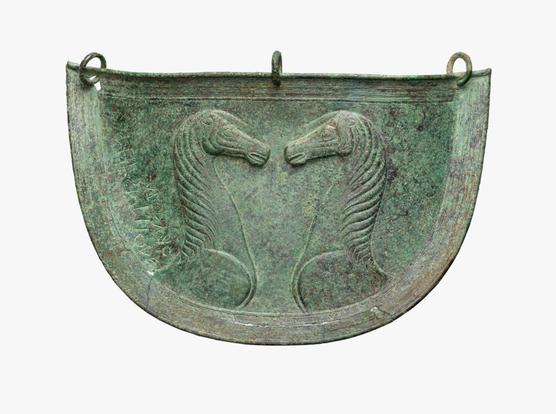
    A bronze mitra (guard for the belly underneath the cuirass) from the same find, Metropolitan Museum of Art, object 1989.281.51. The inscription says “Synenitos, the son of Euklotas, [took] this.”

    Three Generalizations

    Rather than narratives about hoplites, I think it would be possible to start a history from three generaizations about early Greek warfare. The first is as certain as anything can be in ancient history, the second is controversial, and the third is speculative.

    • By about 650 BCE, Greeks shared some common military equipment and practices such as bronze helmets, round shields shaped like a soup-plate, riding horses into battle, and landing from the sea in long galleys with bronze rams. This equipment was very expensive, and early on armourers and bladesmiths competed to show off wealth with intricate embossed designs, long cutting swords, and beautiful castings. They were nothing at all like the arms and arms of the Hjortspring people with their simple affordable materials, minimalist design, and lack of decoration. They were also unlike the simple Montefortino helmets and pila of Middle and Late Republican Italy.
    • Most early Greek societies were minoritarian regimes where a minority of the free male population (and an even smaller minority of the free and slave population) had political rights and was expected to provide itself with arms and fight when called upon. Hanson and van Wees agreed about this, they just disagreed whether up to 50% or up to 25% of Athenian men were obliged to fight as hoplites. The Iliad has a wealthy class who fight in armour and a vaguely described world of spinners and farmhands in the similes.
    • Over time, kit got simpler, durable goods became more common, and the share of the population with a long spear and a strong shield ready to fight in a line increased. Aristotle thinks that in the best polis, those who keep arms and have political rights should barely outnumber those who lack both (Politics 1297b). Neither Hanson not van Wees thinks that this describes most cities in the fifth century BCE or earlier. Note that this is a narrative of progress and increased inclusion, whereas Hanson tells a narrative of a golden age before the Persian Wars and a fall from grace afterwards.

    Within these three general constraints, there was vast variation. While many Greeks used shields with rims, Boeotians, Illyrians, and Macedonians sometimes used smaller round shields without rims. Some men with panoplies fought from horseback or rode into battle, hopped off, and let a squire lead the horse to safety. Some Greek societies had serfs and others did not. Some had many slaves and others had few. Some had many warships who needed rowers and others had few. A Cretan with a beautiful feathered helmet, a bronze-faced shield, a well-balanced spear, and a horn bow with a quiver of heavy bronze-tipped arrows might wear as much wealth as a Corinthian hoplite without fighting the same way. Since 2013, our task has been finding ways to think and write about all this wonderful contradictory diversity in the wider Greek world which are not so complicated that only a few dozen specialists can use them. I think the contrast between the Roman republic’s engineering all of Italy, and thousands of Greek cities and confederations engineering their small parts of the Greek world, might be one place to start.

    Keep reading for a bonus thought on the estimates of ancient Greek incomes in comparison with another society.

    Although I’m not weighed down by armour, I can’t keep dodging my other responsibilities forever while I am paid CAD $30/mo for my writing. If you can, please support this site.

    Back in 2020, Jonathan Dean noted that ancient historians think you needed much less land to be a well-armed infantryman than medieval historians think. I would like to lay out some of those contrasting figures for your consideration, using a book I have on my shelves and an article I have on my laptop.

    People who believe in the Solonic wealth classes think that the zeugitai of Athens had to own a panoply and fight as hoplites and had a minimum income of 200 medimnoi of produce (a volumetric measure different for grain and liquids)3. Hans van Wees estimated that a mixed farm with wheat, barley, olives, and grapes could produce that much on 7.4 hectares (18 acres) plus fallow (up to 12.7 ha / 30 acres) – ed.4 Its traditional to compare peasant incomes in terms of volumes of grain so lets estimate how big 200 measures of wheat is (there were all kinds of ways to cheat, such as piling your bushel high to make it big, or including inedible waste such as the chaff and husks).

    200 medimnoi of wheat @ 51.84 L per medimnos (Devereaux) = 10,368 L of wheat

    In 1299, Robert le Kyng was a serf with a yard of land (as much land as two oxen could plough in a season) at Bishop’s Cleeve in Gloucestershire. We will assume 30 acres of arable land and a three-field system to get his production as high as possible, although yards varied in area and some farmers used a two-field system (half the land fallow to kill weeds and feed livestock, half cropped to feed people). Medievalist Christopher Dyer estimated his productivity as follows:5

    28 quarters 3 bushels of wheat, barley, peas, and oats @ 8 bushels per quarter = 227 bushels @ 35.24 L per bushel (Wikipedia old or US bushel) = 7999 L of wheat, barley, peas, and oats

    Oats and barley are not as nutritious per volume as wheat. The Romans punished soldiers by replacing their wheat rations with barley. These are products before Robert le Kyng has to pay tithes or rent. So Dyer’s comfortable peasant produces about 8,000 L of grain and peas per year, and van Wees’ leisured farmer produces 10,000 L of tasty wheat.

    Edit: Dyer estimates that a family of two adults and three minor children would consume 10 quarters (80 bushels) of grain per year plus meat, cheese, and dairy (so the Robert’s farm produced enough for three families before deducting seed grain), while van Wees (p. 48) suggests that a family of five would consume 44 to 58 measures of wheat, oil, and wine a year (so his minimum zeugites farm would support 3 or 4 families before deducting seed grain). Robert’s family drank ale and spread their bread with butter, so didn’t need olives or grapes. A poor family might feed more people by going hungry and eating less nutritious grains, but “how many comfortable families could this farm support?” is not a bad way of comparing these two farms.

    Dyer imagines Robert hiring farmhands to help with the harvest or thatch his roofs, not having year-round help or being able to leave most of the work to his farmhands. He certainly could not sublease the land and still live well, and was not a rich peasant (traditionally reckoned at £5 / year in income, whereas Robert’s income was probably closer to £3 or £4). He was in the top quarter of peasants by landholding, but still had to work the fields with his own back and his own oxen.6 Under King Henry’s decree de forma pacis conservande of 1242, he was supposed to equip himself with sword, bow, arrows, and knife if he was not excused for holding land as a serf. Nobody with his income was expected to have a helmet or any sort of armour.

    With almost twice the land a similar amount of land, Robert is well short of the standard of living that many ancient historians imagine a zeugites had. Edit: Zeugites is usually thought to come from a yoke (zeugos ζεῦγος) of oxen for drawing a plow and a cart, just what a yardlander was able to afford. End Edit. I am not a specialist in ancient agriculture or demographics but I think it would be very useful for ancient historians and medieval historians to have a conversation about why they come to different conclusions.

    Edit: Lin Foxhall notes farmers at Methone in the Peloponnese living off mixed farms of around 3.5 hectares (8-9 acres) in the 1970s.7 These farmers aimed to produce some excess grain to sell and used some modern fertilizer but no tractors. So van Wees’ zeugites farm is only about twice as big as fed a family in the 1970s.

    (scheduled 11 January 2026)

    Edit 2026-01-12: link Arist. Pol. and Arist. Ath. Pol. Include estimates of how many families each farm could support, cite Foxhall.

    Edit 2025-01-14: add back in van Wees’ allowance for fallow land

  • Josho Brouwers, “From Horsemen to Hoplites: Some Remarks on Archaic Greek Warfare,” BABesch 82 (2007, 305-319. doi: 10.2143/BAB.82.2.2020779) or Brouwers, Henchmen of Ares, pp. 76-78 ↩︎
  • Ruben Post, The Military Policy of the Hellenistic Boiotian League (MA thesis, McGill University, 2012) https://escholarship.mcgill.ca/concern/theses/z316q5029 ↩︎
  • Edit: I was wrong! A medimnos is always a dry measure, but Aristotle (Ath. Pol. 7.4) believes that wet measures were also counted, and van Wees followed him. This could be a mistake because markets in Solon’s Attica were probably limited and “how many tenant farmers and servants can you feed from your land?” may have been more important than “how much could you sell your crop for if anyone wanted to buy it?” See Vincent Rosivach, “Notes on the Pentakosiomedimnos‘ Five Hundred Medimnoi,” The Classical Quarterly, New Series, Vol. 55, No. 2 (Dec., 2005), pp. 597-601 ↩︎
  • Hans van Wees, “The Myth of the Middle-Class Army” in T. Bekker-Nielsen/L. Hannestad (eds.), War as a Cultural and Social Force: Essays on Warfare in Antiquity (2001) pp. 45-71 especially pages 50, 51 ↩︎
  • Christopher Dyer, Standards of Living in the Later Middle Ages (1989, this printing 2003) pp. 110-116 ↩︎
  • Dyer, Standards of Living, p. 119 has a breakdown of English peasants by the size of their land in 1279/1280 ↩︎
  • Lin Foxhall, “A view from the top: evaluating the Solonian property classes,” in Lynette G. Mitchell and P.J. Rhodes (eds.), The Development of the Polis in Archaic Greece (Routledge: London and New York, 1997), pp. 61–74 (this passage page 71) ↩︎
  • #ancient #bonusPost #comparativeEvidence #earlyGreekWarfare #economicHistory #response

    Continuous Combat or Pulses and Lulls?

    A relief of captured arms and armour from the early Roman empire. Metropolitan Museum of Art, object number 2021.264.1

    Over on his blog Bret Devereaux has followed up a chat in the comments with a post on the mechanics of Roman and Iberian combat. About ten years after historians of ancient Greece started to challenge the “rugby scrum” model, Roman Army Scholars started to think hard about what ancient writers said the Roman army and its Iberian opponents did in combat. These descriptions have significant differences from descriptions in earlier Greek writers like Tyrtaeus, Thucydides, and Xenophon (for example, Roman armies can be driven back hundreds of metres before turning the tide, whereas the first time Thucydides’ hoplites turn their backs (tropein) is so important that the other side erects a monument (trope) to it). The blog post is well worth reading. In lieu of a full response I have some comments below.

    First, I don’t know anyone who denies that Republican Romans preferred to throw their javelins and charge with the sword. Writers such as Polybius, Livy, and Caesar describe this many times. The question for debate is whether if both sides stood firm, this would result in uninterrupted combat, or a few minutes of combat after which one or both sides back off to catch their breath, throw things, rethink their techniques, and build up courage to go in again. Its also up for debate how much the two lines would separate: just a few steps, or as far as they could throw a javelin? Devereaux calls these two possibilities micro-pulses and macro-pulses although of course there is no hard divide.

    Second, between say 800 BCE and 200 CE, infantry with spears had one or two spears. I cannot recall a single painting or sculpture which shows more than two, and mass sacrifices of weapons at La Tène ‘Celtic’ sites or the Danish bog of Hjortspring usually contain one, two, or three spears per shield. The Christian Roman army festooned itself with spears and lead-weighted darts called plumbatae, but in earlier times the closest thing I know is Livy’s story that some Roman velites were trained to sit on the horse behind the rider and carry no less than seven short darts to hurl when they dismounted (Livy 26.4.4, cp. Polybius 6.22.4 where the darts are slightly smaller). Livy presents this as a special technique for a special situation, and troops on horses or chariots often carry more weapons than troops who have to walk on their own two feet.

    Therefore, some infantry who ran around the combat zone ducking and leaping and throwing spears had just one or two spears each, and a Roman infantryman’s two pila is not a small load of missiles. One of the beautiful things about throwing spears is that you can pick up the other guy’s and throw them back, whereas a gunner who shoots all his ammunition is out of luck. Two spears is the same load as an Iberian caetratus, Germanic warrior, or Thracian peltast. If you are used to Romans and their customs, you might not realize just how unusual some of these customs are.

    Soldiers with two spears, a shield, a sword, and a helmet could fight many different ways. In tenth-century England they could form a shield wall (OE bordweall) and hurl spears before they closed to trade cuts and thrusts above each other’s shields. In ancient Thrace they could form a loose cloud, run close ducking incoming missiles or beating them aside with their shields, and toss their own spears then decide whether the enemy was weak enough to close in with. Romans seem to have used both approaches some of the time, as when Roman armies in Spain adopted Iberian tactics or Arrian suggested that Romans should form a wall of shields backed by archers against Alan cavalry. There are many open questions among scholars such as whether the round flat shield adopted by the Romans in the third century was better suited for loose formations or a dense shield wall. Some people used to believe that Imperial Roman auxilliaries fought in a looser formation than the legionaries but the evidence for that seems very weak other than that they had slightly smaller and flatter shields. Gear can tell us some things, but there was a great deal of room for two groups of warriors to chose different ways of fighting with very similar equipment. There is lots more to discuss in the original blog post over on ACOUP.

    Don’t let me get run down! If you can, please support this site by sharing it, donating, or talking about it over the holidays!

    Further Reading

    • John Lendon, Soldiers and Ghosts (Yale University Pres, 2006)
    • Quesada Sanz, Fernando (2006) “Not so different: individual fighting techniques and small unit tactics of Roman and Iberian armies.” In P. François, P. Moret, S. Péré-Noguès (eds.) L’Hellénisation en Méditerranée Occidentale au temps des guerres puniques. Actes du Colloque International de Toulouse, 31 mars-2 avril 2005. Pallas 70 (Presses universitaires du Mirail: Toulouse) pp. 245–263
    • Bartosz Kontny, “The war as seen by an archaeologist. Reconstruction of barbarian weapons and fighting techniques in the Roman Period based on the analysis of graves containing weapons. The case of the Przeworsk Culture.” Journal of Roman Military Equipment Studies 16 (2008) pp. 107-146

    (scheduled 20 December 2025)

    #ancient #combatMechanics #comparativeEvidence #response #RomansAreWeird

    Romans and Barbarians

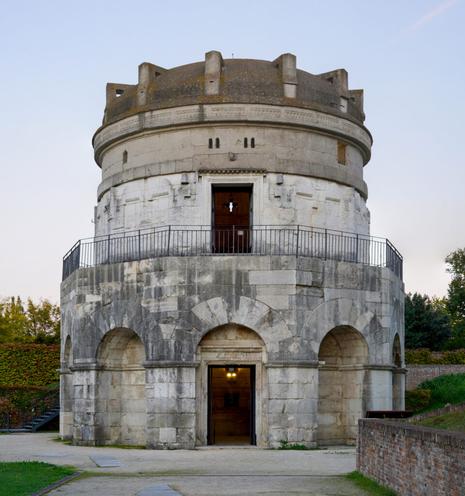
    The tomb of Theodoric, King of the Ostrogoths in Italy (died 526 CE). That roof is a single piece of stone, and he seems to have been buried in a porphyry bathtub. I once visited Ravenna for a few hours. Source: Wikimedia Commons

    If you can bear not just Romans but Christian Romans, late antiquity is a fascinating time. The period from when the Roman empire fell into civil wars in the third century CE, and the remainder of the empire drew inwards under pressure from Arabs and Slavs and angry theologians was a time of rapid changes that we know just enough about to argue about. Some of the biggest questions are about how to think about interactions between Romans and barbarians. This has been discussed so intensively by very clever people with very similar backgrounds that debates sometimes get dogmatic and people have a hard time listening to new perspectives.

    In his brief period of experimenting on posting on other people’s sites, Canadian historian and essayist Phil Paine had a discussion with medievalist Jonathan Jarett. For my post in October I would like to share his words, and the comparative evidence that he uses.

    North America has many well-documented cases of tribal migrations within historic times, in which family groups of hundreds, and sometimes thousands, moved considerable distances with the specific intention of setting themselves up in a new locale. Sometimes this involved making war against existing occupants of a place. Sometimes they were compelled to do so by defeat at the hands of another tribe. At other times it involved deal-making or confederation. It is not known what prompted the entire Mandan Nation, for instance, to migrate a thousand miles from the Midwest to the Upper Missouri country, but they were joined there by the Hidatsa, who were migrating from the equally distant Gulf coast, and they established themselves as allied farmer-traders in a region that had known no agriculture. Some of the locals joined them, some among them split off to become plains warriors. Western Canada witnessed many large scale migrations of people that are traceable over a period of three centuries.

    We cannot assume automatically that things worked the same way in the Europe of late antiquity, but drawing analogies from native North America seems to me a valid way of discussing what is likely, unlikely, possible, or impossible.

    Many countries in Latin America, equipped with modern armies and technology, are unable to prevent tribal peoples from migrating to the edges of their cities and setting themselves up in favelas or bidonvilles, retaining their own languages and customs without much difficulty. Often this takes the form of “chain migration”, where small groups make a foothold, and then whole villages follow them. The national authorities often send in police, or even the army, to stop such incursions, only to find themselves faced with well-organized and effective opposition.

    Despite the Roman Empire’s urbanization and fairly impressive technology, the various tribal peoples on the periphery of the empire could often put together fighting forces that had a good chance of defeating a legion. The difference in military technology was not great — it was money and large-scale co-ordination that kept them out. If that co-ordination and financing was absent, then what was to stop any enterprising, and reasonably aggressive group from simply walking in and carving out a little space for themselves? Especially if they found depopulated areas, or plantations farmed by slaves or aged coloni, or areas in which the local elite saw no percentage in defending the Empire? The fact that the Romans had aqueducts and hypocausts, and the invaders did not, doesn’t seem to weigh much in the equation. Nor does any greater degree of “social complexity” the Empire may have had. The invaders didn’t have to be complex, they just had to fight well. In such a situation, the invading “horde” need not be especially large to put it’s stamp on a region. A well-organized empire could rush disciplined troops to stop isolated incursions — but what about when there were twenty incursions occurring simultaneously, in different locations? The logistic problems pile up quickly. Whatever differences in social complexity existed might work as much in the barbarians favour as against it, just as the crude tribal organization of Afghanistan’s Pathans has proven to be militarily effective against British, Soviet, and American global empires.

    The Rajputs of India were little more than a small military caste with an associated ethnic group, from the marginal lands of the Thar desert. Their associated peasantry migrated with them in some conquests, but not all. The states they attacked far surpassed them in organization, wealth, and technology. Yet Rajputs ruled more than four hundred of the estimated six hundred princely states at the time of India’s independence.

    Phil Paine, comment to https://tenthmedieval.wordpress.com/2009/02/23/two-seminars-two-cities-part-1-seminary-xl-with-peter-heather/

    Roman historians developed a long theoretical and philological argument against barbarian migrations. They used a few historical models of the sort cited by Eric Hobsbawm to argue that what the Romans call “the Ostrogoths” was probably a multiethnic army that picked up soldiers, medics, and camp followers wherever it went, and was united at least as much by their shared hardships as shared language, customs, or ancestry. This works well in some places, in other places the new research on archaeogenetics has challenged some things. But I have never seen any of these historians cite parallels from Turtle Island north of Mexico. It seems generally agreed that the Mexica migrated to their current homeland from far in the north, because that was their tradition and their language is related to languages spoken far to the north but not languages near Mexico City.

    Historians have trouble with comparative evidence because our methods require studying the unique evidence from a specific place and time, and there is just so much history. The case that comes to my mind is probably not one that you know. The structure of our departments also discourages breadth: you keep a job at a research university by publishing many things on a narrow specialty. Historians tend to be lone wolves who resist being told what or how to write, but if 100 historians write case studies of 100 societies, those studies are much more useful if they follow the same format. Informal chats about comparative evidence often break down because not everyone in the discussion is a trained scholar who knows every case well. Keepers of bookandswordblog lore will remember my chat with S.M. Stirling where I made some mistakes because I was going outside my specialty and working quickly without time to fact-check.

    I admire projects like the World History Association where Roman historian Morgan Lemmer-Webber works, or the database of Religious History at UBC, or Robert Rollinger’s project on empires in world history. Broad comparative studies are hard to do well, and neither universities not the market reward them, but without them people can believe that something is a law when its just true some of the time, or believe that something about their favorite society is special when its actually typical.

    Further Reading

    Pereltsavig and Lewis’ book on the Indo-European controversy covers some similar issues

    The rich world that produced the open web is dying, and a new poorer world is struggling to be born. I would like to keep blogging monthly as the lamps go out one by one. If you can, please support this site by sharing pages, donating, or talking about what you read at your next coffee with friends.

    PS. I like Guy Halsall’s idea that the most organized Anglo-Saxons in Britain may have been soldiers from the hill zone that runs north-east to south-west through England who decided that if nobody was paying them any more, maybe they were not Romans either (Caesar’s soldiers had loved playing barbarian for centuries, and by the third century, some European barbarians had reorganized their egalitarian societies so they could support men a lot like Roman soldiers, both in the sense that they had steel swords and silver-plated helmets, and that they bossed around their neighbours and beat or stomped on anyone who was not humble enough).

    (written summer to October 2025, scheduled 10 October 2025)

    #ancient #comparativeEvidence #LateAntique #PhilPaine #worldHistory