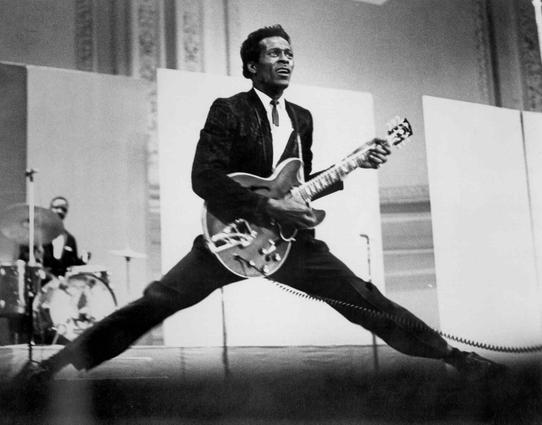
We went to the movies for a #QuentinTarantino themed #threeForFriday #music #quiz last week and well done to @ianpyeiseboe for taking the principled stance of only answering two questions because he thought The Hateful Eight was pants.

If you like Ian didn't get all three the answers are here for you and more questions to follow on Friday as always.

#musicquiz #trivia #musictrivia #questions #musicquestions #popmaster #musicfans #musicgame #quiztime #ennioMorricone #reservoirDogs #chuckBerry

Maybellene

YouTube

“It is impossible to win gracefully at chess. No man has yet said “Mate!” in a voice which failed to sound to his opponent bitter, boastful and malicious.”*…

… but perhaps the offense is muted if the call is remote.

Electronic gaming is huge– and growing, As Rolling Stone reports

The gaming industry, fueled by platforms like Twitch and YouTube, has surged into a multi-billion-dollar powerhouse, projected to exceed $207 billion in 2026. These platforms do more than showcase gameplay—they cultivate vibrant, interactive communities where fans engage in real time, from live chats to virtual watch parties. Games like League of Legends, Call of Duty, Counter-Strike and Fortnite have become a cultural phenomenon, drawing in over 2.6 billion gamers globally, a number that continues to climb each year. Mobile gaming, accounting for over 60% of global gaming revenue, plays a significant role in this growth, making gaming accessible to a broader audience than ever before…

But as Danny Robb explains, using tecnology to play games remotely has a long history…

In 1897, the United States House of Representatives held a series of chess matches to find their most skilled players. The five winners were pitted against counterparts in the British House of Commons. But while the Americans sat down to play in Washington, D.C., their opponents sat in London. The players received moves by telegraph, and sent responses back over wires that crossed the Atlantic.

By this point, “cable chess” had been slowly evolving for decades. Historian Simone Müller-Pohl argues that this form of long-distance chess play offers insight into the cultural and political currents of the industrial era.

By the mid-nineteenth century, she explains, there was a growing sports culture in Europe and the US. Industrial technologies enabled more people to attend games and follow along from a distance. A growing middle class fostered this sporting culture, which came to include chess.

“Weekly,” Müller-Pohl explains, “the liberal and intellectual elites of the time assembled around chess boards in Paris, Berlin, Warsaw, Vienna, Moscow, Rome, and London.” Interest in the game spread, and chess clubs emerged. As clubs arranged tournaments and standardized chess rules, Müller-Pohl argues that chess “was gradually turned into a sport.”

Correspondence chess grew along with the game, in part thanks to cheap and efficient postal services. When the telegraph emerged on the scene, the application to chess was almost immediate.

“It was telegraphy’s fathers who pulled the strings behind the first schemes for cable chess,” Müller-Pohl explains. In 1844, inventor Samuel Morse arranged chess matches on a new telegraph line between Baltimore and Washington, D.C. “All of the 686 moves necessary for the seven games played were transmitted without mistake or interruption,” Müller-Pohl writes.

Not long after, in 1845, inventor Charles Wheatstone attended a demonstration in London. Chess legend Howard Staunton played against his rival George Walker over the South Western Railway line between Portsmouth and London. Müller-Pohl describes how witnesses found the match “rather tedious,” but it received a lot of press. This was partly the point—the matches demonstrated and advertised the capabilities and accuracy of the invention.

The Staunton match had another interesting aspect. Müller-Pohl points out that “the lines were still used for ordinary traffic during the games, allowing a group of chess players from Southampton to have every move telegraphed to them.” A bit like modern e-sports, spectators could observe the virtual match…

The early history of e-gaming– when telegraph cables let chess clubs stage matches across continents, linking players and spectators in a new kind of long-distance competition: “The First E-Sports? Chess by Telegraph,” from @inverting-vision.bsky.social in @jstordaily.bsky.social.

* A. A. Milne

###

As we note that what’s old is new again, we might recall that it was on this date in 1958 that Chuck Berry’s “Johnny B. Goode” was released. It peaked at number two on the Hot R&B Sides chart and number eight on its pre-Billboard Hot 100 chart. Considered “the first rock & roll hit about rock & roll stardom”, it has been covered by many, many other artists and has received many, many honors and accolades, among them being ranked 33rd and 7th, respectively, on Rolling Stone’s 2021 and 2004 lists of 500 Greatest Songs of All Time. It was also included as one of the 27 songs on the Voyager Golden Record (a collection of music, images, and sounds designed to serve as an introduction and record of global humanity’s achievements, innovations and culture, to alien/otherworldly inhabitants).

Apropos the piece above, it was released by Chess Records.

source

https://youtu.be/6ROwVrF0Ceg?si=mn0aUbfgzyWtINVy

#chess #ChuckBerry #culture #eGaming #electronicGaming #gaming #history #mobileGaming #music #rock #rockAndRoll #SamuelMorse #Technology #telegraph #VoyagerGoldenRecord
"Johnny B. Goode" is a song by American musician #ChuckBerry, written and sung by Berry in 1958. Released as a #single in 1958, it peaked at number two on the #HotRAndBSides chart and number eight on its pre-#Billboard #Hot100 chart. The song remains a staple of #rockNRoll music. "Johnny B. Goode" is considered one of the most recognizable songs in the history of #popularMusic. Credited as "the first rock & roll hit about rock & roll stardom".
https://www.youtube.com/watch?v=6swgiM9vSEE
Chuck Berry with Bruce Springsteen & The E Street Band "Johnny B. Goode" | Concert for the Rock Hall

YouTube
Movie TV Tech Geeks #MusicFeatures #Music #ChuckBerry #TheBeatles 68 Years Later, the Greatest Rock and Roll Riff Ever Written Still Hits Different http://dlvr.it/TRhnRS

New Juke Box Hits is the fifth studio album by rock and roll pioneer Chuck Berry, released in March 1961 by Chess Records.

Review by William Ruhlmann

Chuck Berry's fifth Chess Records album, New Juke Box Hits, was recorded and released in the midst of the legal difficulties that would put him in jail the following year. That distraction seems to have kept him from composing top-flight material, while the attendant publicity adversely affected his record sales, such that the album contained no hits. The included single was "I'm Talking About You," later successfully recorded by the Rolling Stones, and the album also contained "The Thirteen Question Method" and "Don't You Lie to Me," worthy minor entries in the Berry canon...

https://www.youtube.com/watch?v=bAUsOn1uQHQ&list=RDbAUsOn1uQHQ&start_radio=1

#ChuckBerry #RockandRoll #ChessRecords #Music

C.h.u.c.k B.e.r.r.y Greatest Hits ~ Top 100 Artists To Listen in 2023

YouTube
🎶 7:33am Memphis, Tennessee - Single Version by Chuck Berry from The Great Twenty-Eight.
DJ Soapy Smith - Gold Soundz
#ChuckBerry #DJSoapySmith #GoldSoundz #Radio1190 #KVCU

Remembering Charles Edward Anderson Berry , aka Chuck Berry who died today 18th March 2017 .

"If you want to release your aggression, get up and dance. That's what rock and roll is all about."

#chuckberry #rocknroll

📸 Ken Regan

On 18 Mar 2017: #ChuckBerry, American rock n' roll #guitarist and #singer-#songwriter ("Roll Over Beethoven"; "Sweet Little Sixteen"), died at 90.
#RIP 🕯️