GeekProjects News
A Fully-Transparent Air Bubble Display https://hackaday.com/2023/12/06/a-fully-transparent-air-bubble-display/ #bendingacrylic #bubbledisplay #classichacks #MiscHacks #solenoid #acrylic #leds

 hackaday unofficial
Modern, Frugal PCB Breathes New Life Into Soviet-Made LED Watch
The first electronic digital watches were admired for their pioneering technology, if not their everyday practicality, when they were introduced in the 1970s. Their power-hungry LED displays lit up only when you pressed a button, and even then the numbers shown were tiny. Their cases were large and heavy, and they drained their batteries rather quickly even when not displaying the time. Still, the deep red glow of their displays gave them a certain aesthetic that's hard to replicate with today's technology.
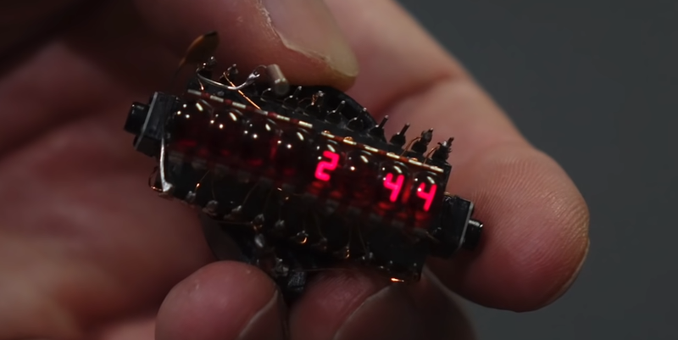
Pressing the top-right button enables those beautiful LED modules
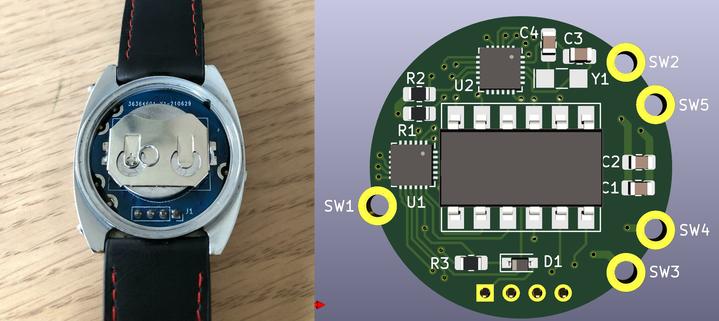
When [Benjamin Sølberg] got his hands on an Elektronika-1, a first-generation digital watch designed in the Soviet Union, he set about designing a modern replacement for its internals. Where the original had several custom chips wire-bonded directly onto a substrate, the new board contains an MSP430 series microcontroller as well as an AS1115 display driver. The PCB makes contact with the watch's pushbuttons through clever use of castellated holes.
For the display [Benjamin] went with period-correct LED modules made by HP, which keep the display's appearance as close to the original as possible. While these draw quite a bit of current, the rest of the watch has become an order of magnitude more frugal: the stand-by time is now estimated to be about ten years, where the old design often needed new batteries within a year. [Benjamin] uses his renovated watch on a daily basis, apparently without trouble.
If you've got an old Soviet digital watch that you'd like to upgrade, you'll be pleased to hear that the entire design is open source. Just like this retro watch, in fact, that uses a similar LED display. If you're into original vintage watches, we've covered them in depth, too.