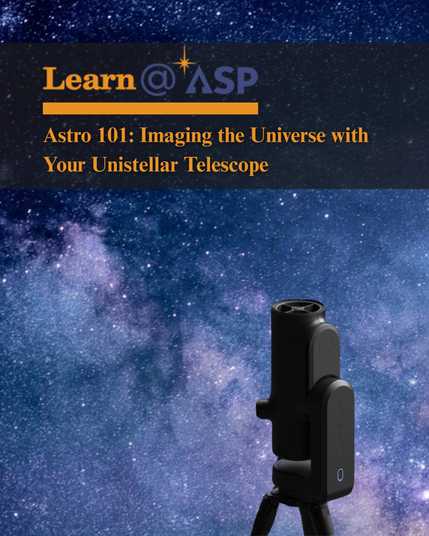
#Astro101: Imaging the Universe with Your Unistellar Telescope is a brand-new five-part online workshop series designed exclusively for Unistellar smart telescope owners who are ready to unlock the full scientific power of their instrument.

Dr. Ian Weaver, Unistellar Education Lead at the SETI Institute, will be one of the workshop leaders alongside Dr. Shanil Virani, Cosmic Engagement Specialist at the Astronomical Society of the Pacific.

Learn more and register here: https://www.seti.org/events/astro-101-imaging-the-universe-with-your-unistellar-telescope/

Join us online on Friday, February 7th, at 7 PM for our next Astro 101 talk! During this hour, you'll gain an appreciation for the size and scale of the cosmos and our place within it. You'll see many examples of beautiful objects in the night sky and learn about how we see them through our telescopes and what we can deduce about them through the light they send us. Sign up on meetup.com/sj-astronomy

#astronomy #astro101

How is your toaster like a cool star?

They both look red and glow because they are hot, dense objects, but they emit most of their light at infrared wavelengths.

1/

Image credits
Toaster: https://commons.wikimedia.org/wiki/File:Toaster_Filaments.JPG
DSS image of Betelgeuse: https://www.eso.org/public/images/eso0927e/
#astronomy #Astro101 #stars

File:Toaster Filaments.JPG - Wikimedia Commons

How can astronomers know exactly how hot stars are? You can guess from their colors, but to get a precise measurement, you have to look at their spectra.

We spread out the light from the stars into a rainbow-like spectrum and look for patterns of lines, made by different elements and molecules in the star's outer layers. The presence or absence of lines tells you the precise temperature.
1/

Download video: https://webbtelescope.org/contents/media/videos/01F9KWXB37VDZXVJVWEBMEQQW9
#astronomy #Astro101 #stars