 Fabio Giglietto
#toread #paper “We, the conspiracy theorists.” How people do symbolic boundary work in the “Great Reset” debates across social media platforms by Kamile Grusauskaite et al. https://doi.org/10.1177/14614448261446590
#toread #paper The hostile misinformation effect: How ideological congruence drives the assessment of misinformation targets by Patrick van Erkel et al. https://doi.org/10.1080/10584609.2026.2671760
#toread #paper What 81,000 people told us about the economics of AI https://scholar.google.com/scholar?q=What%2081%2C000%20people%20told%20us%20about%20the%20economics%20of%20AI
#toread #paper Framing the future of search: A discourse analysis of Google’s AI Overviews by Shir Weinbrand, Ashwin Nagappa, Daniel Angus https://doi.org/10.1177/17504813261447684
#toread #paper The alternative influence network (AIN) of far-right YouTubers in Sweden: Connectivity and hybridisation of online extremism during the Covid-19 pandemic by Tina Askanius, Jullietta Stoencheva, Hernan Mondani https://doi.org/10.2478/nor-2026-0008
#toread #paper Social theory should be a structural prior for agentic AI: A formal framework for multi-Agent Social Systems by Lynnette Hui Xian Ng et al. https://arxiv.org/abs/2605.07069
Social Theory Should Be a Structural Prior for Agentic AI: A Formal Framework for Multi-Agent Social Systems
Agentic AI systems are increasingly deployed not in isolation, but inside social environments populated by other agents and humans, such as in social media platforms, multi-agent LLM pipelines or autonomous robotics fleets. In these settings, system behavior emerges not from individual agents alone, but from the multi-agent interactions over time. Emergent dynamics of individuals in a social group have been long studied by social scientists in human contexts. \textbf{This position paper argues that agentic AI systems must be modeled with social theory as a structural prior, and formalizes a Multi-Agent Social Systems (MASS) framework for how agents interact and influence to generate system-level outcomes.} We represent MASS as a class of dynamical system of information generation, local influence and interaction structure, formulated by four structural priors anchored in social theory: strategic heterogeneity, networked-constrained dependence, co-evolution and distributional instability. We demonstrate the importance of each structural prior through formal propositions, and articulate a research agenda for how MASS should be modeled, evaluated and governed.
#toread #paper The death of Twitter and the decline of Public Debate online by Axel Bruns https://doi.org/10.5204/mcj.3247
#toread #paper “keep your heads held high boys!”: Examining the relationship between the Proud Boys’ online discourse and offline activities by CATIE SNOW BAILARD et al. https://doi.org/10.1017/s0003055423001478

“Keep Your Heads Held High Boys!”: Examining the Relationship between the Proud Boys’ Online Discourse and Offline Activities | American Political Science Review | Cambridge Core
“Keep Your Heads Held High Boys!”: Examining the Relationship between the Proud Boys’ Online Discourse and Offline Activities - Volume 118 Issue 4
#toread #paper Who controls the narrative? How Brazilian parliamentarians pursue epistemic authority in times of crisis by André K. Rodarte, Carolina V. Kuahara, Ahmer Arif https://doi.org/10.1080/21670811.2026.2669534
#toread #paper How do media contribute to the dissemination of conspiracy beliefs? A field study combining panel and web tracking at the outbreak of the COVID-19 pandemic by Silke Adam et al. https://doi.org/10.1093/joc/jqaf033
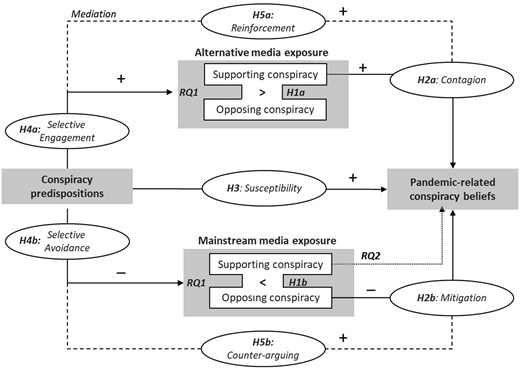
How do media contribute to the dissemination of conspiracy beliefs? A field study combining panel and web tracking at the outbreak of the COVID-19 pandemic
Abstract. As COVID-19 escalated into a global health crisis, pandemic-related conspiracy theories emerged rapidly. Understanding how and under which condit