Over the past couple weeks, Hubble explored #StarrySights! ✨

These new Hubble images showcase the beauty, science, and cosmic activity that star clusters contain.

Hungry for more? Check out Hubble's star cluster Flickr album: https://go.nasa.gov/3UKRPXy
#Hubble

Hubble's Star Clusters

A collection of star clusters imaged by the Hubble Space Telescope

Flickr

Now for the grand #StarrySights finale!

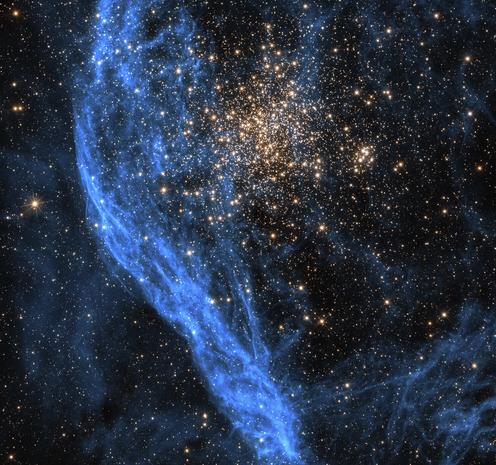
The last image in our star cluster celebration shows NGC 1850, about 160,000 light-years away.

It includes ultraviolet observations, which are ideal for detecting light from the hottest and youngest stars, as seen in this luminous view.
#Hubble

"Small" but mighty!

Inside the Small Magellanic Cloud, a satellite galaxy to our Milky Way, is the star cluster NGC 376.

Seen in this #HubbleFriday view, NGC 376 is made of stars that are loosely bound together by gravity: https://go.nasa.gov/3BmGKoN
#StarrySights
#Hubble

Hubble Captures a Glittering Neighbor

This image from the NASA/ESA Hubble Space Telescope captures a small portion of the Small Magellanic Cloud.

NASA
Hubble Captures a Glittering Neighbor

This image from the NASA/ESA Hubble Space Telescope captures a small portion of the Small Magellanic Cloud.

NASA

A #StarrySights stunner! 😍

Welcome to NGC 1850, a star cluster about 160,000 light-years away in a satellite galaxy to our own Milky Way, known as the Large Magellanic Cloud.

Read more: https://go.nasa.gov/3VIoe2u
#Hubble

Hubble Captures Dual Views of an Unusual Star Cluster

While these two images may look dazzlingly different, they are actually pictures of the same cosmic object: NGC 1850.

NASA

#NASA #Hubble Captures Dual Views of an Unusual Star Cluster

While these two images may look dazzlingly different, they are actually pictures of the same cosmic object, NGC 1850. This 100 million-year-old globular cluster is located in the Large Magellanic Cloud and is approximately 160,000 light-years away in the constellation Dorado.

https://www.nasa.gov/image-feature/goddard/2022/hubble-captures-dual-views-of-an-unusual-star-cluster

#astronomy #Astrodon #astrophotography #Stars #StarrySights

Hubble Captures Dual Views of an Unusual Star Cluster

While these two images may look dazzlingly different, they are actually pictures of the same cosmic object: NGC 1850.

NASA

On the seventh day of #StarrySights #NASA #Hubble gave to me -- brilliant blue globular cluster NGC 2031 and its population of #Cepheid variable stars.

https://www.nasa.gov/image-feature/goddard/2022/hubble-beholds-brilliant-blue-star-cluster

#astronomy #Astrodon #astrophotography #Stars

Hubble Beholds Brilliant Blue Star Cluster

In the top left corner of this starry sight, the globular cluster NGC 2031 shines brilliantly.

NASA

Shine bright like NGC 2031 πŸ’Ž

Hubble's next #StarrySights image shows a cluster that resides about 150,000 light-years from Earth in an extremely dense region of the Large Magellanic Cloud, which is a satellite galaxy of our own Milky Way.

For more: https://go.nasa.gov/3Hgfc8z
#Hubble

Hubble Beholds Brilliant Blue Star Cluster

In the top left corner of this starry sight, the globular cluster NGC 2031 shines brilliantly.

NASA
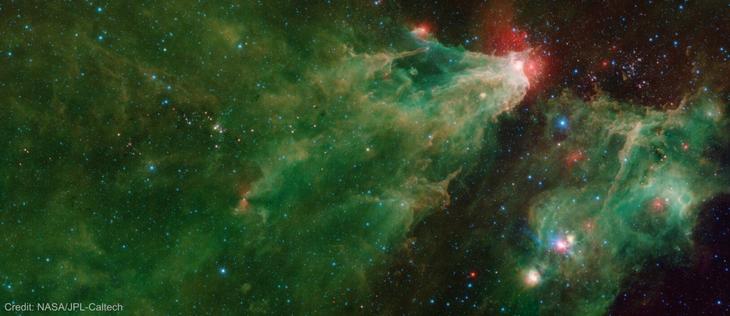
Sometimes the stars that grow up together … stay together! This large infrared mosaic captured by our Spitzer telescope is a multigenerational β€œfamily portrait” of multiple clusters of stars born from the same dense clumps of gas and dust: https://go.nasa.gov/3VUQZbW #StarrySights
#NASAUniverse
Hubble Spots Bright Splash of Stars Amid Ripples of Gas and Dust

Open cluster KMHK 1231 is a group of stars loosely bound by gravity. Seen in the upper left of this Hubble Space Telescope image, this cluster in the Large Magellanic Cloud is surrounded by a crimson nebula of gas and dust extending both to the right and downward, where new stars may someday form.

NASA