
Hard times at Advent and a sad end

Further light can now be shed on the fate of John Alford, subject of the blog below, which was posted in September 2021 ….

↬bernarddeacon.com/2021/09/21/hard-times-at-advent/?page_id=6997

In 1899 John was charged with assaulting and striking his wife Mary at St Teath. She applied for separation, which was granted. John was fined five shillings or a week’s hard labour and told to pay two shillings and six pence a week maintenance (equivalent to just over £21 a week now) for Mary and their children (Royal Cornwall Gazette, 20 Apr. 1899).

Despite obtaining work as a farm labourer in Blisland, John found it difficult to pay this sum. In December 1901 Mary claimed that she had received nothing for 36 weeks. John was duly arrested and brought before magistrates at Camelford. He was charged with refusing to comply with the maintenance order and given a month’s hard labour (Royal Cornwall Gazette, 19 Dec. 1901). This was the third time he was imprisoned on the same charge and probably the reason for his presence in Bodmin Jail at the time of the 1901 census.

John was clearly a ‘character’. At the petty sessions, to some amusment, he had ‘made a rambling statement and refused to desist when asked’. The magistrate ‘threatened to commit him if he did not behave’ but John was undeterred. Arrayed in ‘a silk hat and gloves … he left the court smiling, remarking “goodbye all, until I see you again”‘ (Cornish Guardian, 20 Dec. 1901)

In 1902 John, ‘an eccentric person well known at Camelford‘ was in more serious trouble, charged with threatening to murder his daughter Susan, a domestic servant employed by a grocer at Boscastle. John had turned up late at night demanding to see her, having taken against her plans to marry. John claimed he merely wanted to take her to her mother at St Teath, as she was only 18, although from the census and the newspaper report it seems she was at least 20.

Returning to the grocer’s house at 1am John was reported as saying ‘I’ll break your ____ door open and I’ll murder the ___ maid unless you let her come to me’, before being chased off after the grocer set his dogs on him. John got off quite lightly for this, bound over to keep the peace for six months (Cornish Guardian, 14 Nov. 1902).

In the high summer of 1913, John Alford, a farm labourer at Trencreek, Blisland and a ‘very familar figure in the district’ was found dead in a barn, having shot himself through the head. The inquest found a verdict of suicide while temporarily insane (West Briton, 5 Jun. 1913).

#Advent #Alford #Blisland #Camelford #StTeath

Digging for riches: not just miners but quarriers

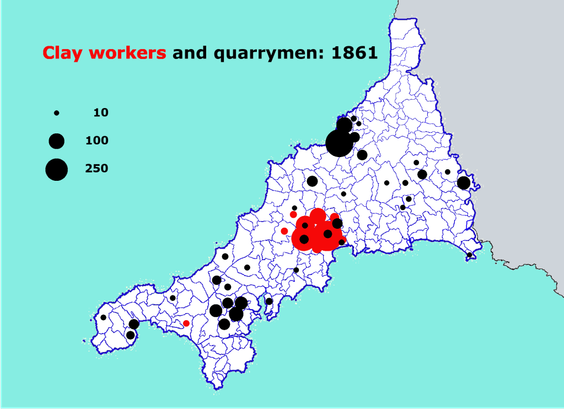
Most modern employment classifications treat mining and quarrying as a single economic sector. So how many more workers did clay extraction and quarrying add to the mining and quarrying sector in 1861? The answer is not that many when compared with the dominant mining for copper, tin, lead and other minerals.

While metal mines accounted for 30 per cent of adult male workers in 1861, quarrying added a maximum of 1.8 per cent and the china clay industry another 1.1 per cent. Nonetheless, this means that almost a third of Cornwall’s men in the early 1860s were directly engaged in working the natural underground resources of the region. There would have been many others who were indirectly dependent on this sector, something that would have dire consequences when mining began to contract in importance.

China clay was still in its infancy in the early 1860s, although it was growing fast and was destined to take over from mining as the main industrial pursuit in mid-Cornwall well before the end of the century. As the map above shows, this was an extremely concentrated business, focused almost entirely on the St Austell district in mid-Cornwall.

Quarrying on the other hand was more widely distributed. While there were 91 parishes in 1861 each with ten or more metal miners, there were just ten with ten clay workers or more but 38 with more than this number of quarrymen. The two principal quarrying districts – St Teath and Tintagel for slate and the eastern part of Carnmenellis near Penryn for granite – can clearly be identified from the map.

#chinaClay #granite #slateQuarries #StAustell #StTeath #Tintagel
Victorian Cornwall’s leading sector: metal mining

There was no question about Cornwall’s leading economic sector in the mid-1800s. In terms of income, productivity and employment it was metal mining. The early 1860s marked the peak of Cornish mini…

Cornish studies resources