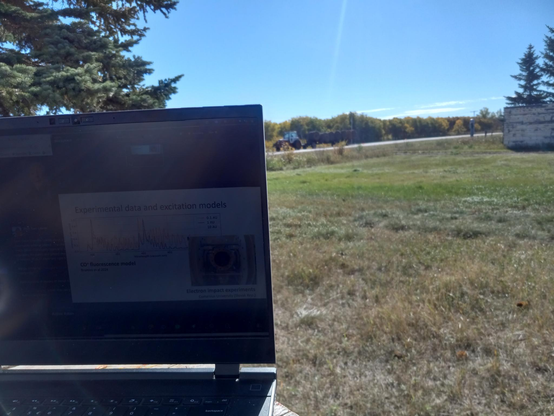
Cicero Lu talking about exocomets and water delivery. Beauuuutiful JWST spectra of UV fluorescence (I am not a spectra person, but wow).

10 Myr old system can contain 1/1,000,000 of an EArth mass of warm gas, which COULD be from exocomets. More data needed!

#SolarSystemInContext

It is extremely pleasant sitting outside and listening to this last session! (ok not the last session, but the last session I will be able to attend of this lovely conference)

#SolarSystemInContext

Dennis Bodewits: using cations to study molecules coming out of weird comet 29P Schwassmann-Wachmann 1. Most active object in the solar system.

Lots of physical processes required to explain what's going on, including solar wind!

#SolarSystemInContext

Colin Orion Chandler talking about a Rubin community science project. The challenge: too much data!! Community science is also great for educating the public and getting people involved in science, REALLY important right now!

Will be similar to https://activeasteroids.net/ project, very successful

Rubin has lots of images of comet 3I

http://cometcatchers.net is live! You can go help with Rubin science now

#SolarSystemInContext

Active Asteroids – Active Asteroids Citizen Science, a NASA Partner

Asteroids also spin-up from YORP and then disrupt as their rotation flings stuff off the surface or causes avalanches. 101955 Bennu (Osiris-rex target) was discovered to be active!

Need a census to figure out how much volatile material is in the solar system now, how much there was originally. Rubin will help!

How much water is in our asteroid belt is important for understanding habitability in other solar systems too

#SolarSystemInContext

Henry Hsieh talking about active asteroids (Main Belt Comets): asteroids that have cometary activity due to sublimation or a recent collision.

Four MBC's have been observed by JWST, no CO2 or CN detected, just H2O, as expected.

Talked about lab study that helped figure out what was happening in 596 Scheila: impact happened shortly before observation! Could see a difference in the lightcurve after: impact uncovered brighter material.

Also DART impact!

#SolarSystemInContext

Talks done for the day, will be a few more talks tomorrow. In person attendees now get a tour of Lowell Observatory, which sounds lovely, except the bus has to go through an (illegal) internal border checkpoint... there have been lots of emails about "be sure to bring your passport!" and it gives me deep anxiety... #SolarSystemInContext

Atsuhiro Yaginuma: interstellar comet 3I/ATLAS will have its close approach to Mars in a few days!

Thought experiments: could we send a spacecraft to 3I? This is hard from Earth, large delta V needed and that is getting higher over time, lowest is 24km/s, no spacecraft can do that. Could do it from Mars, lowest 4km/s delta V.

#SolarSystemInContext

What about debris disk systems? Can make radiant predictions (like for meteor showers), and velocity predictions.

So, if an interstellar meteor is measured (from radar or Global Meteor Network) you can look at this table and figure out which star it (maybe) came from.

Global Meteor Network shout-out! (Which I've been interacting with A LOT the last few days... https://www.cbc.ca/player/play/video/9.6917882)

#SolarSystemInContext

Starlink debris lights up night sky

Footage from the University of Western Ontario and Defence R&D Canada shows space debris from a SpaceX Starlink satellite lighting up the night sky.

CBC

Cole Gregg: looking at how much material (asteroids/comets) could have come from the alpha Centauri system and passed through our Solar System. Have they hit us on Earth? Interstellar meteors?

45 interstellar dust bits per year, one million in solar system now, but the observable fraction is teeny tiny. Estimate 10 per year entering Earth's atmosphere. But none detected (but 7 trillion meteors per year... "like finding a needle in an earth-sized haystack")

#SolarSystemInContext