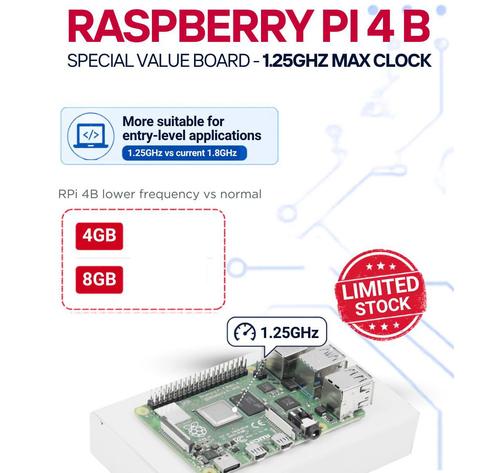
Discounted 1.25 GHz Raspberry Pi 4 Model B shows up online
Cytron is currently selling a Raspberry Pi 4 Model B "Special Value Board" with 4GB or 8GB of RAM, whose unique feature is to be clocked at 1.25 GHz instead of 1.8 GHz. The Raspberry Pi 4 initially launched with a 1.5 GHz BCM2711 SoC in 2019, but all recent boards are upgraded to the BCM2711C0 clocked at 1.8 GHz, first found in the Raspberry Pi 400 keyboard PC. So that 1.25 GHz version is odd, let's check it out. Raspberry Pi 4 "Special Value Board" specifications: SoC – Broadcom BCM2711C0 quad-core Cortex-A72 (ARMv8) @ 1.25 GHz max with VideoCore VI GPU supporting OpenGL ES 3.0 graphics System Memory – 4GB or 8GB LPDDR4-3200 Storage – microSD card slot Video Output & Display I/F 2x micro HDMI ports up to 4Kp60 (Currently 1080p60 max. in dual-display configuration, although 2x 4Kp30 is being worked on) 3.5mm AV port with composite video
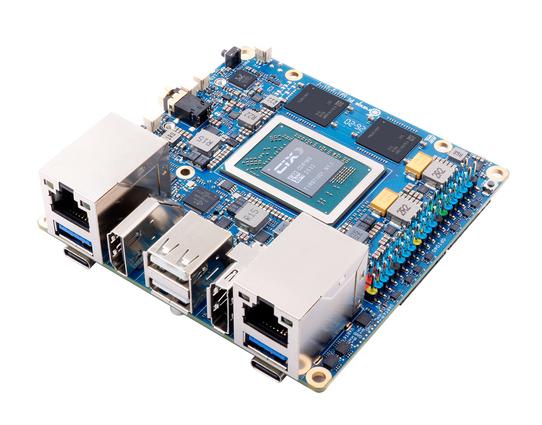
Orange Pi 6 CIX CD8180 12-core Arm SBC gets 2.5GbE networking, smaller form factor, drops battery support
Orange Pi 6 is a compact single board computer (SBC) powered by CIX P1 (CD8180) 12-core Arm Cortex-A720/A520 SoC coupled with up to 32 GB 128-bit LPDDR5 memory. It shares many of the features of the Orange Pi 6 Plus board introduced last October, but comes in a smaller and lighter form factor (90 x 90mm vs 115 x 100mm), features two 2.5GbE ports instead of two 5GbE jacks, drops support for LiPo batteries, and is offered with lower RAM capacity options (8GB-24GB vs 16GB-64GB). Orange Pi 6 specifications: SoC – Cix P1 (Codename: CD8180) 12-core DynamIQ processor 4x Cortex‑A720 big cores @ up to 2.6 GHz 4x Cortex‑A720 medium cores @ up to 2.4 GHz 4x Cortex‑A520 LITTLE cores @ up to 1.8 GHz Cache – 12MB shared L3 cache GPU – Arm Immortalis G720 MC10 with hardware ray-tracing support, graphics APIs: Vulkan 1.3, OpenGL ES 3.2, OpenCL 3.0

Optocam Zero – A Raspberry Pi Zero 2 W -based DIY digital camera
Inspired by Kodak Charmera and similar toy cameras, the Optocam Zero is a Raspberry Pi Zero 2 W-based DIY digital camera made of off-the-shelf components and 3D-printed parts. It connects the Pi Zero 2 W SBC with a Raspberry Pi Camera Module 3, a 1.3-inch LCD, a 14500 Li-Ion battery holder, and other components. The camera supports autofocus, eight photo filters, USB-C charging, and lasts 70 to 80 minutes on a charge. Optocam Zero camera key features: Based on Raspberry Pi Zero 2 W SBC Display 1.3-inch LCD with 240 x 240 resolution 15–20 FPS camera preview on the screen. Screen dimming when inactive to preserve battery Camera features 2592 x 2592 JPEG image capture. GIF recording and playback support. Autofocus support 8 photo filters included. Misc Image transfer through custom hotspot interface. Fully 3D printed case parts 3D printable TPU protective sleeve and lanyard design is available. 22-second boot

SpacemiT K3 Pico-ITX RISC-V Chassis Kit Review – Part 2: What works, what doesn’t in Bianbu OS 4.0
Last month, I received the SpacemiT K3 Pico-ITX Chassis Kit based on the company's K3 16-core RISC-V SoC, and started the review with an unboxing, a teardown, and a first boot to Bianbu OS 4.0. Since the system features a 10Gbps Ethernet SFP+ cage, I also had to order a 10GbE SFP+ to Copper adapter, as my 10GbE networking gear is exclusively based on RJ45 ports. In this review, I'll check system information in Bianbu OS 4.0.1, run a few benchmarks, test 10GbE, GbE, and WiFi 6 networking performance, play YouTube videos at various resolutions, run AI workloads (LLM), check all/most features work as expected, and measure the power consumption of the SpacemiT K3 "Pico-ITX Chassis Kit" mini PC. Bianbu OS 4.0 System Information Before running anything, I updated the system: 594 packages were updated. For reference, the update also involved updating the EC (Embedded Controller) firmware: Let's double-check the
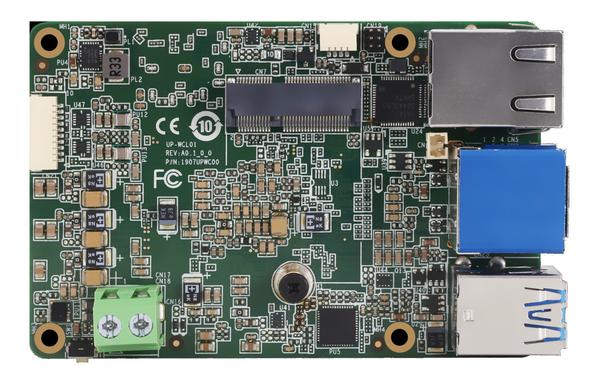
UP WCL – A credit card-sized Wildcat Lake SBC with up to 24GB LPDDR5, 256GB UFS
AAEON's UP WCL is an upcoming credit card-sized single board computer (SBC) powered by an Intel Wildcat Lake processor up to the Core 7 350 hexa-core CPU paired with up to 24GB LPDDR5 and 256GB UFS storage. The board also features an HDMI 2.1 video output, a 2.5GbE RJ45 jack, an M.2 Key-E socket for optional WiFi and Bluetooth connectivity, three USB 3.2 ports, and a few wafers for I/O expansion. AAEON UP WCL specifications: Wildcat Lake SoC (one or the other) Intel Core 3 304 5-core CPU – 1x P-cores @ 1.5/4.3 GHz (Turbo) + 4x LPE-cores @ 1.4/3.3 GHz (Turbo) GPU – 1-core Intel Xe3 Graphics @ 2.3 GHz (9 TOPS) NPU – 15 TOPS Intel Core 5 320 6-core CPU – 2x P-cores @ 1.5/4.6 GHz (Turbo) + 4x LPE-cores @ 1.4/3.4 GHz (Turbo) GPU – 2-core Intel Xe3 Graphics @ 2.5 GHz (20 TOPS) NPU –

Orange Pi 6 single-board PC has a 12-core CIX P1 processor and two 2.5 GbE LAN ports - Liliputing
Orange Pi 6 single-board PC has a 12-core CIX P1 processor and two 2.5 GbE LAN ports
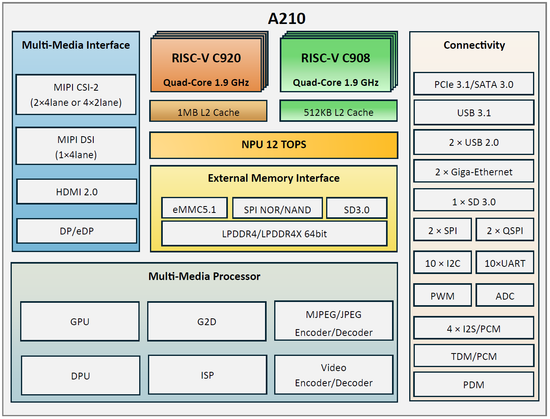
Zhihe A210 octa-core RISC-V SoC with 12 TOPS NPU powers SoM-based development board
Last year, we noted three upcoming high-performance RISC-V SoCs to watch out for: Zhihe A210, SpacemiT K3, and UltraRISC UR-DP1000. The K3 has already been launched, and I'll work on the K3-Pico-ITX SBC/mini PC review this coming weekend, while the UR-DP1000 is (still?) expected on the Milk-V Titan motherboard. However, we did not have that many details about the Zhihe A210 so far. This has now changed since documentation has surfaced for the Zhihe A210 and a development kit (A210 SODIMM V2) based on a carrier board and a system-on-module itself powered by the octa-core RISC-V processor. Let's have a look at both. Zhihe A210 octa-core RISC-V SoC Zhihe A210 specifications: CPU - Octa-core RISC-V RV64GCV processor 4x 64-bit RISC-V C920 cores @ up to 2.3 GHz with 64 KB I Cache and 64 KB D Cache for each core, 1 MB L2 cache; note: 1.9 GHz is also shown
Linux 7.1 Release – Main changes, Arm, RISC-V, and MIPS architectures
Linus Torvalds has just released Linux 7.1 on LKML: So it's only Sunday morning back home, but it's Sunday afternoon where I am right now, so I'm doing the 7.1 release at the regular time - just not in the regular timezone. This obviously means that the merge window opens tomorrow, but I'll be in yet another timezone by then, so timing will all be a bit irregular. Normally I try to front-load the merge window and do as much as possible the first few days - this time I'm not sure that will work out with my laptop and a couple of long flights without internet, but I've made sure that I have fetched the early pull requests (thank you - you know who you are), so I will be able to do some of it off-line. Anyway, possible slight hiccups in the merge window aside, the news today

Gateworks Catalina GW9200 NXP i.MX 95 SBC features Flexible Socket Adapter sockets for M.2 or mPCIe modules
Last March, Gateworks introduced the Catalina SBC family, starting with the GW9200 board, based on NXP i.MX 95 SoC for industrial Edge AI applications, and featuring Flexible Socket Adapter (FSA) sockets to accommodate either mini PCIe or M.2 module adapters, depending on requirements. We missed the original announcement, but the new SBC family was brought to our attention when Ezurio announced the acquisition of Gateworks last week. The GW9200 board comprises a system-on-module with the NXP i.MX 95 chip, 4GB LPDDR5 and 8GB eMMC flash by default, as well as a carrier board with 10GbE and GbE RJ45 ports, a MIPI DSI/CSI display/camera interface, two FSA sockets for M.2 or mini PCIe expansion, and a range of I/Os. Ezurio/Gateworks Catalina GW9200 specifications: SoC – NXP i.MX 95 CPU Up to 6x Arm Cortex-A55 application cores clocked at 1.8 GHz with 32KB I-cache and D-cache, 64KB L2 cache, and 512KB L3

NanoPi M6V2 RK3588S SBC gains support for dual analog microphone input
FriendlyELEC's NanoPi M6V2 is an update to the NanoPi M6 Rockchip RK3588S SBC, whose main change is a 4-pin connector for dual analog microphone input. The RAM is also now fixed to 8GB (no more 4GB, 16GB, or 32GB options), some buttons have changed, and the company has stopped offering an enclosure with a built-in 3.5-inch display. The rest of the specifications remain the same, with LPDDR5 memory, support for microSD, eMMC flash, or NVMe storage, HDMI 2.1 and MIPI DSI display interfaces, MIPI CSI camera inputs, Gigabit Ethernet and optional M.2 WiFi/Bluetooth connectivity, a few USB ports, and a 30-pin GPIO header. NanoPi M6V2 specifications: SoC – Rockchip RK3588S CPU – Octa-core processor with 4x Cortex-A76 cores @ up to 2.4 GHz, 4x Cortex-A55 cores @ up to 1.8 GHz GPU – Arm Mali-G610 MP4 GPU compatible with OpenGL ES 3.2, OpenCL 2.2, and Vulkan 1.2 APIs VPU –
 cnx-software.com [Unofficial]
 Liliputing