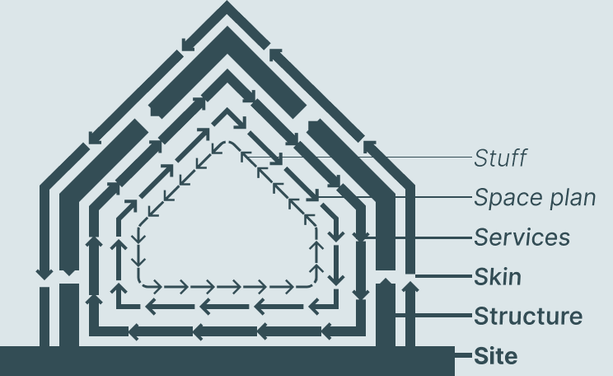
For some reason Brand's #PaceLayering gets explained by the first diagram, but I find the earlier formulation, #ShearingLayers (second diagram), and its building construction metaphor to be much more intuitive
(via https://jods.mitpress.mit.edu/pub/issue3-brand/release/2 )

Pace Layering: How Complex Systems Learn and Keep Learning
Pace layers provide many-leveled corrective, stabilizing feedback throughout the system. It is in the contradictions between these layers that civilization finds its surest health. I propose six significant levels of pace and size in a robust and adaptable civilization.
Pace layers in experience design — Stabilise innovation by understanding people’s needs
Innovation falls flat when it doesn’t respond to a human need. Use human-centred approaches to understand people’s fundamental motivations and needs. These are the stabilising forces for innovation.
https://duncanstephen.net/pace-layers-in-experience-design-stabilise-innovation-by-understanding-peoples-needs/
#swDevTermOfTheDay #ShearingLayers is a concept from civil engineering which also applies to software systems. It emphasizes that different parts of systems tend to change a different speeds and thus need different design approaches.
 juno
juno

 Duncan Stephen


 Michael Hönnig