Seattle Neighborhood Greenways becomes the Seattle Streets Alliance

Seattle Neighborhood Greenways is now the Seattle Streets Alliance.

“It’s a better explanation of who we are and what we’re about,” said Streets Alliance Executive Director Gordon Padelford. It’s true. The organization convenes coalitions around safe streets and transit and housing. They have led and helped lead major pushes to increase the size of multiple transportation levies and then helped gather support to pass those levies. They have advocated around boosting public benefits from major projects like the Convention Center Expansion. They have led efforts to craft transportation equity policies and best practices. They have helped organize memorial walks and bike rides for people who have been killed in traffic. The partner groups that make up the Streets Alliance advocate to fix local issues, like more and better crosswalks. They help the city craft biking and walking improvements that are informed by the detailed knowledge and experiences of people who live near them. The name “Seattle Neighborhood Greenways” has not really fit their work for a long time.

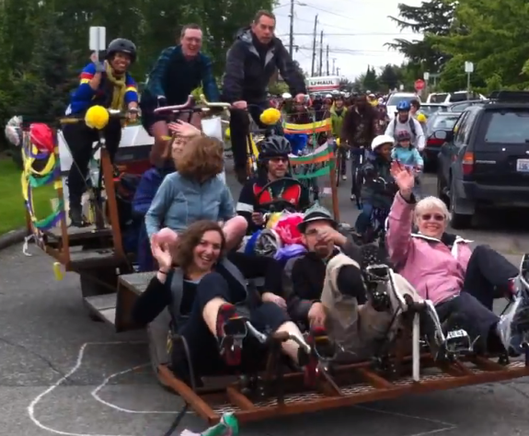
The organization started as a handful of neighbors on Beacon Hill and in Wallingford who were attempting to get the city to start building neighborhood greenways to make it easier for people to walk and bike around their own neighborhoods. So much of the focus around bike projects to that point had been on cross-city commute routes, and these groups wanted the city to also pay attention to routes between homes and schools and parks and business districts. In 2010 when the organization started to form, the city had not yet built such a project. They quickly found success. Spokespeople in Wallingford, led by Cathy Tuttle, convinced the city to create a pilot neighborhood greenway on N 44th Street in Wallingford while Beacon BIKES (which long ago changed its name to “Beacon Hill Safe Streets“) won a grant to hire a design firm to create an entire neighborhood circulation plan focused on walking and biking. That plan still forms the skeleton of the city’s bike facilities plan for Beacon Hill. The Beacon Hill group created the template for other groups to try to follow. They valued community building as much or more than the technical details of a design plan. To advocate for their preferred route for the neighborhood’s first neighborhood greenway, they held a community parade along the route, including Councilmembers Sally Bagshaw and Transportation Committee Chair Tom Rasmussen riding an eight-seated pedal-powered parade float (the driver has a steering wheel, brake pedal and clutch because this thing is a stick shift and can only be driven if you have enough people to pedal it). It wasn’t about taking away space from cars, it was about creating space for joy and community.

The 8-seated people-powered parade float designed by Colin Stevens pedaled with the help of then-Councilmembers Sally Bagshaw and Tom Rasmussen (Transportation Committee Chair). April 2011. Video.

The Beacon Hill and Wallingford successes inspired other neighborhoods to get together and form their own groups, and Tuttle saw the need for a new non-profit organization to support all these neighborhood groups and help them share resources. So she became the founding executive director of Seattle Neighborhood Greenways, which followed an unusual but powerful philosophy of being a bottom-up organization where the work of the satellite groups informs the work of the central organization. Rather than having HQ send orders and tasks down to the smaller groups, HQ exists to support the work of the independent groups that are most comprised of volunteers. The idea set off an explosion of neighborhood-level organizing in all corners of the city as folks got together to commiserate about annoying and scary streets or crossings they have to use every day and then come up with ideas for how to fix them. Padelford called this alliance of neighborhood groups “our secret sauce,” which is why their new name uses that term.

Almost immediately after forming, Seattle Neighborhood Greenways and its growing number of member groups were advocating for changes beyond neighborhood greenways. The neighborhood greenway was a solid and achievable grounding task that a new group could rally around, but sometimes the biggest neighborhood safety need was a bike lane or a crosswalk or curb cuts or a traffic signal. Sometimes what was really needed was a neighborhood celebration. The exact infrastructure wasn’t really as important as the end goal of creating safer streets for people of all ages and abilities.

The first internal document discussing the need to change the name of Seattle Neighborhood Greenways is from 2014, Padelford said. They picked the issue back up 2019, but it fizzled out. It’s a lot of work to change a name once it is established, and it kept getting kicked to the to-do list as more pressing work got priority. But when Joshua Holland came on board as Communications Director, he finally saw it through. “Credit to Josh Holland for keeping up on task,” said Padelford.

Several of the neighborhood groups are using this as an opportunity to also change their names, though it was not a requirement. Here’s the updated list of group officially part of the alliance:

  • Ballard Fremont Green Streets
  • Beacon Hill Safe Streets
  • Central Seattle Streets for All
  • Downtown Seattle Greenways
  • Duwamish Valley Safe Streets
  • First Hill Improvement Association
  • Green Lake Wallingford Safe Streets
  • Lake City Streets Alliance
  • Northeast Safe Streets
  • Northwest Greenways
  • Queen Anne Streets Alliance
  • Rainier Valley Safe Streets
  • West Seattle Bike Connections

If you’re interested in become part of the effort to make your neighborhood’s streets safer, you can find info on each group on the Seattle Streets Alliance website. As with any volunteer-led effort, some groups are very active while others are in need of more leaders and volunteers. So if you aren’t seeing very much on the calendar in your neighborhood, then maybe you can be the next person to step up and make things happen.

#SEAbikes #Seattle

Alert: It is once again time to voice overwhelming support for a safer Lake Washington Blvd

Speed cushions don’t stop anyone from driving, but they do make it a little harder to drive too fast.

Even the dramatically watered-down and insufficient traffic calming improvements planned for Lake Washington Boulevard are now apparently at risk after pushback from “people who enjoy driving as fast as they want along the boulevard,” as Seattle Neighborhood Greenways put it. Neighbors have campaigned for years about the need for safer walking and biking space on the storied lakeside boulevard, one of the only reasonably flat north-south routes in southeast Seattle. Extensive public outreach showed very strong support for ambitious changes, but SDOT and Seattle Parks decided to ignore their own outreach and instead give a baffling amount of authority to a failed and resentment-consumed community task force effort in 2022–23 that was unable to agree on much of anything beyond a short list of low-cost, unoffensive and insufficient traffic calming improvements that finally made it to construction in 2024 and 2025. We’re talking about a handful of crosswalk improvements, some speed humps, and some boulders in places where people keep driving off the road and into the park and lake. The final list falls far short of than the permanent on-street walking and biking path and expanded Bicycle Weekend hours advocates were initially hoping for. Safety opponents won, and now at least some of them are fighting even the scraps that made it through by pressuring the city to cancel the second half of the planned improvements.

You can help by using their handy online form to send letters to city leaders supporting completion of the traffic calming work. You can also join supporters at a community meeting 6:30 p.m. December 12 at the Mount Baker Rowing and Sailing Center (3800 Lake Washington Blvd S) in person or online.

I honestly have no idea why the winners of this joke of a public process would want to reopen debate on this matter, but fine. Let’s do it. Let’s reopen this project debate. If they don’t know how to take a W, then let’s turn it into an L.

Every time the city surveys people about the idea of a permanent safe space for walking and biking on Lake Washington Blvd., the result is resounding and enthusiastic support. A 2022 public outreach effort got survey responses from 3,048 people, 73% of whom lived in a Seattle zip code that includes Lake Washington Boulevard. The survey asked respondents to pick up to three of their preferred improvements they you like to see on the boulevard. Respondents overwhelmingly supported adding dedicated space for biking (2,319 or 76%), increasing the number of Bicycle Weekends days (1,754 or 58%), and adding traffic calming like speed humps (1,664 or 55%), the top three of eight options. Even though 31% of respondents said they drive on the boulevard as their main commute route, only 14% chose “do nothing” as one of their three preferred changes to the street, a dismal 5% of total responses to the question. Even when they did in-person intercept surveys at nearby grocery stores and community events, they got similar support for better walking and biking conditions on the boulevard even from people who said they usually drive there. Yet we find ourselves once again having to fill out action alerts and pressure city leaders not to listen to this demonstrably unpopular opinion even after these decisions were already made and work is already underway.

From Jan 2015 to April 2022, there were 101 collisions on this park boulevard, including 36 that injured at least one person and 6 that resulted in serious potentially life-long injuries. This is unacceptable and must change. Speed humps, stop signs and raised crosswalks should help, which is why Rainier Valley Greenways has been supporting the watered-down plans despite their frustrations with the process and result. But even once the traffic calming elements are completed, the work will not be finished. Hopefully the rate of serious crashes will be reduced, but there will still be no dedicated space for people of all ages and abilities to bike on the street.

Lake Washington Boulevard is a park. It falls under the purview of the Department of Recreation and was originally designed by the Olmsted Brothers in the early 1900s as a park boulevard, though the Parks Department has since deferred much of the process to SDOT as the city’s experts on roads and traffic. Lake Washington Boulevard is not and has never been a highway, and fast car travel should not be a priority on this street at all. The goal should be to maintain vehicle access to homes and destinations including parking lots, loading zones and boat launches, but that is where a park’s duty to vehicle access ends. The primary goal needs to be providing safe access to everyone regardless of how they traveled there, and the secondary goal should be fostering an extraordinary park experience along our waterfront.

The issue of how to make Lake Washington Boulevard safe for everyone is not over. I am still angry at the city for the way they handled the task force in 2022, which had no logical reason to be given decision-making power. Ideas that got 73% support from a survey of thousands of neighbors got shut down because on the day of task force voting only 10 people could make it and 5 of them voted no. This is not how public outreach or community task forces are supposed to work. Community task forces are supposed to exist so a subset of community members can discuss an issue in a more in-depth manor. You can gather a lot of qualitative feedback, and the task force members can take what they learn back to their larger communities, etc. They are not supposed to be used as democratic decision-making bodies because they were not selected by a population. In a best scenario, task force members could come together and attempt to find some common ground, learn from each other and then maybe some people would change their minds. If you purposefully create a task force so that it contains half people in favor and half against as the city did in this case, you cannot treat a resulting 5–5 split vote as a sign of anything other than that your task force process did not change anyone’s mind. By saying that they would follow whatever the task force recommends, the city essentially told a few safe streets supporters that if they wanted the city to make it safe to ride a bike on this park boulevard, they would need to change the minds of a couple of their outspoken opponents within 10 meetings. They couldn’t, and so the city didn’t. What a ridiculous hoop to force advocates to jump through, and what a mockery of real public outreach.

Let’s get the rest of these speed humps and crosswalks done so we can get to work on the next phase: Safe access for all park users.

More details on the latest action from Seattle Neighborhood Greenways:

Thanks to past community advocacy for a safer and more accessible Lake Washington Boulevard, construction began this November, dramatically reducing dangerous speeding on the boulevard! 🎉🎉🎉 The project is now half completed, with another round of construction expected in spring/summer 2025.

📣But now, completion of the these basic safety improvements for Lake Washington Boulevard are at immediate risk. People who enjoy driving as fast as they want along the boulevard are opposed to basic traffic calming improvements like speed humps are pushing to axe the second phase of traffic calming improvements slated for next summer.

We need your help:

  • Show up: Community Meeting on Thursday, Dec 12, 6:30 – 8:00 pm. In person at the Mount Baker Rowing and Sailing Center (3800 Lake Washington Blvd S)
  • Write an email in support of a safer and more accessible Lake Washington Blvd. Use the easy form letter to the right or write your own and send to: [email protected], [email protected], [email protected], [email protected], [email protected], [email protected], [email protected], [email protected], [email protected].
  • Share this page with 3 neighbors or friends. Word of mouth is the best form of advocacy.
  • Thank you for your ongoing advocacy!

    BACKGROUND:

    Lake Washington Boulevard is one of Seattle’s greatest parks. Year round, Seattle families enjoy walking, biking, rolling, swimming, pleasure drives, and more along the 3-mile shoreline between Mt Baker Beach and Seward Park.

    As our city has grown, car traffic on Lake Washington Blvd has grown dramatically. More and more drivers use the blvd as a highway, rather than as a scenic drive, bike ride, or stroll it was originally designed for, threatening the safety of other park users.

    The proposed renovations are a set of low-cost “short term improvements” that are the result of an extensive three-year process, with vocal and ongoing community support for slowing dangerous speeding and rollover crashes along this peaceful park boulevard. The goal is to reduce vehicle speeds to the posted speed limit, reduce street racing, improve pedestrian access when crossing the blvd to access the waterfront, and improve safety for people walking, rolling, and biking along the blvd.

    The curb bulbs, stop signs, and speed humps installed in November are incredibly helpful in slowing dangerous speeding, but not adequate to address safety for the full 3-mile corridor.

    We are asking elected officials and city staff to complete the remaining portion of the project without delay or watering down the designs from Mt. Baker Beach to Seward Park.

    #SEAbikes #Seattle

    Seattle prepares to pass budget with huge increases for safe streets + What CM Saka should do about Delridge

    From an SDOT presentation to the City Council’s Special Budget Committee (PDF).

    Thanks to Seattle voters, in 2025 the city is poised to invest $21 million in new sidewalks, $4.2 million in sidewalk repairs, $8.6 million in Vision Zero, $1.6 million in Safe Routes to School, $9.8 million in new protected bike lanes, and $1 million to upgrade existing bike lane barriers. To deliver all this, they are also going on a hiring spree, so if you know anything about building sidewalks you should keep an eye out for job listings.

    The sidewalks funding line is particularly eye-catching and is the result of a decision to front-load sidewalk construction early in the first four years of the levy. Not only will this result in more sidewalks sooner, it should also help prevent sidewalks from getting cut in future years if some unforeseen issue arises that leads to cuts in the levy spending plan.

    SDOT could get an even faster start if the Council dropped their proposed proviso on about half the levy funds for 2025 ($89 million), which would prevent the department from accessing those funds until they have presented a spending plan that the council approves. The council could instead request a spending plan by a certain date without holding up the funds, and they can always take action at that point if they want to change something. SDOT has a huge amount of work to complete in just eight years, including the time-consuming process of finding, hiring and onboarding new staff. Getting a slow start on Move Seattle projects was a huge problem for the previous levy, and a mistake the city should not repeat. The Council should not get in their way unnecessarily.

    Seattle Neighborhood Greenways has put out an action alert urging folks to contact Councilmembers with a set of asks outlined at the bottom of this post. You can find documents regarding the Council’s budget amendments via the 2025-26 budget’s Legistar page. Many are within the “proposed consent amendment package,” though the final outstanding changes are in the “amendments for individual vote.” You may also need to reference Mayor Bruce Harrell’s proposed budget, which is found on a completely different website. The Council is debating amendments this week and will make their final votes on Tuesday and Thursday next week.

    As part of the consent package, City Council has proposed creating a new $7 million per year Council District Fund within the SDOT budget for “neighborhood-scale traffic safety improvements and other district transportation priorities at the direction of the City Council.” In other words, a council slush fund. This would be a rare diversion from the usual way council and mayoral duties are divided in Seattle since Council rarely ever “directs” a department. Usually, the council is limited to providing (or placing conditions on) funding and setting official policy, but the actions of the departments nearly always go through the mayor.

    I know “slush funds” have a bad rep, but I’m very interested to see how this new fund works in practice. It could be nice for Councilmembers to actually be able to respond more quickly to reasonable smallish requests from constituents. It’s frustrating for everyone when, say, a group of neighbors ask for a stop sign only to run into a dead end trying to get it onto SDOT’s workplan. But I’m sure the quality of return the public gets from these investments will vary greatly depending on the Councilmember directing the funds. I am also very interested to see what happens if a councilmember directs a project that the mayor opposes. Whose “direction” will win?

    There are a handful of items that are still up for debate. We reported yesterday about the Council’s proposed actions to come up with a plan to shut down the South Lake Union Streetcar and remove the Center City Streetcar from the capital improvements list, so I won’t go into that again here.

    Councilmember Sara Nelson has proposed a pointless and frankly obnoxious amendment that would “Request that SDOT provide a report on the performance measures and evaluation criteria used for consideration of bus-only lanes.” Specifically, she wants the report to detail how SDOT evaluates things like the “impact on general traffic capacity and congestion” and “any measures SDOT may take to mitigate potential underperformance.” Nelson and the rest of the City Council just passed a massive policy document called the Seattle Transportation Plan, and it includes meticulous explanations for how and why the city will make various transportation improvements including bus-only lanes. Here’s the transit section (PDF), which has a whole section starting on page T-62 about “defining success” that lists all the ways SDOT will measure outcomes from transit investments. Nelson either doesn’t understand what she voted for when approving the Seattle Transportation Plan or she is trying to undermine it. For example, the city very intentionally shifted to metrics that “prioritize person-throughput rather than vehicle throughput,” (page T-66) not metrics that prioritize the “impact on general traffic capacity.” Council should vote no on this one.

    The transportation amendment that has gotten the most attention (other than the streetcar) is probably Councilmember Saka’s $2 million project in the consent package to allow left turns into the Refugee and Immigrant Family Center Bilingual Preschool. This is the site of the Delridge Way SW centerline curb that Saka infamously compared to the Trump border wall in an email years before he ran for City Council, as reported by Publicola. We addressed this location and those emails with Councilmember Saka in an introductory interview at the start of the year when he was named Chair of the Transportation Committee. That little curb, which prevents left turns into and out of the preschool his kids attended, was one frustration that helped set him down the path to running for office. The inflammatory border wall comment is hanging over the conversation about this amendment, but that annoying curb is one symptom of larger and genuinely frustrating issues with the Delridge design.

    If I were to advise Councilmember Saka on this, I would suggest clearing the air about the border wall comparison. Mea culpa. Then expand the scope of this amendment to address issues at the core of the Delridge design problem so that the benefits expand across the neighborhood rather than just this one preschool, which feels a bit too specific for a public investment of this scale. Folks at the preschool were not the only ones who were ignored during the creation of this Durkan-era planning monstrosity. Many of the oddities on the street design (like the center buffer areas that look like turn lanes but aren’t or the fact that there’s only one bike lane on a two-way street) are because the street has three lanes southbound (one general, one bus and one bike) and one lane northbound, which is pure nonsense. Traffic is not heaver in one direction than the other, so why on earth would the road be designed this way? It’s as though the street thinks people head south and never come back. This is the actual source of Councilmember Saka’s issue. That center line curb is only needed because people would have to turn across multiple lanes plus the bike lane, a scenario we know to be potentially dangerous. The curb itself is not the problem, it’s a symptom of the street design’s illness. With a left turn pocket instead of a second southbound lane, people would only need to turn across one lane plus the bike lane, which is easier to do safely. All the unmarked crosswalks along Delridge would also become much safer with only one lane in each direction, another benefit. The primary tradeoff would be that southbound buses would need to use in-lane stops the way northbound buses already do, and SDOT staff would need to check that this would not negatively impact transit service. It would also be amazing if this project could add the missing northbound bike lane to the street because it makes no sense to have a protected bike lane in only one direction. I’d go as far as to say the Delridge street design is downright embarrassing to the city and the RapidRide name.

    Below is the text of the amendment as currently written. Hopefully Councilmember Saka will do a rewrite before final passage:

    This Council Budget Action (CBA) would impose a proviso on $2 million of appropriations in the Seattle Department of Transportation’s (SDOT’s) budget to make improvements to Delridge Way SW near the SW Holly St right-of-way to allow for left-turn ingress and egress from adjoining properties, including the Refugee and Immigrant Family Center Bilingual Preschool. These improvements would resolve access conflicts with the operation of the Delridge RapidRide service. It is the Council’s expectation that SDOT shall deliver these improvements, and that SDOT will begin project development and implementation no later than August 1, 2025.

    One small note is that the revised budget reverses about $8 million over two years that the mayor’s initial levy-free budget had planned to add for “protected bike lanes and transit corridor improvements,” largely work that had been delayed past the end of the Move Seattle Levy. The plan from the start was to instead use Seattle Transportation Levy funds for these projects if voters approved it, which they did. When I initially saw the reduction in bike lane spending, I was concerned. But after a lot of budget diving and searching (can Seattle please make this process easier to follow?), I finally figured out that the “cuts” were from the mayor’s proposed budget, which had to be written assuming the levy would fail. The mayor’s office had cobbled together funds to finish projects that went past the Move Seattle Levy end point so that even if voters did not approve the levy, those projects could still be completed. Once the levy passed, those cobbled together funds were removed as planned. So really this change is not a problem, but I am leaving this paragraph here just in case someone else discovers those apparent “cuts” and has the same concern I did.

    Seattle Neighborhood Greenways sent out an action alert calling for the following budget changes:

  • No cuts to Accessibility. There is a massive backlog to make our streets accessible for everyone. Funding from the newly passed transportation levy will make large investments in accessibility, but unfortunately the City Council is proposing to cut some of existing ADA funding in the mayor’s proposed budget. The levy is meant to be additive, not a replacement for existing funds. 
  • Don’t undo valuable safety projects. An amendment proposed by Councilmember Saka would spend $2M of taxpayers’ dollars to remove a safety barrier that prevents an illegal left turn into a parking lot on Delridge Way SW. Traffic safety barriers prevent the hitting and killing of pedestrians.
  • Do not hold Levy funding hostage. Council already approved this levy proposal in July before sending the package to voters. But now they’re proposing a proviso on half the levy, or $89M. This would delay SDOT hiring new staff and hinder their ability to advance projects quickly in 2025, and holds hostage funding that voters just approved by a landslide.
  • Automated camera revenue needs to go back into traffic safety. The 2025 budget includes an expansion of automated school zone speed cameras while diverting revenue from automated enforcement away from physical street improvements that keep kids safe on their way to school. Any automated enforcement cameras should be a temporary solution, and all revenue should go towards physical street improvements.
  • We also stand in support of the Solidarity Budget Coalition’s push against austerity budgeting. We need to shift funding from criminalization to invest in community needs and pass new progressive revenue to adequately fund our city’s needs. See here for more details.
  • #SEAbikes #Seattle

    Seattle prepares to pass budget with huge increases for safe streets + What CM Saka should do about Delridge – Seattle Bike Blog

    From an SDOT presentation to the City Council's Special Budget Committee (PDF). Thanks to Seattle voters, in 2025 the city is poised to invest $21 million in new sidewalks, $4.2 million in sidewalk repairs, $8.6 million in Vision Zero, $1.6 million in Safe Routes to School, $9.8 million in new protected bike lanes, and $1…

    SNGreenways storymap shows how the 2015 transportation levy ‘made Seattle a safer place for walking, biking and rolling’

    Check out the full feature.

    The 2015 Move Seattle Levy added nearly 100 miles to Seattle’s bike network, repaired or replaced 44 public staircases, built 1,600 new accessible curb ramps, made 293 transit improvements, repaired 220 blocks of sidewalk and built 350 new blocks of sidewalk. This is in addition to all the other road and bridge maintenance work.

    It’s easy to forget how much Seattle has accomplished since voting in 2015 to nearly triple its transportation levy. Now that voters are in the process of deciding whether to increase the levy by yet another 88% annually by voting YES on Seattle’s Proposition 1, it is worth revisiting what the expiring levy has accomplished.

    Seattle Neighborhood Greenways, which has endorsed Prop 1 and has been working to get out the vote, created a StoryMap highlighting just a few of the projects that only exist because voters in 2015 approved the levy. Some of my favorite projects that they didn’t list include the Duwamish Trail connection just south of the West Seattle Bridge, the SW Admiral Way bike lanes (do you all remember how scary that climb used to be?), and the Rainier Valley Neighborhood Greenway (though it’s not an effective alternative to Rainier Ave bike lanes, it is a great project on its own). A few more major levy-funded additions are still pending construction, including the Georgetown to Downtown bike route, the Alaskan Way bikeway completing the Elliott Bay Trail, and the in-construction project on 11st/12th Ave NE that will connect to the Eastlake bike lanes as part of the under-construction RapidRide J project.

    I, for one, am excited to see what SDOT can accomplish with 86% more annual funding for Vision Zero, 105% more funding for sidewalks, curb ramps and crosswalks, and 108% more funding for bicycle safety. Vote YES on Proposition 1! If you want to help further, sign up for a volunteer effort to get out the vote.

    #SEAbikes #Seattle

    ‘Our kid is biking on MLK!’

    This photo turned out much cooler than I expected when I took it.

    The new bike lanes on MLK Jr. Way from S Judkins Street to Mount Baker Station feel like a shortcut. It’s both more direct and more gradual than any of the alternative bike route options previously available. You no longer need to scale the cliffside up to Leschi to get between Franklin High School and the I-90 Trail. While a handful of people would just go ahead and bike on the four-to-five-lane road, it was not an experience for the faint of heart.

    Even though I have ridden (and reported about) these new bike lanes previously, watching my six-year-old ride comfortably from Mount Baker Station to Judkins Park was still amazing. When my spouse Kelli yelled out, “Our kid is biking on MLK!” that’s exactly how I was feeling. If she can do it, then that means so many more people can, too. Sure enough, I saw more people biking on MLK in one block than I think I have ever seen biking there previously. I’m not even counting the people biking in the Seattle Neighborhood Greenways family-friendly celebration ride we joined Sunday.

    Photo from Gordon Padelford of Seattle Neighborhood Greenways.

    The investments Seattle is making to create bike routes that children can use are going to keep paying off for generations. My child’s experience of growing up here will involve more independence and freedom than children had in my generation. And so long as Seattle passes the transportation levy in November and continues to build bike lanes like the ones on MLK, the next generation of Seattle kids will have even more freedom than my child. After a century of changes to our roads that pushed kids to the side, keeping them confined to their homes or limited areas like parks or a few indoor recreation spaces, we are finally creating real space for them within the fabric of our city. In the process, we’re creating connections and spaces that are comfortable for everyone.

    Share

    #SEAbikes #Seattle

    ‘Our kid is biking on MLK!’

    This photo turned out much cooler than I expected when I took it. The new bike lanes on MLK Jr. Way from S Judkins Street to Mount Baker Station feel like a shortcut. It’s both more direct an…

    Seattle Bike Blog

    Greenways: 6 people killed in Seattle traffic in a single week as Council considers street safety funding

    Base map of the High Injury Network from the recently-approved Seattle Transportation Plan. Broken hearts added by Seattle Bike Blog to note the locations of the six traffic deaths in Seattle between May 23 and 29.

    Traffic deaths in Washington State reached a high in 2023 that the state has not seen in 33 years. That number of deaths in 2023 increased 10% over 2022. King County leads the way with 167 people killed in traffic, more than double the number in 2014. These are all the big numbers on a scale that it’s difficult to wrap your head around.

    But then last week happened. Six people were killed in Seattle traffic in just seven days, a horrific level of traffic carnage the city has not seen in such a short period of time since the 2015 Ride the Ducks disaster on the Aurora Bridge killed five people. But these six deaths were not the result of one negligently-maintained axle on a dangerous tourist vessel, they were spread out across the city on streets that Seattle knows are dangerous.

    Our condolences to the friends and families of the six people killed.

    Three of those killed were inside cars while the other three were walking when someone in a car struck them. As you can see in the map above, every single death occurred on a street designated with a high injury score on the newly-approved Seattle Transportation Plan’s High Injury Network. These are streets “where fatal and serious crashed have already occurred,” according to the plan (page V-30 in the technical report). “Its use is considered a reactive approach that informs safety corridors of focus for the Vision Zero program and more.”

    Seattle has more than enough data to identify where we need Vision Zero safety improvements, but now these six people have involuntarily added six more data points to this terrible map. Their lives are why this work is so important, and why the Seattle City Council could not possibly add too much funding for Vision Zero work in the next transportation levy. Every time SDOT’s Vision Zero team makes significant safety improvements to a street, it works. But the city continues to fund this work at a snail’s pace.

    Seattle should simply not have a “high injury network” of streets. We built these streets, and so now it’s our city’s job to fix them before more people get hurt or killed. SDOT’s Vision Zero team has proven themselves worthy of our trust. It’s time to fund them properly and make a moonshot to actually reach Vision Zero by 2030 as is the city’s official policy goal. It’s not going to be easy or cheap, but we owe it to all those who have been killed and all their communities who have been shattered. Every time I speak to a grieving loved one of someone who has been killed, they all say the same thing: This can never happen to anyone else again. Let’s listen to them.

    Seattle Neighborhood Greenways is calling on the City Council to increase the funding for safety, sidewalks and transit in the transportation levy proposal, and they are encouraging people to attend the final scheduled public hearing on the proposal at 4:30 p.m. June 4 at City Hall. Their polling suggests that voters are eager for more safety funding and would be willing to invest hundreds of millions more than is included in the current levy proposal. More details from SNG:

    In a shocking surge of deadly collisions, six people have been killed while traveling on our streets in the past week:

  • A 70-year-old woman was killed on May 23rd while a passenger at 4th Ave S and S Washington St in the C-ID neighborhood. 
  • A 19-year-old man was killed on May 23rd while driving on Aurora Ave N at 137th St in the Haller Lake neighborhood.
  • Stephen Willis, a UW Medical Assistant, was killed on May 23rd while walking on Aurora Ave N at Northgate Way in the Licton Springs neighborhood. 
  • A 30-year-old man was killed on May 24th while walking on Boren Ave at Olive Way in the Denny Triangle neighborhood.
  • A 63-year-old woman was killed on May 26th while walking on 12th Ave S at S Weller in the C-ID Neighborhood.  
  • A 78-year-old person was killed while driving on May 29th on MLK Jr. Way S at Rose St. 
  • While investigations into each case are ongoing, what can be said now is that we are not making sufficient progress on Seattle’s Vision Zero goal, to eliminate fatal and serious injury collisions. At Seattle Neighborhood Greenways, we believe the next transportation levy, which will be on the Seattle November 2024 general election ballot, must take bold steps to invest in safe streets improvements to get this safety crisis under control. The levy is currently with the Seattle City Council for review and amendments.

    More…

    Share

    #SEAbikes #Seattle

    Greenways: 6 people killed in Seattle traffic in a single week as Council considers street safety funding

    Base map of the High Injury Network from the recently-approved Seattle Transportation Plan. Broken hearts added by Seattle Bike Blog to note the locations of the six traffic deaths in Seattle betwe…

    Seattle Bike Blog

    Rita Hulsman donates $20,000 from GoFundMe for late husband Steve to benefit safe streets orgs

    Watch the KIRO 7 News report.

    In the aftermath of the devastating news that Steve Hulsman was struck and killed while biking in West Seattle, 177 people donated more than $20,000 to help his wife Rita cover costs related to his death. But Rita had a different idea in mind for this money raised with love for her and her late husband: Use it to make streets safer so this doesn’t happen again.

    Rita donated $10,000 to both Cascade Bicycle Club and Seattle Neighborhood Greenways to support their work to improve street safety. “I don’t want anyone else to go through what my husband went through and I know the work you do will move that along,” she said to Cascade Executive Director Lee Lambert during a KIRO 7 News report.

    The driver who struck and killed Steve, who KIRO 7 News identified as Aaron Ludberg, has not been charged for actions directly related to the collision. He is facing lesser charges for driving with a suspended license and driving without a court-mandated ignition interlock device. We reported previously on the investigation in which SPD’s Traffic Collision Investigation Squad did not begin working the case until after the scene had been cleared and streets were reopened.

    Steve sought out difficult rides with lots of climbing, which is why he was riding on Marine View Drive that evening in December. It was a route he had done countless times, and he was scheduled to lead a free group ride along it just days later. After his death, many people posted remembrances of how he had been an encouraging presence to help them complete difficult rides like the annual Ride Around Mount Rainier in One Day (RAMROD) event with its 10,000 feet of elevation gain. Rita told KIRO 7 News that Steven didn’t count miles, he counted feet of elevation gain. His goal was to log 1,000,000 feet of climbing to his cycling tracker Strava. When he died, he had climbed 787,641 feet, just 212,359 feet short of his goal.

    From Rita:

    Dear Tom,

    Thank you for your suggestions on which organizations I should consider for distributing the proceeds of the Remembering Steve Hulsman fundraiser I set up on GoFundMe several months ago.  After getting acquainted with each organization, I zeroed in on two that seem centered on the kinds of efforts I want to focus on in the aftermath of my husband’s death.  And since then I have distributed all of the proceeds of the Remembering Steve Hulsman fundraiser to two organizations.  

    This evening I posted an update on the Remembering Steve Hulsman GoFundMe page to let the almost 200 donors know how their contributions had been distributed, and I thought you might be interested as well, so I’ve included that update below my signature.  Please feel free to share it with your readers if you wish.

    Best regards,

    Rita Hulsman

    Thank you again for contributing to the Remembering Steve Hulsman GoFundMe. I have been so deeply touched by the generosity of the nearly 200 donors to this fundraiser which I set up initially to help cover medical costs for my late husband’s medical treatment and care in the hours before he passed away. Once I learned that these costs would be almost entirely covered by our medical and uninsured motorist insurance, I decided to pay your contributions forward to organizations that focus on cycling advocacy, education, and safety to decrease the likelihood that what happened to Steve would happen to another cyclist.

    I am happy to report that as of Friday, May 10, all of the funds raised through the Remembering Steve Hulsman fundraiser have now been distributed to two very worthwhile organizations: Cascade Bicycling Club and Seattle Neighborhood Greenways. In response, each organization has provided an explanation of how the funds that you contributed will be used. Following is what each organization wrote.

    From Cascade Bicycle Club:
    Your generous contribution in Steve’s memory will bolster Cascade Bicycle Club’s efforts to make bicycling safer. Specifically, these funds will help cover the staff costs of our policy team’s efforts to make our streets safe for people who walk or bike. Over the next six months, the team will be focused on ensuring bicycle safety is prioritized and funded in the Seattle Transportation Levy. Team members will participate in advisory committees, attend public hearings, and mobilize the Cascade Community to make their voices heard.

    From Seattle Neighborhood Greenways:
    Purpose
    The purpose of this gift is to advocate for improving safety for people bicycling in Seattle. Since our founding in 2011, we have organized and mobilized people to make every neighborhood a great place to walk, bike and live. We believe it is possible to transform our city into a place where it is safe, comfortable and convenient for people of all ages and abilities to bicycle, whether they use a bike to get where they need to go or to stay active and recreate.

    This gift comes at a transformative moment, as Seattle faces decisions that will determine whether the city will take bold action to prevent what happened to Steve from happening to anyone else. SNG is positioned to mobilize its coalition of 13 volunteer-led local groups, 2,000+ volunteers, partners and allies to push for meaningful progress.

    Use of Funds
    Specifically, SNG will use this gift in support of its 2024 work on the following priorities:

    Seattle Transportation Funding: The 20-year Seattle Transportation Plan was adopted in late April. This June, an 8-year levy to fund it is expected to be placed on the November ballot. We are working to secure at least $200 million for bicycling and Vision Zero projects.

    Vision Zero: Seattle is in a traffic safety crisis and we must make sure that everyone can get home safely. This work includes advocating to fix the city’s most dangerous streets – Aurora Ave N, Rainier Ave S, MLK Jr. Way S, 4th Ave S in SODO, and Lake City Way NE. It also includes spot safety improvements throughout the street network.

    UnGap the Map: 80% of people biking who are killed on our streets are run over on streets without bike infrastructure. We’ll continue our advocacy to connect every neighborhood with a safe bike route. Key corridors of focus include Beacon Ave S along its southern sections (working with Beacon Hill Safe Streets) and Sylvan Way SW & Fauntleroy Way SW (working with West Seattle Bike Connections). Together with our network of local groups we have produced a map of bike routes that should be prioritized for safety upgrades.

    To advance these priorities, SNG will: (1) engage community members in identifying community needs and advocating for solutions and investments that improve access to safe, comfortable and convenient bike routes; (2) make the possible visible by supporting neighborhood volunteer projects and storytelling about bicycling safety; (3) build public support for change through coalition building with groups working for a more bikeable, walkable and liveable city; and (4) work to hold the city accountable for achieving safety goals. This funding will also help leverage other individual contributions, foundation grants and corporate support to provide the collective resources necessary to advance these efforts.

    So once again, thank you from the bottom of my heart for your contribution to this effort. I look forward to developing an ongoing relationship with these two organizations and working with them on bicycling and pedestrian safety initiatives throughout our city and region.

    Share

    #SEAbikes #Seattle

    Rita Hulsman donates $20,000 from GoFundMe for late husband Steve to benefit safe streets orgs

    Watch the KIRO 7 News report. In the aftermath of the devastating news that Steve Hulsman was struck and killed while biking in West Seattle, 177 people donated more than $20,000 to help his wife R…

    Seattle Bike Blog

    How Mayor Harrell’s proposed transportation levy compares

    https://www.seattlebikeblog.com/2024/04/16/how-mayor-harrells-proposed-transportation-levy-compares/

    #SEAbikes #Seattle

    How Mayor Harrell’s proposed transportation levy compares

    The $930 million Move Seattle Levy was the most ambitious city transportation levy in the U.S. in 2015, but it also overpromised on what it could feasibly deliver for those dollars. The result is t…

    Seattle Bike Blog

    Alaskan Way bikeway will be wider, better protected in latest design update – UPDATED

    https://www.seattlebikeblog.com/2023/12/21/alaskan-way-bikeway-will-be-wider-better-protected-in-latest-design-update/

    #SEAbikes #Seattle

    Alaskan Way bikeway will be wider, better protected in latest design update

    The design for the Alaskan Way bike lane has reached the 90% milestone, and the latest version is wider and better protected. As before, the bike lane is still on the waterfront side of the street …

    Seattle Bike Blog

    Council passes budget with Mt. Baker, S Henderson safety projects + more

    https://www.seattlebikeblog.com/2023/11/22/council-passes-budget-with-mt-baker-s-henderson-safety-projects-more/

    #SEAbikes #Seattle

    Council passes budget with Mt. Baker, S Henderson safety projects + more

    Seattle Neighborhood Greenways organized a group to advocate for safer streets by holding up the names of victims of traffic violence during a budget hearing. For a budget cycle with tough revenue …

    Seattle Bike Blog