I was really honored to give a talk (remotely) at NASA Goddard today! Thanks for the invitation, and I hope we'll stay in touch!
#RemoteSensing #NighttimeLights #NightLightRemoteSensing #VIIRS_DNB #SDGSat1 #ESA #EarthExplorer #EarthObservation #LightPollution
I'm soon starting up a Nighttime Lights Remote Sensing webinar. Speakers will come from all over the world, and the talks will take place alternately in the (European) morning or late afternoon/evening, to allow international participation.
The first talk in the series is next Monday. If you're interested in attending, sign up here: https://www.listserv.dfn.de/sympa/subscribe/nlrs_webinar
#RemoteSensing #NighttimeLights #VIIRS_DNB #SDGSat1 #EarthObservation #FutureEO #ESA #NASA #NOAA
Really important new paper from Noam Levin comparing measurements with the #LANCube to #SDGSat1: https://www.mdpi.com/1424-8220/23/19/8237
This establishes for the first time that the flux of artificial light at street level is correlated with observations from space. That's not actually surprising, but it's an important step in establishing whether or not light measured from space is correlated with human exposure to light. #LightPollution #RemoteSensing
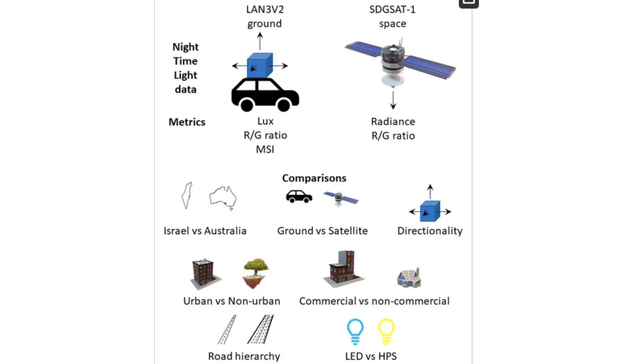

Quantifying the Variability of Ground Light Sources and Their Relationships with Spaceborne Observations of Night Lights Using Multidirectional and Multispectral Measurements
With the transition to LED lighting technology, multispectral night-time sensors are needed to quantify the changing nightscapes, given the limitations of the panchromatic sensors. Our objective was to quantify the contribution of lighting sources as measured on the ground and examine their correspondence with night-time brightness and color as measured from space. We conducted ground-based measurements of night-time brightness using the multidirectional (top, rear, right, front, left) and multispectral LANcube v2, which was mounted on the roof of a car, over 458 km of roads in central Israel and in Brisbane, Australia. For spaceborne measurements, we used the SDGSAT-1 multispectral Glimmer sensor. We found that spaceborne measurements of apparent radiance were best explained when including all ground-based directional measurements, with greater explanatory power for highways (R2 = 0.725) than for urban roads (R2 = 0.556). Incoming light in the five directions varied between road classes and land use. In most cases, the variability in night-time brightness and color was greater for urban road sections than for highways. We conclude that due to the spectral mixture of lighting sources, at a medium spatial resolution, the impact of the transition to LED lighting may be more easily recognized from space over highways than in dense urban settings.
 Christopher Kyba 🇨🇦🇪🇺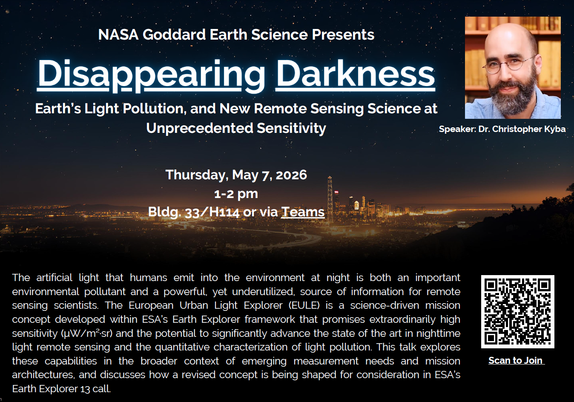

 Christopher Kyba