 Hotspur🏳️🌈🇺🇦
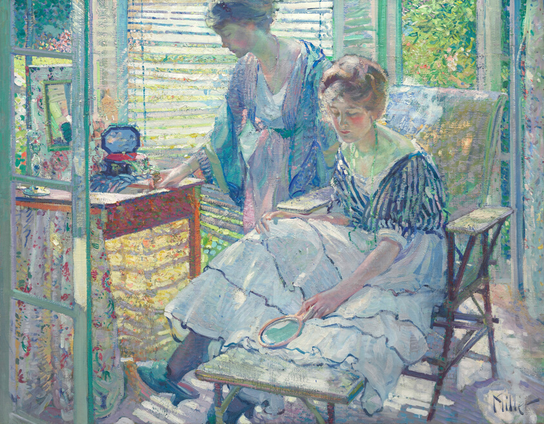
"Sunlight," Richard E. Miller, c. 1913.
Miller (1875-1943) was an American Impressionist painter, known mostly for works like this, showing women posing languidly, either outdoors or in sunny rooms.
A native of St. Louis and the son of a noted civil engineer, Miller began drawing early in life and ended up studying art at the St. Louis School of Fine Arts, the first art school in the US that was part of a university (Washington University of St. Louis). He won many prizes there and began to exhibit locally, but traveled to Paris to continue his education in 1898. Later he spent his summers at the Giverny art colony, where his later style truly came into being.
He returned to the US at the start of WWI, taught in Pasadena for a few years, and then moved to the art colony at Provincetown, MA, where he spent the rest of his life.
Miller's sunny scenes didn't tell stories; although his style was very Impressionist, his philosophy, of not being afraid to be simply decorative, was definitely Nabi. But his work was popular in his time although his star has faded somewhat in the 21st century.
From the Art Institute of Chicago.
#Art #Impressionism #RichardEMiller #AmericanImpressionism #WomenInArt #Sunlight