I note that mental health professionals—therapists, social workers, and counselors—will find these results pertinent. In two rigorous randomized, double-blind trials, psilocybin microdosing produced no reliable gains in memory, attention, or social cognition among healthy volunteers, despite pharmacological activity and anecdotal claims. Instead, the findings point to the placebo effect as a driving factor in subjective impressions, with blinding successfully maintained and no objective cognitive advantages detected.

Article Title: Psilocybin microdosing fails to boost cognitive performance in rigorous trials

Link to PsyPost Article: ift dot tt/DpXIgcY

Copy and paste broken link above into your browser and replace "dot" with "." for link to work. We have to do it this way to avoid displaying copyrighted images.

#psilocybin #microdosing #cognition #placeboeffect #randomizedtrial

The latest #LargeScale experiment of #testosterone manipulation fail to replicate previous findings [typically in smaller-scale studies] on #economic #preferences in men, calling into question the idea that short-term testosterone fluctuations are important drivers of men’s economic preferences.

Investigating the effects of single-dose intranasal testosterone on economic preferences in a large #RandomizedTrial of men

@PNASNews
#OpenAccess

https://www.pnas.org/doi/10.1073/pnas.2508519122

3/
Want more?

Here we consider estimators to generalize inferences from randomized trials to all trial-eligible individuals:
https://ncbi.nlm.nih.gov/pubmed/30488513

And here we clear some confusions about equivalence of estimators:
https://journals.lww.com/epidem/fulltex

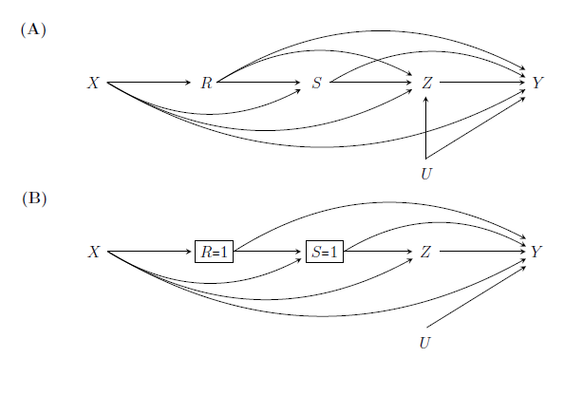
Do you prefer to express your #generalizability assumptions using causal diagrams?

No problem. Led by Issa Dahabreh, here
https://arxiv.org/abs/1906.10792
we use graphs to examine the conditions for generalizability of causal inferences from a #randomizedtrial.

Generalizing causal inferences from individuals in randomized trials to all trial-eligible individuals - PubMed

We consider methods for causal inference in randomized trials nested within cohorts of trial-eligible individuals, including those who are not randomized. We show how baseline covariate data from the entire cohort, and treatment and outcome data only from randomized individuals, can be used to ident …

PubMed