
Winding Motion of Spirals in a Gravitationally Unstable Protoplanetary Disk
The discovery of wide-orbit giant exoplanets has posed a challenge to our conventional understanding of planet formation by coagulation of dust grains and planetesimals, and subsequent accretion of protoplanetary disk gas. As an alternative mechanism, the direct in-situ formation of planets or planetary cores by gravitational instability (GI) in protoplanetary disks has been proposed. However, observational evidence for GI in regions where wide-orbit planets are formed is still lacking. Theoretical studies predict that GI induces spiral arms moving at the local Keplerian speed in a disk. Here, with multiple high angular resolution observations over a seven-year time baseline using the Atacama Large Millimeter/submillimeter Array (ALMA), we report the evidence for spiral arms following the Keplerian rotation in the dust continuum disk around the young star IM Lup. This demonstrates that GI can operate in wide-orbit planet-formation regions, establishing it as a plausible formation mechanism for such planets.
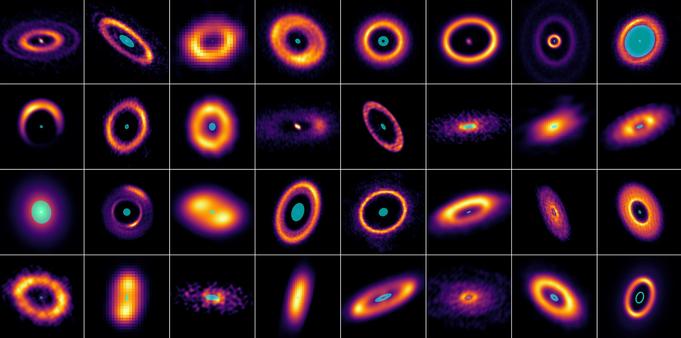
A #Protoplanetary #Disk is a rotating circumstellar disk of dense gas and dust surrounding a young, newly formed star.
This disk is where planets, moons, and other celestial bodies are believed to form through the process of accretion.
https://knowledgezone.co.in/kbits/65e83040c4be2995da7fafeb
A deep Search for Ethylene Glycol and Glycolonitrile in the V883 Ori
#Protoplanetary Disk:
https://arxiv.org/abs/2507.14905 (and two slightly older papers) -> The evolution of life may have its origins in outer space:
https://www.mpia.de/news/science/2025-05-v881-ori - astronomers find signs of complex organic molecules (precursors to sugars and amino acids) in a planet-forming disc.
A deep Search for Ethylene Glycol and Glycolonitrile in the V883 Ori Protoplanetary Disk
Ethylene glycol ($\mathrm{(CH_2OH)_2}$, hereafter EG) and Glycolonitrile ($\mathrm{HOCH_2CN}$, hereafter GN) are considered molecular precursors of nucleic acids. EG is a sugar alcohol and the reduced form of Glycolaldehyde ($\mathrm{CH_2(OH)CHO}$, hereafter GA). GN is considered a key precursor of adenine formation (nucleotide) and can be a precursor of glycine (amino acid). Detections of such prebiotic molecules in the interstellar medium are increasingly common. How much of this complexity endures to the planet formation stage, and thus is already present when planets form, remains largely unknown. Here we report Atacama Large Millimeter/sub-millimeter Array (ALMA) observations in which we tentatively detect EG and GN in the protoplanetary disk around the outbursting protostar V883 Ori. The observed EG emission is best reproduced by a column density of $\mathrm{3.63^{+0.11}_{-0.12} \times 10^{16} \; cm^{-2}}$ and a temperature of at least 300 K. The observed GN emission is best reproduced by a column density of $\mathrm{3.37^{+0.09}_{-0.09} \times 10^{16} \; cm^{-2}}$ and a temperature of $88^{+1.2}_{-1.2}$ K. Comparing the abundance of EG and GN relative to methanol in V883 Ori with other objects, V883 Ori falls between hot cores and comets in terms of increasing complexity. This suggests that the build up of prebiotic molecules continues past the hot core phase into the epoch of planet formation. Nascent planets in such environments may inherit essential building blocks for life, enhancing their potential habitability. Further observations of this protoplanetary disk at higher spectral resolution are required to resolve blended lines and to confirm these tentative detection.
Astronomers have made a groundbreaking discovery in the #protoplanetary disc of V883 Orionis, detecting complex #organic molecules such as ethylene glycol and glycolonitrile. These compounds are potential precursors to sugars and #AminoAcids, suggesting that the building blocks of #life may form widely throughout the Universe. 🌌 #Astrophysics #OrganicMolecules
https://www.mpia.de/news/science/2025-05-v881-ori
Initial results are promising: The water tornado's flow behaviour closely matches that of #protoplanetary discs, offering new insights into how dust particles interact and promote #planet formation.
#PlanetaryScience #Innovation
#Experiment #Simulation #Astronomy
@unigreifswald
https://www.mpia.de/news/science/2025-04-water-tornado-flock

Water Tornado in the Laboratory: A Simple Experiment Simulates Planet Formation
A new laboratory experiment uses a water tornado to simulate key processes in planet formation within protoplanetary discs.
Refractory solid condensation detected in an embedded
#protoplanetary disk:
https://www.eso.org/public/archives/releases/sciencepapers/eso2512/eso2512a.pdf -> For the first time, astronomers witness the dawn of a new solar system:
https://www.eso.org/public/news/eso2512/ Daniel Fischer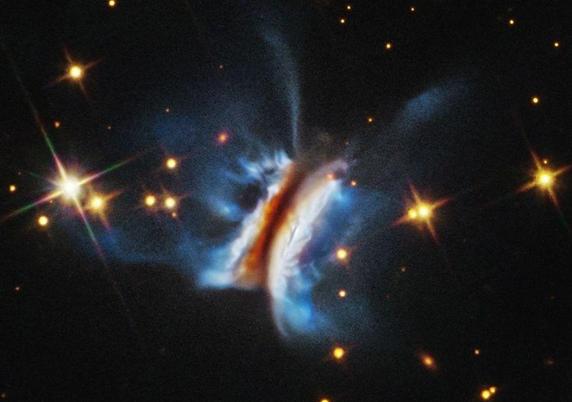
 Knowledge Zone

 earthling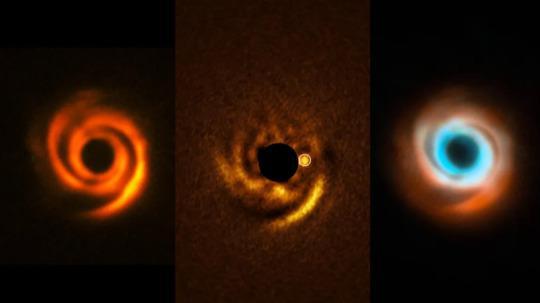
 MPI für Astronomie