 WE AND THE COLOR
The Cottage in Vysočina by Plus One Architects Proves Darkness Is a Design Tool
Something changes when you stop treating light as the only goal. Most cottage renovations chase brightness — white walls, exposed beams, linen curtains, every cliché you’ve seen a hundred times on Pinterest. Plus One Architects did the opposite. Their attic conversion of a 19th-century farmhouse in the Czech Vysočina region builds atmosphere through shadow, raw material, and deliberate restraint. The result is one of the most quietly radical rural renovation projects in Central Europe right now.
This isn’t a project about nostalgia or preservation theater. It’s about using a historic shell to create something genuinely contemporary. And it asks a question worth sitting with: what if darkness — not light — is the true luxury in residential design?
What Makes the Cottage in Vysočina Different From a Typical Czech Rural Renovation?
Most Czech cottage renovations follow a familiar script. Restore the façade, open up the interior, add underfloor heating, and sand the floorboards. The vernacular gets softened into a lifestyle product. Plus One Architects didn’t follow that script.
The farmhouse sits in the rolling landscape of the Vysočina region. Its construction began around 1820 and concluded toward the end of the 19th century. The investor’s family purchased it in 1993 and spent years restoring the exterior themselves. By 2020, the ground floor had been renovated. Then, the owners commissioned Plus One Architects for something more demanding: the full conversion of the upper floor attic into a livable, layered retreat.
The brief was specific. Create a cozy and relaxing setting for extended family and guests. Ensure sufficient privacy, both within the interior and in relation to the surrounding landscape. And, critically, don’t simply extend the aesthetic of the ground floor upstairs. Build something with its own identity.
That identity, as it turns out, is built from darkness, granite, and silence.
Cottage in Vysočina Plus One ArchitectsThe Atmosphere-First Design Philosophy Behind the Attic Renovation
Atmosphere-first design is a framework worth naming explicitly. It describes an approach where spatial decisions serve emotional and sensory outcomes before they serve function. Plus One Architects applied this principle rigorously throughout the Vysočina attic conversion.
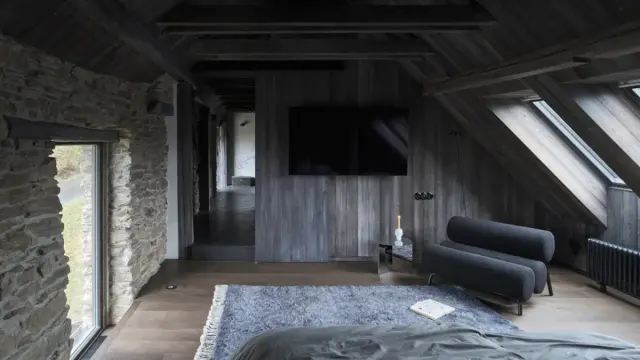
Dark tones dominate the private zone. Raw materials — solid spruce wood, exposed original stone wall, black solid granite — anchor every surface. These choices are deliberate and, as architect Petra Ciencialová notes, they were instrumental in achieving the intended atmosphere. “Combined with carefully designed lighting, the space reduces visual distractions and supports both focus and rest,” she explains.
Consider what that means structurally. The architects used darkness not as an aesthetic flourish but as a functional instrument. Reduced visual noise supports concentration. Controlled light levels support sleep and rest. The material palette communicates permanence and calm. Every decision connects back to a single atmospheric goal.
This is the kind of coherence that separates exceptional interior architecture from competent decoration.
Why Solid Spruce Wood and Black Granite Work Together
The material palette in the Vysočina cottage follows what designers sometimes call a tonal gravity system — where materials are chosen not just for texture or durability, but for the emotional weight they carry in relation to each other.
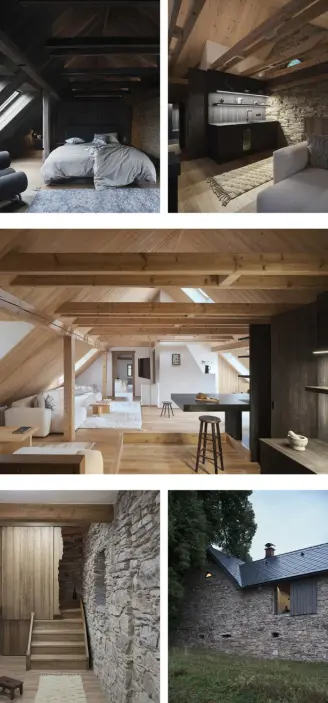
Solid spruce wood brings warmth and a sense of craft. It references the lower floor without simply repeating it. Black solid granite, used in the bathroom and as a bar table that transitions seamlessly into a worktop beneath the sloped roof, introduces a different quality entirely. It is cool, dense, and formal in a way that feels unexpected in a rural setting.
Together, these two materials create productive tension. The spruce softens. The granite disciplines. Neither overpowers the other, and both respond beautifully to the indirect lighting scheme that ties the whole space together.
The original stone wall, left exposed throughout, anchors both materials in the historical context. It is the one element that connects the 1820s building to the 2020s interior without compromise or apology.
Spatial Zones in the Vysočina Attic: Privacy as Architecture
The interior divides into two zones, spatially and atmospherically distinct. The private area contains a bedroom and dressing space in dark tones. The guest rooms, conceived in a hotel-like format, are lighter and more restrained. A central social space — with a bar, seating area, and workspace — connects the two zones.
This dual-zone logic is more sophisticated than it first appears. Most domestic renovations treat privacy as a problem of walls and doors. Plus One Architects treated it as an atmospheric condition. The private zone doesn’t just have a door; it has a material register that communicates its purpose before you reach it. The lighter guest rooms signal openness and hospitality. The transition between zones is felt before it is seen.
Near the staircase, a shared bathroom and toilet complete the program. A sliding partition at the staircase separates the two floors in winter, supporting heat retention alongside upgraded door and window seals and radiators. Summer comfort comes from air-conditioning. Practical considerations, handled without fuss.
The Raised Floor and Its Architectural Consequences
One of the most technically interesting decisions in the project involves the floor. Spatial modifications included interventions in the roof structure to expand the usable area. The floor level was raised with a timber build-up to unify heights across the plan. This necessitated a new staircase from the lower level.
As a consequence of the raised floor, the windows are partially recessed relative to the interior floor level. From inside, only their upper frames are visible. This is a detail that produces a specific quality of light — indirect, filtered, arriving from above. “The attic alterations allowed us to insert new windows into the original openings in the stone wall and bring daylight deep into the layout,” explains architect Kateřina Průchová. “Light enters the space more indirectly, reinforcing the calm atmosphere.”
Added shutters allow for gentle regulation of privacy, security, and the degree of connection to the surrounding landscape. This is a small detail with large implications. The occupant controls not just how much light enters, but how much relationship with the exterior they want at any given moment.
Darkness as a Tool: Reframing the Attic Interior Design Approach
There is a tendency in contemporary residential design to equate quality with light. More windows. Higher ceilings. Lighter finishes. The assumption is that brightness signals openness, modernity, and generosity of spirit.
The Vysočina cottage pushes back against that assumption firmly. Here, the architects articulate what might be called the Darkness Utility Principle: the idea that shadow, when intentionally deployed, produces spatial conditions that brightness cannot. Calm. Focus. Rest. Shelter.
This is not a new idea in architecture — Japanese spatial philosophy, particularly the aesthetic of in-ei (shadow and shade), has theorized this for decades. But it is rare to see it applied with this level of rigor in a rural Czech renovation context. That’s part of what makes this project genuinely interesting.
Darkness, in the Vysočina attic, is not an effect. It is a tool for calm. The architects say so explicitly, and the space demonstrates it convincingly.
How Indirect Lighting Shapes the Attic Atmosphere
The lighting design reinforces the atmospheric strategy throughout. A combination of lamps, reflected light, and integrated LED strips enables adjustments in both intensity and character. The system doesn’t produce a single lighting condition — it produces a range of moods.
This is lighting conceived as environmental control rather than illumination. The resident doesn’t just turn lights on or off. They tune the atmosphere of the space in real time. That’s a significant shift in how we think about residential lighting in heritage renovation contexts.
A steel pole placed in the center of the social space supports a rotating television on a custom hook — a practical concession to the investors’ brief that, in lesser hands, might have disrupted the spatial logic. Here, the pole reads as a clean vertical element, and the rotating mechanism means the screen can disappear from view when not in use.
Craftsmanship in the Vysočina Renovation: What Local Artisans Delivered
Projects like this one depend on craft. Not as a marketing term, but as a genuine condition of execution. Plus One Architects worked with local artisans throughout, and the evidence is visible at every scale.
Consider the sliding door at the staircase. Its edge follows the uneven surface of the original stone wall — a detail that required direct measurement, hand fabrication, and patience. No CNC machine produces a result like that. It takes a craftsperson who understands both material and context.
The black solid granite bar table, which transitions seamlessly into the worktop beneath the sloped roof, is another example. The geometry required by that transition — where the horizontal bar surface meets the angled ceiling plane — is the kind of problem that only precise stonework can solve cleanly.
Architect Petra Ciencialová notes that the family’s deep knowledge of the house was a key advantage. “From the beginning, the owners knew they did not want to rush the renovation. It was important for them to approach it thoughtfully and with quality, even if it took longer.” That patience made precision possible.
Gradual Renovation as a Design Strategy: The Layered Transformation Model
The Vysočina cottage didn’t become what it is through a single decisive intervention. It evolved over decades. The exterior restoration began in the 1990s. The ground floor followed in 2020. The attic conversion came after. Each phase built on the last without erasing it.
This is what might be called the Layered Transformation Model of heritage renovation — an approach that treats a building not as a project to be completed, but as a long-term accumulation of considered decisions. The renovation did not result in a radical change, but rather became another layer in the house’s ongoing evolution.
That framing matters. It means the building retains memory. The exposed stone wall isn’t decorative; it’s historical evidence. The spruce wood references the choices made for the floor below. The new staircase connects the present to the past literally and spatially. Each addition is legible as an addition, not an erasure.
This approach has real implications for how we think about rural heritage architecture in Central Europe. Too many renovation projects treat the historic fabric as a constraint to overcome. Plus One Architects treats it as a collaborator.
What Does This Project Mean for Contemporary Rural Retreat Design?
Rural retreat design is having a significant cultural moment. Remote work, post-pandemic recalibration, and growing interest in slow living have produced enormous demand for well-designed rural properties. Most supply is mediocre — either over-polished boutique hotel pastiche or under-thought weekend house sprawl.
The Vysočina cottage offers a more interesting model. It doesn’t perform rusticity. It doesn’t fetishize modernity. Instead, it negotiates carefully between the building’s historic character and the genuine needs of contemporary occupants — privacy, focus, rest, sociality — and produces a coherent spatial experience that serves both.
For architects working on rural renovation projects, this is a useful reference point. The project demonstrates that dark tones work in intimate attic spaces. That exposed stone and solid granite can coexist without visual conflict. That indirect lighting is as powerful a tool as natural light. And that the best brief isn’t always the most ambitious one.
Plus One Architects and the Quiet Architecture of Restraint
Plus One Architects, the Czech studio behind this project, works in what might be described as the architecture of restraint — spatial practice defined not by gesture or spectacle, but by precision, atmosphere, and the quality of the lived experience. The Vysočina cottage is consistent with that approach.
Architects Petra Ciencialová and Kateřina Průchová handled a complex brief with evident confidence. They resisted the easy moves. In addition, they didn’t open everything up, and they didn’t impose a contemporary aesthetic over the historic fabric. They worked with what was there, added what was needed, and removed the rest.
That kind of discipline is harder than it looks. It requires a very clear understanding of what the space is supposed to do — and the willingness to let function and atmosphere drive decisions rather than portfolio ambition.
The result is a space that feels both deeply specific to its site and broadly instructive for anyone thinking seriously about rural renovation, attic conversion, or atmosphere-first residential design.
Frequently Asked Questions About the Cottage in Vysočina by Plus One Architects
Who are the architects behind the Vysočina cottage renovation?
The attic conversion was designed by Plus One Architects, a Czech architecture studio. Architects Petra Ciencialová and Kateřina Průchová led the project.
What is the focus keyword concept of “darkness as a tool” in interior design?
Darkness as a design tool refers to the intentional use of shadow, dark tones, and reduced light levels to produce specific spatial atmospheres — particularly calm, focus, and rest. In the Vysočina cottage, Plus One Architects used dark materials and indirect lighting not as aesthetic choices alone, but as functional instruments for shaping how occupants experience the space.
What materials dominate the attic interior of the Vysočina cottage?
The primary materials are black solid granite, solid spruce wood, and the exposed original stone wall of the 19th-century farmhouse. Indirect LED lighting and crafted joinery complete the material register.
How was the floor level of the attic handled during renovation?
The floor level was raised using a timber build-up to unify heights across the plan. This raised level partially recesses the windows relative to the interior, allowing only their upper frames to be visible from inside — producing indirect, calm natural light.
What is the Layered Transformation Model mentioned in this article?
The Layered Transformation Model is a framework coined in this article to describe a renovation philosophy where interventions accumulate over time as readable layers, preserving the building’s historic memory rather than erasing it. The Vysočina farmhouse exemplifies this approach across several decades of phased renovation.
Is the Vysočina cottage open to visitors?
The cottage is a private family retreat and not open to the public. Photography by Radek Šrettr Úlehla has documented the completed interior.
All images © Radek Šrettr Úlehla. Browse WE AND THE COLO’s Architecture and Interior Design sections for more inspiring projects from around the globe.
#architecture #cottage #CzechRepublic #interiorDesign #PlusOneArchitects