#PLOSCompBio: Ten simple rules for fostering creativity in research labs
https://dx.plos.org/10.1371/journal.pcbi.1012788 
Ten simple rules for fostering creativity in research labs
Research lab groups are hotspots for the education of the next generation of scientists, and making these units work as creatively as possible is essential for solving pressing issues in biology, the environment, and beyond. This article highlights 10 points that can help make labs as creative as possible. Several of these points are about setting up a creative lab culture; others are about fostering group-level creative output, some are more about encouraging creativity of individual team members, or both. While the head of a research group, the principal investigator, plays an important role, this can only be successful in healthy labs where everyone contributes.
"We also modelled rhythmic EEG generation, finding that action potentials can generate detectable narrowband power between approximately 60 and 1000 Hz,"
#PLOSCompBio https://dx.plos.org/10.1371/journal.pcbi.1012794
Contributions of action potentials to scalp EEG: Theory and biophysical simulations
Author summary Electroencephalography (EEG) allows researchers and clinicians to measure millisecond changes in human brain activity without surgery or other invasive procedures. However, the neural mechanisms that produce EEG signals remain only partially understood. While brain rhythms have been extensively characterized with EEG, scalp recordings also exhibit non-rhythmic, broadband signals, which are only beginning to be understood. It is known that in recordings made inside brain tissue, neuronal spiking activity produces broadband signals at high frequencies. Here, we performed detailed biophysical and computational modelling of electric field generation in the brain to ascertain the extent to which spiking activity contributes to scalp EEG. We find that it generally does not, suggesting that high frequency broadband EEG signals reflect noise unrelated to brain activity, and validating that low frequency broadband signals are produced by electrical transmission between neurons and not spiking activity. However, our results do characterize a range of frequencies where EEG oscillations may be generated, either in part or in full, by spiking activity. We conclude that spiking activity does not produce broadband signals, but can still generate narrowband signals at high frequencies. Understanding the origins of high-frequency EEG signals has important implications for interpreting scalp recordings and informs the design of quantitative methods for signal analysis.
#PLOSCompBio: Ten simple rules to complete successfully a computational MSc thesis project: helpful ideas for both students and supervisors
https://dx.plos.org/10.1371/journal.pcbi.1012756 
Ten simple rules to complete successfully a computational MSc thesis project
The thesis project is an essential step to obtain an MSc degree. Within STEM and Life Sciences disciplines, computational theses have specific characteristics that differentiate them from wet laboratory ones. In this article, we present Ten simple rules to direct and support Master students who are about to start a computational research project for their Master thesis. We begin by recommending defining the personal learning goals for the project; we then highlight specific pitfalls that computational students might encounter during their work, such as procrastination by computation or wasting time while attempting to reinvent computational tools. We provide the students a series of suggestions on how to work following FAIR principles, learn new computing languages, and think ahead for computational challenges. We hope that these 10 simple rules will provide Master students with a framework for the successful completion of their computational thesis.
#PLOSCompBio: Theta oscillations optimize a speed-precision trade-off in phase coding neurons
https://dx.plos.org/10.1371/journal.pcbi.1012628 
Theta oscillations optimize a speed-precision trade-off in phase coding neurons
Author summary The mammalian hippocampus exhibits prominent oscillations in the theta band (3–8 Hz) during exploration, enabling individual neurons to rhythmically sample and represent input signals from the cortex. However, the reason behind the specific frequency of this hippocampal rhythm has remained unclear. In this study, we developed a biologically-based theoretical framework to demonstrate that neurons using oscillations to efficiently sample noisy signals encounter a trade-off between their sampling speed (i.e., oscillation frequency) and their coding precision (i.e., reliability of encoding). Notably, our findings reveal that this trade-off is optimized precisely within the theta band, while also providing insights into other fundamental features of the hippocampus. In conclusion, we offer an explanation grounded in efficient coding for why hippocampal oscillations are confined to the theta band and establish a foundation for exploring how the properties of neurons determine optimal sampling frequencies across neural circuits.
#PLOSCompBio: Autistic traits foster effective curiosity-driven exploration
https://dx.plos.org/10.1371/journal.pcbi.1012453 
Autistic traits foster effective curiosity-driven exploration
Author summary Research has long recognized that individuals display curiosity and explore their environments in order to learn. It is suggested that personal characteristics, including autistic traits, might influence how one engages in such exploratory behaviors. In this study, participants with varying levels of autistic traits participated in a game of locating hidden characters. We aimed to understand their decision-making process: which character they decided to engage with and for how long. Remarkably, participants with stronger autistic traits exhibited distinct exploration patterns, and in scenarios requiring persistence, their approach was particularly effective. This research underscores the importance of recognizing that individuals, especially those with autistic traits, may possess unique strategies for exploration and learning. This realization can guide educators and policy-makers in crafting more tailored learning environments. Furthermore, it emphasizes that the presence of autistic traits can be associated with specific strengths, reshaping our understanding and appreciation of neurodiversity.
Interesting approach: EEG microstate transition cost (based on transport theory calculations) correlates with task demands
#PLOSCompBio https://dx.plos.org/10.1371/journal.pcbi.1012521
EEG microstate transition cost correlates with task demands
Author summary In our daily lives, our brains manage various tasks with different mental demands. Yet, quantifying how much mental effort each task demands is not always straightforward. To tackle this challenge, we developed a way to measure how much cognitive effort our brains use during tasks directly from electroencephalography (EEG) data, which is one of the most used tools to non-invasively measure brain activity. Our approach involved the identification of distinct patterns of synchronized neural activity across the brain, named EEG microstates. By employing optimal transport theory, we established a framework to quantify the cost associated with cognitive transitions based on modifications in EEG microstates. This allowed us to link changes in brain activity patterns to the cognitive effort required for task performance. To validate our framework, we applied it to EEG data collected during a commonly employed cognitive task known as the Stroop task. This task is recognized for challenging us with varying levels of cognitive demand. Our analysis revealed that as the task became more demanding, there were discernible shifts in the EEG microstates. Importantly, these shifts in neural activity patterns corresponded to higher costs associated with cognitive transitions. Our approach offers a promising methodology to assess cognitive effort using neural data, contributing to our comprehension of how the brain manages and adapts to varying cognitive challenges.
#PLOSCompBio: Ten quick tips for ensuring machine learning model validity
https://dx.plos.org/10.1371/journal.pcbi.1012402 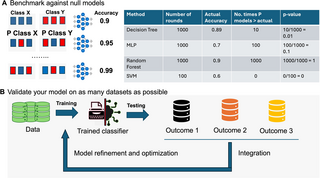
Ten quick tips for ensuring machine learning model validity
Author summary Artificial Intelligence (AI) and Machine Learning (ML) models are increasingly deployed on biomedical and health data to shed insights on biological mechanism, predict disease outcomes, and support clinical decision-making. However, ensuring model validity is challenging. The 10 quick tips described here discuss useful practices on how to check AI/ML models from 2 perspectives—the user and the developer.
#PLOSCompBio: Ten simple rules for training scientists to make better software
https://dx.plos.org/10.1371/journal.pcbi.1012410 
Ten simple rules for training scientists to make better software
#PLOSCompBio: Implementing Oscillations in an artificial neural network help improve its performance by segregating inputs
https://dx.plos.org/10.1371/journal.pcbi.1012429 
Oscillations in an artificial neural network convert competing inputs into a temporal code
Author summary Computer vision is a subfield of artificial intelligence focused on developing artificial neural networks (ANNs) that classify and generate images. Neuronal responses to visual features and the anatomical structure of the human visual system have traditionally inspired the development of computer vision models. The visual cortex also produces rhythmic activity that has long been suggested to support visual processes. However, there are only a few examples of ANNs embracing the temporal dynamics of the human brain. Here, we present a prototype of an ANN with biologically inspired dynamics—a dynamical ANN. We show that the dynamics enable the network to process two inputs simultaneously and read them out as a sequence, a task it has not been explicitly trained on. A crucial component of generating this dynamic output is a rhythm at about 10Hz, akin to the so-called alpha oscillations dominating human visual cortex. The oscillations rhythmically suppress activations in the network and stabilise its dynamics. The presented algorithm paves the way for applications in more complex machine learning problems. Moreover, we present several predictions that can be tested using established neuroscientific approaches. As such, the presented work contributes to both artificial intelligence and neuroscience.
 Marieke van Vugt
 Steve Haroz