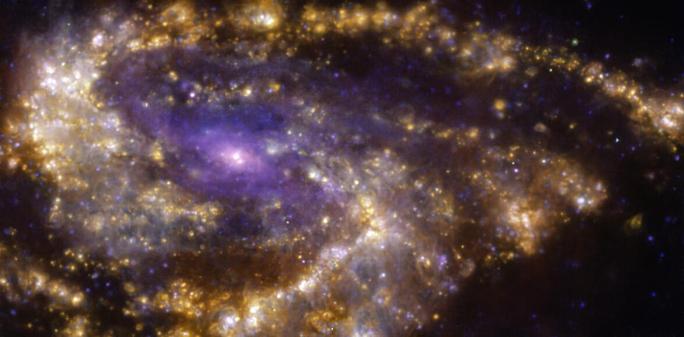
VLT image of Arp 16, also known as M66.

The glittering image of M66 was taken with the Multi-Unit Spectroscopic Explorer (MUSE) on ESO’s Very Large Telescope (VLT) in Chile.
The image highlights the galaxy's warm gas, with hydrogen (red), oxygen (blue), and sulfur (orange). It was taken as part of the PHANGS survey.

Credit: ESO, PHANGS
Source: https://www.eso.org/public/images/potw2218a/

#ArpGalaxy #Galaxy #Space #Astronomy #PHANGS

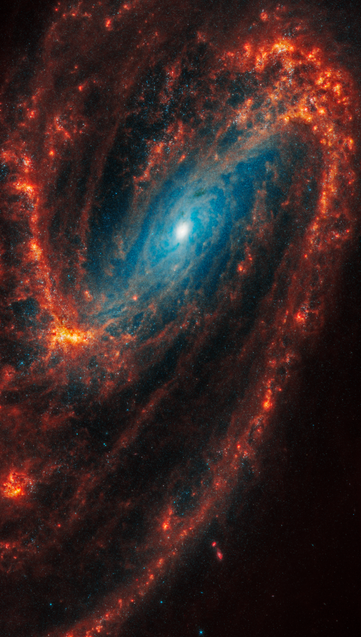
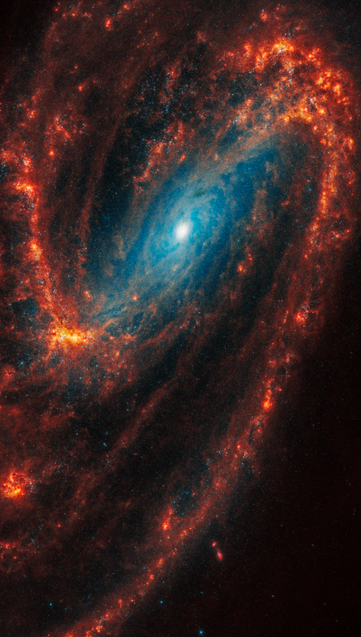
JWST image of Arp 16, also known as M66.

This image was taken as part of the PHANGS program. They take high-resolution observations of galaxies at many different wavelengths of light to learn how the small-scale details of how stars form influence the large-scale structures of galaxies.

Credit: NASA, ESA, CSA, STScI, J. Lee (STScI), T. Williams (Oxford), PHANGS Team
Source: https://webbtelescope.org/contents/media/images/2024/105/01HMA6P3V363GW0EA0347CR6HV

#ArpGalaxy #Galaxy #Space #Astronomy #JWST #PHANGS

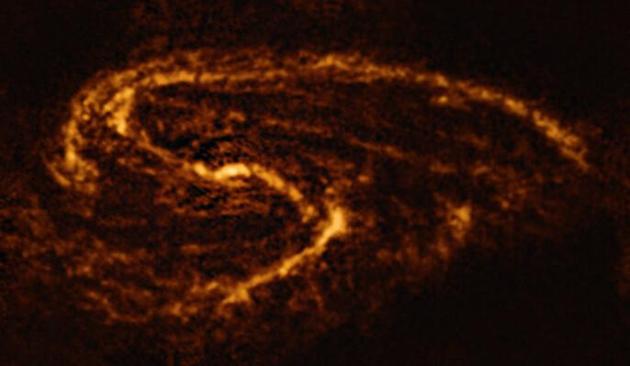
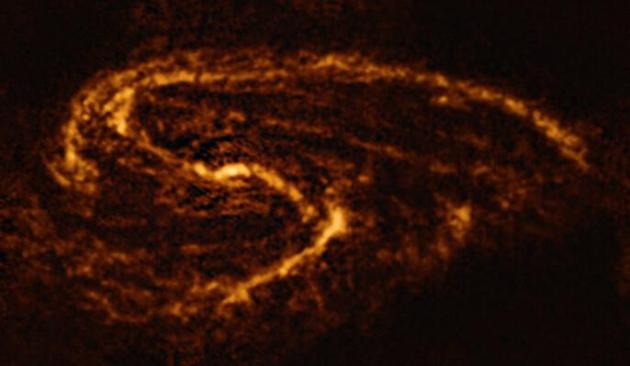
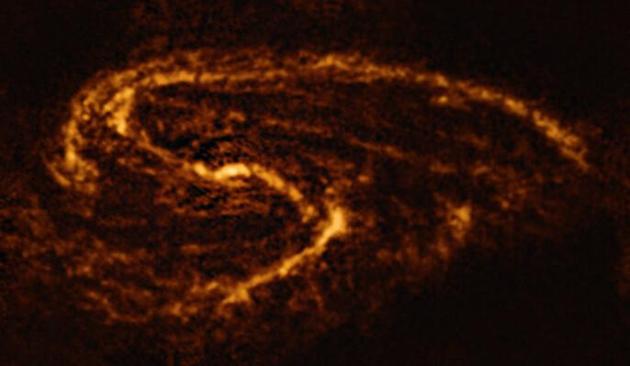
ALMA image of Arp 16, also known as M66.

This image of M66, shows the location of cold clouds of molecular gas. It’s in these cold, dusty clouds that new stars form.
It was taken as part of the PHANGS program, to help understand how the small-scale details of how stars form influence the large-scale structures of galaxies.

Credit: ESO, ALMA (ESO/NAOJ/NRAO), PHANGS
Source: https://www.eso.org/public/images/ngc3627-alma-cc/
#ArpGalaxy #Galaxy #Space #Astronomy #PHANGS

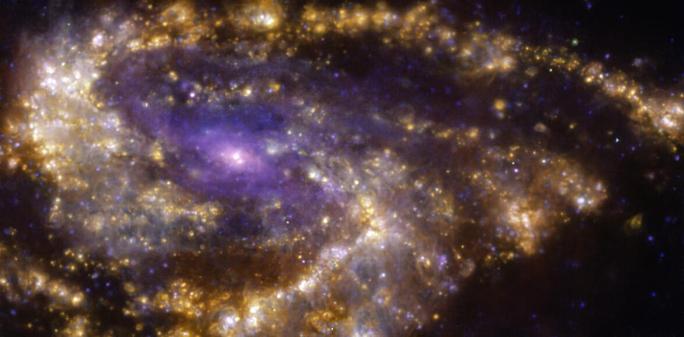
VLT image of Arp 16, also known as M66.

The glittering image of M66 was taken with the Multi-Unit Spectroscopic Explorer (MUSE) on ESO’s Very Large Telescope (VLT) in Chile.
The image highlights the galaxy's warm gas, with hydrogen (red), oxygen (blue), and sulfur (orange). It was taken as part of the PHANGS survey.

Credit: ESO, PHANGS
Source: https://www.eso.org/public/images/potw2218a/

#ArpGalaxy #Galaxy #Space #Astronony #PHANGS

JWST image of Arp 16, also known as M66.

This image was taken as part of the PHANGS program. They take high-resolution observations of galaxies at many different wavelengths of light to learn how the small-scale details of how stars form influence the large-scale structures of galaxies.

Credit: NASA, ESA, CSA, STScI, J. Lee (STScI), T. Williams (Oxford), PHANGS Team
Source: https://webbtelescope.org/contents/media/images/2024/105/01HMA6P3V363GW0EA0347CR6HV

#ArpGalaxy #Galaxy #Space #Astronony #JWST #PHANGS

The PHANGS-MUSE/HST-Halpha Nebulae Catalogue: https://arxiv.org/abs/2510.11778 -> "We present the PHANGS-MUSE/HST-Halpha nebulae catalogue, comprising 5177 spatially resolved nebulae across 19 nearby star-forming galaxies (< 20 Mpc [here NGC 1566]), based on high-resolution Halpha imaging from HST, homogenised to a fixed 10 pc resolution and sensitivity. Combined with MUSE spectroscopy, this enables robust classification of 4882 H II regions and separation of planetary nebulae and supernova remnants. [...] The dataset provides a detailed, spatially resolved link between nebular structure and ionising sources, serving as a benchmark for future studies of feedback, diffuse ionised gas, and star formation regulation in the interstellar medium. The full catalogue is made publicly available in machine-readable format." #PHANGS

ALMA image of Arp 16, also known as M66.

This image of M66, shows the location of cold clouds of molecular gas. It’s in these cold, dusty clouds that new stars form.
It was taken as part of the PHANGS program, to help understand how the small-scale details of how stars form influence the large-scale structures of galaxies.

Credit: ESO, ALMA (ESO/NAOJ/NRAO), PHANGS
Source: https://www.eso.org/public/images/ngc3627-alma-cc/
#ArpGalaxy #Galaxy #Space #Astronony #PHANGS

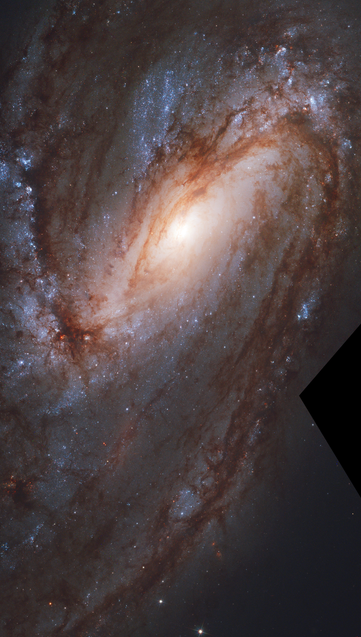
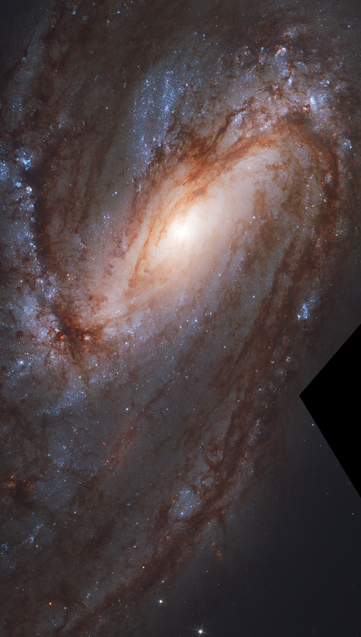
Hubble Space Telescope image of Arp 16, also known as M66.

M66 is about 37 million light-years (11.3 Mpc) away.
It was discovered by Charles Messier on 1 March 1780, object 66 in his catalog of “fuzzy things in the night sky that are not comets." He described it as "very long and very faint."

Credit: NASA, ESA, STScI
Source: https://webbtelescope.org/contents/media/images/2024/105/01HMA6P3V363GW0EA0347CR6HV

#ArpGalaxy #Galaxy #Space #Astronony #Hubble #PHANGS

VLT image of Arp 16, also known as M66.

The glittering image of M66 was taken with the Multi-Unit Spectroscopic Explorer (MUSE) on ESO’s Very Large Telescope (VLT) in Chile.
The image highlights the galaxy's warm gas, with hydrogen (red), oxygen (blue), and sulfur (orange). It was taken as part of the PHANGS survey.

Credit: ESO, PHANGS
Source: https://www.eso.org/public/images/potw2218a/

#ArpGalaxy #Galaxy #Space #Astronony #PHANGS

JWST image of Arp 16, also known as M66.

This image was taken as part of the PHANGS program. They take high-resolution observations of galaxies at many different wavelengths of light to learn how the small-scale details of how stars form influence the large-scale structures of galaxies.

Credit: NASA, ESA, CSA, STScI, J. Lee (STScI), T. Williams (Oxford), PHANGS Team
Source: https://webbtelescope.org/contents/media/images/2024/105/01HMA6P3V363GW0EA0347CR6HV

#ArpGalaxy #Galaxy #Space #Astronony #JWST #PHANGS