 Richard Penner
Take a set, 𝑥. Is it finite or infinite? Well what definition do you use?
① ∃𝑦 ∈ ω₀ 𝑥 ≈ 𝑦 ; There is a natural number, 𝑦, such that you may may map 𝑦 one-to-one onto the set 𝑥, enumerating each of its members. So 𝑥 is finite for the same reason { 1, 2, 3 } is finite.
② ¬ ∃𝑧 ∈ (On ∖ ω₀) 𝑥 ≈ 𝑧 ; There is no such infinite ordinal, 𝑧, such that you may map 𝑧 one-to-one onto the set 𝑥. So 𝑥 is finite because ω₀, the smallest infinite ordinal, cannot be mapped 1-to-1 into it.
Do ① and ② say the same thing?
Obviously, ① implies ② in all cases for if it didn't there would be at least one natural number, 𝑦, which may be used to enumerate at least one infinite ordinal, 𝑧.
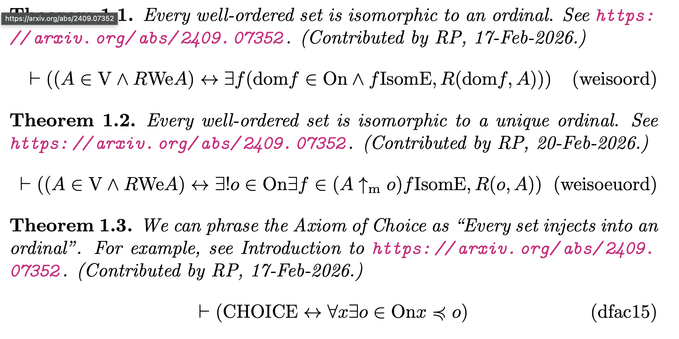
But does ② imply ①? If ② doesn't imply ① then there must be sets which can't be be placed side-by-side with any infinite ordinal and yet can't be placed side-by-side with any finite ordinal. In short, there must be sets which can't be well-ordered. But the axiom of choice says all sets may be well-ordered, even if it doesn't provide a recipe.
Not only does the axiom of choice say all sets can be well-ordered and thus ② implies ①, but assuming ② implies ① is equivalent to the axiom of choice. It was invented by Zermelo for this purpose and so that ①, ②, and 6 alternative definitions of "finite set" all mean the same thing.
The axiom of choice is basically saying the border between finite and infinite has nothing trapped in it.
 Bodling
 CelesteBancos