Five-Thirty Customs Fenderbird

Speaking of building your own…

The original Fenderbirds were created for bassist John Entwistle, who liked the Gibson Thunderbird body, but preferred Fender necks.

This is a tribute, created by someone who took a broken Epiphone and routed it to accept a bolt-on neck with Tele-style headstock. And it’s sparkly purple!

Honestly, we are only posting this because we have been wanting to do something similar for decades now. Gibson/Epiphone are notoriously weak where the headstock meets the neck so broken ones pop up periodically for sale on the internet. Epiphone even offered a bolt-on Thunderbird at one point that you could sometimes buy without a neck at all. Of course, we did not want just any neck, but rather a Bass VI neck! Which would require different pickups and bridge, and take some extra work to get everything positioned properly, but hey, we still might try it someday.

The end result would be a bass that is a guitar in a bass that is bird like some kind of bassguitarducken‽

#PurpleGuitarPhursday #NoTrebleNovember

Squier Classic Vibe Bass VI

A 5-string bass adds a lower B string, and a 6-string bass adds a higher string to all of that, conventionally tuned in fourths across the board as B-E-A-D-G-C. Whereas a Bass VI is a different animal, tuned E-A-D-G-B-E one octave lower than a standard guitar.

Fender originally introduced the Bass VI in the early ‘60s (although Danelectro had something similar a few years earlier) yet, as is often the case, it was not popular at the time, and only caught on decades later after it had already been discontinued.

The design is essentially a big Jaguar. Interestingly, the Jaguar guitar is a 24” short scale, while this has a 30” scale, which is obviously long for a guitar, but still short for a bass. [And coincidentally, the third 30” scale we have posted this month. At this point, one might assume that we were doing it on purpose, and that it is our preference, but it was actually completely unintentional.]

It features a Jaguar style bridge and tremolo, and the Jaguar “claw” pickups. We have discussed the lack of standards among bass pickups, but those are not even common among guitars. It does have a third pickup as opposed to the Jaguar’s two, each selectable via individual slide switch, with an additional switch for the “strangle” low cut filter. There is also a master volume and tone.

This model has big pearled block inlays and metallic purple finish with matching headstock.

We very much wish that this existed when we were young and in our prime playing days. Now there are also a number of other brands that offer similar style instruments, but back then the choices were an expensive Fender reissue, try to track down an even more expensive and rare vintage one, or there were a couple of companies that offered a suitable neck to build/mod your own.

With the shorter scale and thinner strings than a typical bass, the low E string was notoriously flubby sounding. With all of the options for multi-scale and extended range these days, this design is probably not the best choice for playing in that register. Nevertheless, it still might be just what you are looking for if you want to play The Cure covers or need to write the soundtrack for a spaghetti western.

#PurpleGuitarPhursday #NoTrebleNovember #MaybeSomeTrebleNovemeber #Squier

Offbeat Guitars Shelby

Offbeat Guitars is a husband and wife team. It is not clear whether both are involved in making the instruments, or if one is the builder and the other handles the business side, but that is not really important.

This bass is a 30 inch short scale. The body is a sort of non-offset jag shape with a German carve. It is made from Spanish Cedar, which we typically only see used for acoustic guitars.

We previous mentioned how basses are more open to variety than their guitars, and part of that is much less standardization of pickups. Even the category of “Jazz Bass pickups” is a minefield of different sizes. When it comes to aftermarket replacement pickups, it is basically a crapshoot whether a particular manufacturer will offer something in a compatible form factor. It is not unusual for bass manufacturers to design their own unique pickups in whatever shape they fancy.

All that is to say that this bass features a single T-Bird pickup, which we do not think we have ever seen anywhere besides an actual Thunderbird bass. Completed with basic volume and tone controls and a Badass bridge (as in, that is the actual name of the product, not our assessment of it).

All around, a solid no-nonsense instrument finished in one of the better purples that we have seen so far.

#PurpleGuitarPhursday #NoTrebleNovember #OffbeatGuitars

@MamasPinkyToe
How dare you. And in the middle of #NoTrebleNovember

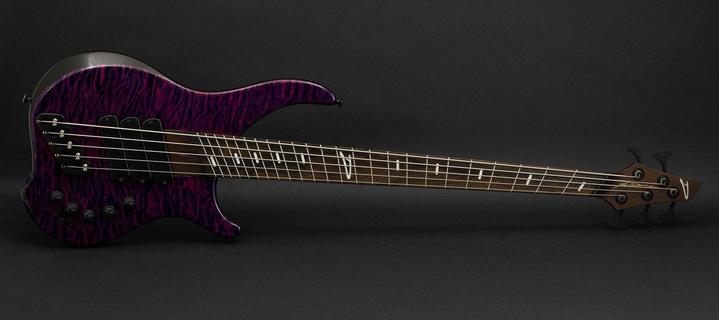
Dingwall Afterburner I

While the guitar industry as a whole is generally stuck doing copies and variations of designs from the ‘50s and ‘60s, bass players and builders are more open to trying new things. Not that there are not plenty of bass players perfectly satisfied with the tried and true instruments, but it seems like for every P or J bass copy out there, there is another company who is not afraid to get weird. (Also maybe don’t check last week’s post as that is not really going to help our point just now.)

So, let’s get weird. Here we have a 5-string, fanned fret bass with a neck extending quite far into the body. Some basses have a “finger ramp”, which is a raised block between the pickups that aids finger positioning and helps with certain techniques. These are commonly made of wood or increasingly 3D-printed, but Dingwall apparently decided, “Why not just throw a whole ‘nother pickup in there‽” So unlike that Hofner [we said, “don’t look!”] whose pickups wanted nothing to do with each other, these three are all smooshed together like kittens cuddling up for warmth.

The neck is Wenge, with fret inlays not dissimilar to those on the Yamaha Revstar that we had not seen before. The markers are angled to match the frets, and also form an arc along the length of the neck with a big ‘D’ (grow up) at the 12th fret. We get what they were going for, but the overall effects is, “Go home inlays, you’re drunk!”

Loads of knobs for volume, rotary pickup selector, and three band active EQ. Also the pickups are humbuckers and there is a mini series/parallel toggle switch for each.

The body is a… shape, with a wavy figured top stained purple and maybe some colors that are not purple.

#PurpleGuitarPhursday #NoTrebleNovember #Dingwall

It’s #NoTrebleNovember! Let’s get low!

Hofner 500/1 Violin Bass

We love a violin cutaway. We love a hybrid. A bass guitar neck on a violin body‽ Yes, please!

Many refer to this model as the “Beatle Bass.” As far as we can tell, most players who choose this particular bass fall into one of two categories: those who want to evoke the sound/look/vibe of Paul McCartney, and those who… literally are Sir Paul McCartney.

Look, it’s like a mini upright bass, that you hold like a bass guitar! Because of the c-bouts, you could even play it with a bow if you wanted to. We would think that would be popular in a variety of genres even for artists who do not care at all about the Beatles, but what do we know?

The bass has a 30 inch “short scale” neck with a zero fret. Frets are made of metal and the nut is typically made of something else (traditionally bone, or plastic on cheaper instruments, but nowadays might be all sorts of materials like graphite or wood or some kind of composite, or even a different type of metal). Because of this, open notes will have a slightly different tonality than fretted notes. A zero fret allows even the open strings to contact a fret for more consistency. As a bonus, the cut of the nut slots is less critical. Unfortunately, for that reason, zero frets became commonly associated with cheap, low quality instruments and never really caught on. Ironically, these days you can easily distinguish a real German-made Hofner from a licensed import model because the cheaper ones DON’T have the zero fret. Here the nut itself looks to be made of white-black-white binding material.

It has two pickups spaced as far apart as they can possibly get, with a volume control for each and three incredibly unintuitive switches. “TREBLE ON” turns the neck pickup off and adds in a low-cut filter. “BASS ON” is the opposite, turning the bridge pickup off and adding a high-cut filter. Both on at the same time results in no sound at all. Finally, a “SOLO/RHYTHM” switch is simply a pre-set volume cut.

We once saw a Hofner factory tour video and were astounded by the low tech way they did things. For some operations, we felt that if we were building ONE (1) instrument in our garage, then that is probably how we would do it, but we would assume that in a production factory they would have machines or jigs or something to make the process more efficient and repeatable. At other times, they were just fully freehand going for it in a way that, even in our garage for personal use only, we would still try to come up with a more reliable way to do it than THAT ffs.

The good news is, these are truly hand crafted instruments. The bad news is, if you are buying one, you better hope that the luthier was not having an off day. Then again, presumably part of the premium price is that they make sure not to sell any crappy ones.

You usually see these models in a sunburst finish, less commonly black, occasionally other finishes, and sporting a pearloid pickguard and control plate. This particular specimen has no pickguard, a black control plate and is painted [checks notes] purple.

#PurpleGuitarPhursday #Hofner