 Contemporary Classical - Thea Derks
Maya Verlaak presents portrait-CD: ‘I like to use subversive methods’.
Every night she fell asleep to the sounds from a music box; from the age of four she made her own melodies. In 2015 Maya Verlaak completed her master’s degree in composition, three years later she obtained her doctorate. In 2020 the British Label Another Timbre released the portrait-CD All English Music is Greensleeves.
Maya Verlaak (1990) grew up in Ghent. Her father was an artist and often took her along to exhibitions and museums. ‘The cover of my CD shows a fragment from one of his paintings’, she says enthusiastically. ‘He also had a large record collection, varying from pop and rock to opera and classical music. My mother is from Calabria and whenever we visited her family in the deep south of Italy, folk music was invariably sung and the guitar played. Those were wonderful moments.’
Maya Verlaak (c) Ana LemnaruPerhaps it was because of this that little Maya was so irresistibly drawn to music. She played every record in their home, but was most fascinated by the music box on the nightstand next to her bed. ‘Every night I would fall asleep to the sound of the French nursery rhyme Alouette.’ She soon started making her own tunes, which have been preserved on a series of cassettes.
A 4-year-old registering songs on a recording device seems somewhat unlikely. Was it perhaps her parents who wanted to preserve her fledgling experiments for posterity? ‘No, I did it all by myself’, responds Verlaak. ‘I have no idea how I managed, but I often spent hours recording all kinds of sounds. My own pieces usually sounded a lot like Alouette, but I also found a recording that was so experimental it makes me wonder what on earth was on my mind at the time. I found those tapes by accident, but because my parents had written dates on them I know I made them when I was between four and eight years old.’
At the age of five, she asked her parents to send her to music school, but children were only admitted there from the age of seven. ‘Fortunately I could attend the theatre class, so I did that first.’ The moment she is finally admitted to the music school proves pivotal. She learns to play the piano and later the classical guitar and at thirteen she is assigned a new mentor, Marc Maes. This turns out to be a pure stroke of luck: ‘He asked me to write harmonic accompaniments to the most diverse music styles. Sometimes he gave me only half finished scores, which I had to complete creatively. Noticing how seriously and inventively I carried out such assignments, he started teaching me composition.’
Maes himself played in the Stockhausen Trio: ‘I remember attending one of their concerts. It was such a confusing experience that I had to think about it for a year! When I then asked Marc for more information, he offered it with a meaningful smile. Thanks to my piano teacher Alfonso Medinilla I learned to perform the music of Karlheinz Stockhausen, but I also played works by John Cage and other modernists.’
On Maes’ advice, Verlaak enrols at the Royal Conservatoire in The Hague to study composition. Its open climate perfectly suits her experimental streak. Together with fellow students Robert Blatt and David Pocknee, she starts the Acid Police Noise Ensemble in 2009. ‘We did all kinds of projects and later also Leo Svirsky and Ana Lemnaru joined the group. Whenever one of us had a crazy, hard-to-implement idea, we’d help carry it out together. Nothing was considered out of bounds; sometimes I would spend days realizing someone else’s dream. I learned a lot from that.’
She also cherishes good memories of her various teachers. ‘I still have a lot of contact with Peter Adriaansz, but Gilius van Bergeijk perhaps understood my work best. Once he reacted very dismissively to a new composition: “Something like that doesn’t fit in with your method.” That was an eye-opener: even though I was only in my second year, he already considered me to have my own style. I thought about that a lot over the years. What is my style, my way of working?’
The answer turns out to be complex. Verlaak reveals that she likes to use ‘subversive’ methods: ‘Subversion has mostly negative connotations, but it can also mean that you question a system by turning around established patterns.’ On the website of Another Timbre she tells a revealing anecdote: ‘When I was 11 years old, the Minister of Transport decided to cycle through Ghent along with my primary school. He wanted to underline that to him the availability of safe cycle paths was important. In my childish innocence, I asked why he didn’t simply make the cars use the small path alongside the road and the cyclists on the much wider lane itself.’
But how does this translate into music? ‘I am not so much interested in overturning existing norms as in challenging performers to discard their customary role of simply reproducing notes. By giving them insight into the compositional process, I hope they become aware of the questions I ask myself while composing. This ideally leads to a committed, open-minded performance practice and stimulates the musician not to sail on autopilot. Some people love to be challenged thus; others discuss it, which in turn makes me think. I enjoy such dialectic processes.’
Take Formation de Sarah for violin and computer, for example. She especially composed it for the CD, in close collaboration with violinist Sarah Saviet. ‘We wanted to accentuate the performer’s involvement with the musical material. Sarah plays from a computer, but her part is an element in a larger, labyrinthine score. There is a way out of the maze, but she doesn’t know it. After every note she plays, the computer offers her 2 or 3 new possible routes. Each choice she makes can either bring her closer to her goal, or set her back a few steps. Then she has to choose a new route again. A French computer voice says “Non” every time she takes a wrong turn.’
The effect is as hallucinatory as it is witty. Saviet tries to fuse the icy tones of a spiked violin – literally a plank with four nails – with the overtones of her own instrument. The inexorable “Non” sounds constantly, upon which Saviet starts all over again. In Formation de Mark for piano and computer, the maze consists of the jarring voice of un untrained performer who sings names of notes without knowing their relevant pitch. The computer names the note she actually produces and interrupts the pianist’s frantic attempts to bring her closer to the intended pitch.’
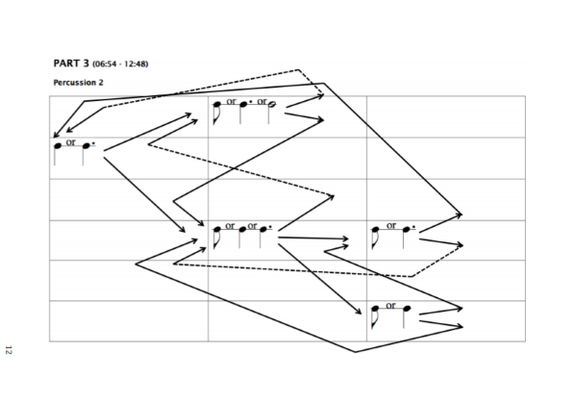
For the ensemble piece Song and Dance Verlaak used a different procedure. ‘The concept of this piece is “justification”. As a composer, you’re always analysing your work in order to justify it, as it were. Instead of a written score, I only give the musicians my justification, in the form of very precise instructions. In order to perform them well, they must listen and respond to each other really attentively. If one of them makes a mistake, the music gets stuck on one note. In this way, the musicians gain insight into the composition. While playing, they discover the musical relationships and the structure of the material, which makes them play with a different kind of concentration. That is exactly what I aim for.’
Page from Song & DanceVerlaak uses yet another method in the title track All English Music is Greensleeves. ‘I wanted to turn things around: what if the pitches in the score do not serve to produce music, but to stop it? I asked all the musicians to play variations on the well-known Scottish folksong. I wrote these down, recorded them and fed them into the computer as samples. When they play their notes, the musicians turn these pre-recorded fragments on or off through speakers on their instrument. This creates two sound layers, one of the recordings, the other of the sounds played live.’
The title is intriguing. ‘It refers to a statement by Gilius van Bergeijk’, Verlaak laughs. ‘He once suggested that English music always sounds like Greensleeves. When I was studying in Birmingham, I once told this joke to my teacher Howard Skempton. During a concert featuring British composers, he suddenly remarked: ‘It really does sound like Greensleeves.’
Liked my post? Show your appreciation with a gift through PayPal, or direct money transfer to my bank account:
T. Derks, Amsterdam, NL82 INGB 0004 2616 94. – Any amount, however small, is welcome. Thanks!
#AllEnglishMusicIsGreensleeves #ApartmentHouse #GiliusVanBergeijk #MarcMaes #MayaVerlaak