Math Game Monday: Greedy Pig

This game tests each player’s risk tolerance as they roll dice to rack up points.

Many parents remember struggling to learn math. We hope to provide a better experience for our children. And one of the best ways for children to enjoy learning is through hands-on play.

So what are you waiting for? Let’s play some math!

This game tests each player’s risk tolerance as they roll dice to rack up points.

Greedy Pig

Math Concepts: addition, probability of dice rolls, strategic thinking.

Players: two or more.

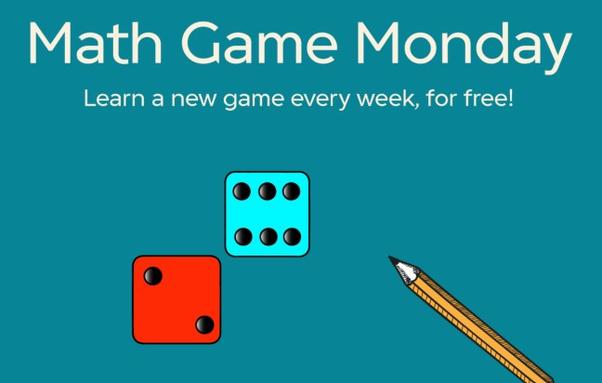
Equipment: two 6-sided dice, pen and paper for keeping score.

How to Play

Players agree on a target score, such as 100. The first player to reach or pass the target wins the game.

Roll two dice as many times as you want, adding the numbers to your score. Stop when you wish, and pass the dice to the next player.

Beware: If you roll a 1 before you stop, you lose all the points you added during that turn. If you roll double-1, your score resets to zero.

Optional House Rule: If you roll doubles other than double-1, you have to roll again. You can’t end your turn on doubles.

Variation

Use the game as a journaling prompt. Here are some sample questions:

  • What is your strategy for winning?
  • Do you think this is a fair game, or does one player have an advantage?
  • How would you count score, so you could compare your performance from one game to the next?
  • How would you modify the game rules? Is your version easier or harder than the original game?
  • Do you prefer logical strategy games or games of chance? Or do the best games have a bit of both? Explain.

History

Pig is a folk-game cousin to Farkle and was first described in print by American magician and author John Scarne in his 1945 book Scarne on Dice.

 
* * *

This game is an excerpt from 312 Things To Do with a Math Journal. Discover more of my books, printable activities, and cool mathy merchandise at Denise Gaskins’ Playful Math Store.

Special Offer: Would you like to access a growing archive of Math Monday games and other activity ideas as convenient printable pdf downloads, ready to print and play with your kids? Join me on Patreon or choose the paid subscription on Substack for mathy inspiration, tips, printable activities, and more.

“Greedy Pig” copyright © 2026 by Denise Gaskins.

#Addition #Arithmetic #Games #MathGameMonday

Math Game Monday: The Number That Must Not Be Named

This challenging game stretches everyone’s working memory and offers children the delightful possibility of stumping an adult.

Many parents remember struggling to learn math. We hope to provide a better experience for our children. And one of the best ways for children to enjoy learning is through hands-on play.

So what are you waiting for? Let’s play some math!

The Number That Must Not Be Named

Math Concepts: addition, subtraction, multiplication, division, integers, fractions, factoring, powers and roots, prime numbers, and other number properties.

Players: two or more (a cooperative game).

Equipment: none.

Set-Up

Because all calculations are done mentally, players must agree on what types of numbers are allowed. For example, beginners may want to start with the positive whole numbers 1–100. As players gain experience, you can expand the range of possibilities.

How to Play

The first player names any number within the permissible range. Players take turns naming mathematical operations, performing each calculation mentally but never saying their answer aloud.

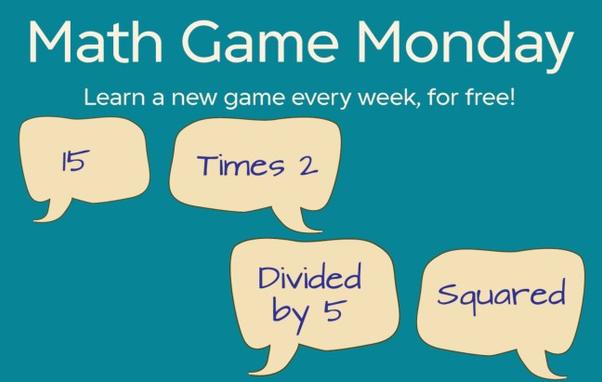
For example, suppose the first player names “15.” Turns may then proceed as follows, with the number changing as shown in parentheses:

  • “Times two.” (30)
  • “Divided by five.” (6)
  • “Squared.” (36)
  • “Subtract it from one hundred.” (64)
  • “Square root.” (8)
  • “Cube root.” (2)
  • “To the fifth power.” (32)
  • “Plus one.” (33)
  • “Nearest prime number.” (31)
  • etc.

Players try to show style by naming operations that haven’t been used, especially something particular to the current number. Since the last calculation left the number at thirty-one, you might say “plus sixty-nine.” This proves you’ve been paying attention and gives everyone’s brain a brief rest on the nice, round number 100.

If a player names a calculation that makes no sense or that takes the number outside the agreed-upon range, that player is out of the game.

At any time, one player may challenge another to name the current number. If the challenged player says the wrong number, that player drops out of the game. But if the answer is correct, then the challenger is out.

The game continues until only one player remains, or until the players decide to stop.

History

When I was a kid, our teachers used to make students keep up with a long chain of mental calculations. This game offers students a chance to fight back and see if they can stump the teacher.

I found the game on Joel David Hamkins’s blog. Your children may also enjoy his Rule-Making Game:

 
* * *

This game is an excerpt from Prealgebra & Geometry: Math Games for Middle School. Discover more of my books, printable activities, and cool mathy merchandise at Denise Gaskins’ Playful Math Store.

Special Offer: Would you like to access a growing archive of Math Monday games and other activity ideas as convenient printable pdf downloads, ready to print and play with your kids? Join me on Patreon or choose the paid subscription on Substack for mathy inspiration, tips, printable activities, and more.

“The Number That Must Not Be Named” copyright © 2026 by Denise Gaskins.

#Arithmetic #Games #MathGameMonday #MiddleSchool #PreAlgebra

Math Game Monday: Dinosaur Race

This game helps preschool children develop counting and number sense.

Many parents remember struggling to learn math. We hope to provide a better experience for our children. And one of the best ways for children to enjoy learning is through hands-on play.

So what are you waiting for? Let’s play some math!

Dinosaur Race

Math Concepts: number symbols, counting beyond ten, number line.

Players: any number.

Equipment: subitizing cards, number line racetrack, small plastic dinosaur or other toy for each player.

Set-Up

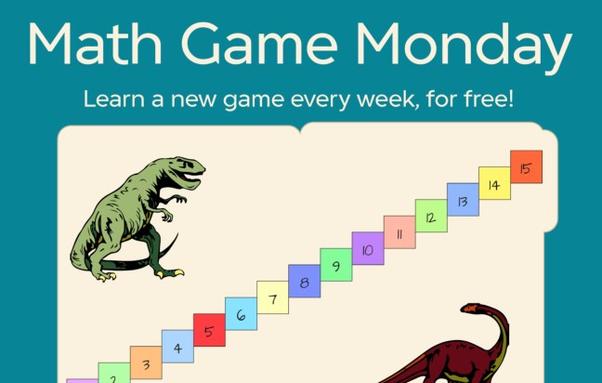
Draw a straight path on paper or a manila file folder, either horizontal or slanted uphill (so the larger numbers will be higher). Divide the racetrack into twelve to twenty spaces large enough for small toys to rest in. Or glue squares of colored construction paper in a long line on poster board. Number the spaces in order, beginning with one.

Create subitizing cards by drawing 1, 2, or 3 dots on several index cards or cut-up squares of cardboard. Better yet, let your kids make them with dot markers (but make sure the dots don’t show through the back).

Turn the subitizing cards face down and spread them out to form a fishing pond. Do not use dice or regular playing cards. The number of squares moved each turn must be low enough to recognize at a glance, or else counting will distract the player from saying the track numbers in order.

A manila folder makes a sturdy game board, decorated with pictures from a coloring book.

How to Play

Each player should choose a small dinosaur or other toy and place it near the beginning of the racetrack. On your turn, draw a card and move your dinosaur that many spaces, saying each number as you land on it. Cards should be mixed back into the pond after each turn.

This is the most important rule: when moving their toys, players must say the number in each space. Repeating the numbers in order focuses the child’s attention and helps build number sense, a gut feeling for how numbers work, which is important to future learning.

The first player to reach the end of the path wins the race.

Variations

After children have played the game normally many times, try starting at the end of the path and counting down the number line.

Or use the game board for counting practice. Count pennies or dried beans onto the racetrack spaces, or write numbers on small plastic lids so children can match them to the board.

Whole-Body Counting: Draw a Dinosaur Race path outdoors with sidewalk chalk, or use colored painter’s tape along a hallway floor. Children can walk or jump along the line, saying the numbers as they go.

History

Counting up and down a number line forms a strong foundation for children’s understanding of arithmetic. Dinosaur Race is based on the research of Robert S. Siegler and Geetha B. Ramani, who studied how preschool children responded to a variety of games. Playing a number line game like Dinosaur Race for as little as an hour (in fifteen-minute segments spread out over a couple of weeks) made a dramatic difference in the children’s ability to learn and retain arithmetic facts, while similar games played on a round track or on a linear track without numbers produced no measurable change.

 
* * *

This game is an excerpt from Counting & Number Bonds: Math Games for Early Learners, available at my bookstore (Thank you for cutting out the middleman!) and through many online retailers. Read more about my playful math books here.

Special Offer: Would you like to access a growing archive of Math Monday games and other activity ideas as convenient printable pdf downloads, ready to print and play with your kids? Join me on Patreon or choose the paid subscription on Substack for mathy inspiration, tips, printable activities, and more.

“Math Game Monday: Dinosaur Race” copyright © 2026 by Denise Gaskins.

#Games #MathGameMonday #Preschool